The most trustworthy picture of a puppy is not produced by an hour of formal testing at seven weeks but by three or four weeks of small dated notes — because a session tells you how that puppy was on that morning, while a record tells you what it does repeatedly.
The most important first
- Spread your observation across weeks rather than concentrating it in one session: in a meta-analysis of 31 studies, personality measures taken in puppyhood were consistent at r = 0.30, against r = 0.51 in adult dogs.
- Record behavior, not conclusions — “left the food when the bin lid banged, eating again within about forty seconds” can be re-read in a month; “nervous” cannot.
- Assume your expectations shape what you see: in one study, veterinary students scored identical video recordings differently according to false context they had been given first.
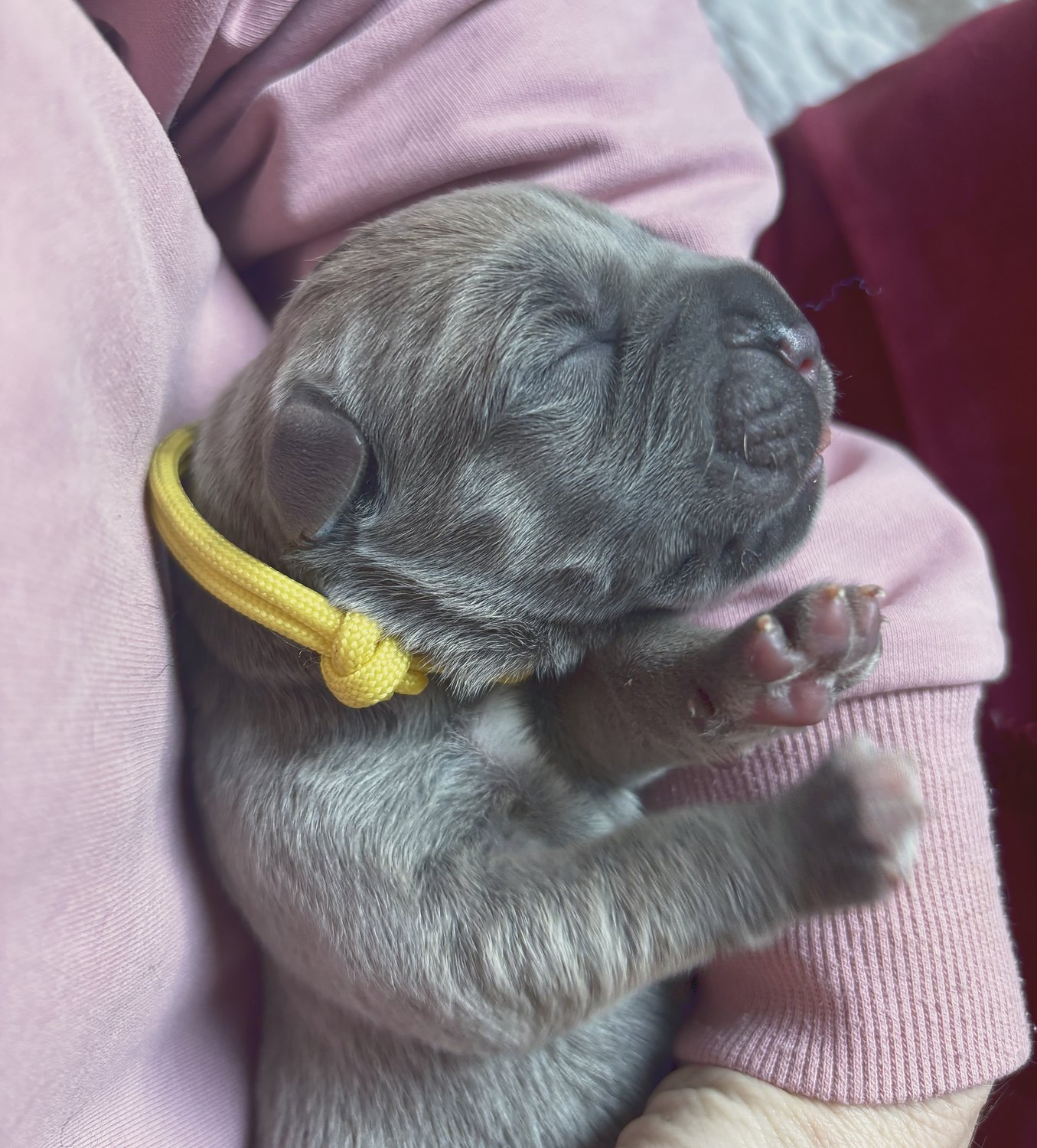
- Early nicknames become predictions, and the breeder’s favorite is the puppy most likely to be described inaccurately — keep collar colors neutral and write notes before you write names.
- The response column of your socialization checklist is already evaluation data; this article is mostly about reading it properly rather than collecting more.
Why many small observations beat one session
A single assessment gives you one reading of a moving target. The puppy that scores as bold at half past nine has just woken from a solid sleep; the one that scores as cautious was flattened by an hour of play ten minutes earlier. Both readings are honest, and neither is the puppy. The evidence on consistency points the same way: pooling 31 studies with 822 effect estimates, adult consistency was about 1.7 times that of puppies, and consistency was higher when the interval between measurements was short, especially in adult dogs. Anything measured once in a seven-week-old therefore carries a great deal of noise.
The practical answer is cheap. Look at four or five specific things a week from around four weeks, each taking a minute or two, and date every entry. It is the repeated pattern — the puppy first out of the box on every one of nine mornings — that is worth telling a buyer about. Repeated observation also catches the thing a single test cannot: change. A puppy that was the most reactive at five weeks and unremarkable at eight has shown you a trajectory, which is more useful than either point alone.
What to write down
Keep the record thin enough that you will actually keep it. Four columns do most of the work: the date, the puppy, what happened, and how long it took to return to normal. To that add, once a week, a one-line note per puppy on each of the handful of qualities you are actually placing on — typically how readily it approaches a stranger, how it handles a startle, how much it uses its mouth and body in play, how long it persists at something difficult, and how easily it settles when handled or separated.
Two habits make the record usable. The first is describing the situation as well as the behavior: “backed off from the umbrella, approached on the third attempt, two other puppies already there” is a different fact from “backed off from the umbrella”. The second is noting the non-events, because an absence you have deliberately recorded — the puppy nobody has yet seen alone in a room — is a gap in your knowledge, not a quality of the puppy. Keep it on the same page as your weighing and growth records, since a puppy that has fallen behind physically will often look temperamentally different for reasons that have nothing to do with temperament.
Your notes double as a health record. When a puppy that usually plays hard goes quiet, eats less, or falls behind on the scale, write it down and act on it. Do not treat it as a temperament note. Keep dates of worming, vaccinations and vet findings in the same file. Kennel clubs and some licensing authorities expect breeders to hand these records to the new owner, along with a record of the puppy’s socialization.
When a puppy has a real scare, note what happened, how long it took to recover, and what helped. Veterinary references stress that puppies are especially sensitive to stress in these weeks. The aim is gentle, recoverable exposure, not flooding, so use your notes to avoid repeating something a puppy has already found frightening before it is ready.
The halo, the favorite and the nickname
The most common failure in puppy evaluation is not a missed observation. It is the observation you made in week two hardening into a category by week five. A puppy called Bruiser at three days old because he was the biggest gets read as the confident one for the next two months, and every ambiguous thing he does is filed under confidence. Names and collar colors chosen for early impressions actively cause this, so choose them arbitrarily and write the notes first.
Expectation genuinely alters scoring; it does not merely feel that way. The 2014 work on observer bias in animal behavior research found that students who watched the same recordings scored more positive interactions between pigs when told the animals had high breeding value, rated cattle as panting more when told the temperature was higher, and judged welfare better when told hens came from organic farms. If false context can move a score in a controlled task, three weeks of quietly hoping that the puppy you want to keep is the good one will certainly move yours.
There is a second, quieter bias. Your favorite is the puppy you handle most and take out of the pen most often, so by eight weeks it genuinely has had more experience than its littermates — and you will then read the result as innate quality. Counting one-to-one sessions per puppy is a simple correction.
In practice
A breeder is certain which puppy in a litter of six is the confident one, and has been saying so to buyers since week three. Going back over four weeks of dated notes before the final matching round, the breeder finds the claim rests almost entirely on feeding order, and that a different puppy — quiet in a group, easily overlooked — recovered fastest from every startle and was the only one to approach three of four novel objects unprompted. The two placements are swapped, and the notes, not the impression, are what the breeder now reads aloud to buyers.
(Illustrative, composite scenario.)
Video, and a second pair of eyes
Video is the only part of your record that lets you check yourself, because it is the only part that does not pass through your expectations before it is stored. Thirty seconds on a phone from a fixed position is enough: the litter meeting a new object, one puppy alone on the floor, ten minutes of play left running from a shelf. Watched two weeks later, the clips regularly disagree with the memory, and the disagreement is the point. They are also the most convincing thing you can send a buyer.
Someone else’s eyes are the other correction. Inter-rater agreement on puppy behavior can be good — in a study of 105 seven-week-old puppies from 21 litters and 13 breeds, three independent assessors agreed closely on four of five subtests, the sudden-appearance task being the weakest — so an outside observer is not adding randomness. Ask them to describe what they see rather than which puppy they like, and ask before you have told them anything.
Turning notes into a placement
At around seven weeks the record has to become a small number of sentences per puppy, in language a buyer can use: what this puppy does often, what it found hard, what it has not yet met, and what you would do next if it were staying. Avoid single adjectives, which buyers hear as guarantees, and avoid ranking the litter from best to worst, which is a claim your data cannot support.
The same document then travels. It is the basis of matching puppy to home, it goes into the puppy pack as the honest version of what you observed, and it becomes the baseline you compare against when you follow these dogs up as adults.
When to call your vet
- A puppy falls behind its littermates on the scale or stops gaining. As a benchmark, puppies should be at least 1.5 × birth weight by day 7 and about double by day 10–14, and should keep gaining steadily after that.
- A puppy eats less, goes off its food, or is noticeably quieter than its own normal for more than a day.
- You notice diarrhea, vomiting, coughing, or discharge from the eyes or nose.
- A puppy limps, wobbles or moves differently from its littermates on more than one day.
- A puppy stays fearful long after a scare, or shows growling or snapping during handling that your notes show is getting worse, not better. Ask about a veterinary behaviorist.
- If in doubt, call — your vet would rather hear from you early.
Work on it
A few minutes here will teach you more than re-reading the article.
Ask yourself
- Are my notes on this litter descriptions of what happened, or verdicts I have already reached?
- Could I say, per puppy, how many times I have handled or observed it on its own — and is the spread even?
- Which of my current beliefs about these puppies dates from the first two weeks, and has it been tested since?
Find out & check
- Go back through your records from your last litter and check how many of your seven-week descriptions you can still support with a dated observation.
Do one thing
- Film thirty seconds of each puppy alone with one novel object today, and label the files with the date and the puppy.
Was this article helpful?
Anonymous. We do not store your name, email or IP address.
Sources & further reading
- Fratkin, J. L. et al., PLOS ONE 2013;8(1):e54907 — Personality Consistency in Dogs: A Meta-Analysis. journals.plos.org
- Tuyttens, F. A. M. et al., Animal Behaviour 2014;90:273–280 — Observer bias in animal behaviour research: can we believe what we score, if we score what we believe?. sciencedirect.com
- Alberghina, D., Giunta, F., Gioè, M. & Panzera, M., PLOS ONE 2020;15:e0236271 — Behavior test for seven-week old puppies (Canis familiaris): Inter-rater reliability and factors associated with test performance. journals.plos.org
- Riemer, S. et al., PLOS ONE 2014;9(7):e101237 — The Predictive Value of Early Behavioural Assessments in Pet Dogs – A Longitudinal Study from Neonates to Adults. journals.plos.org
- Merck Veterinary Manual — Social Behavior of Dogs. merckvetmanual.com
- The Royal Kennel Club — Puppy pack template. royalkennelclub.com
- Welsh Government — Puppy Socialisation Plan (Animal Welfare (Breeding of Dogs) (Wales) Regulations 2014). gov.wales
Where evidence is limited, recommendations rest on established practice and expert judgment, and may be updated as knowledge develops. Consistency figures describe averages across studies and do not tell you how stable any individual puppy will prove to be.
Next steps
- Read next: Temperament and individual differences.
- Related: Socialization checklist.
- Return to the area hub: Understanding and placing each puppy.