Weaning is the first real handover of responsibility from the dam to you — done gradually, over two to three weeks, it is uneventful; rushed, it shows up as loose stools, weight plateaus and unnecessary stress for both dam and litter.
The most important first
- Weaning normally begins around three to four weeks, when the first teeth erupt and the dam starts spending longer away from the nest.
- The transition is gradual: it typically takes two to three weeks, and most litters are fully weaned somewhere around five and a half to seven weeks.
- Start with a thin, lappable gruel of a complete puppy food and thicken it over the following weeks rather than changing food type mid-transition.
- Reduce the dam’s access shortly before meals, then let her back in afterwards — this encourages eating without cutting nursing off abruptly.
- Keep weighing through weaning: a stalled or falling weight is the earliest sign the transition is moving faster than the litter can manage.
When weaning starts, and why then
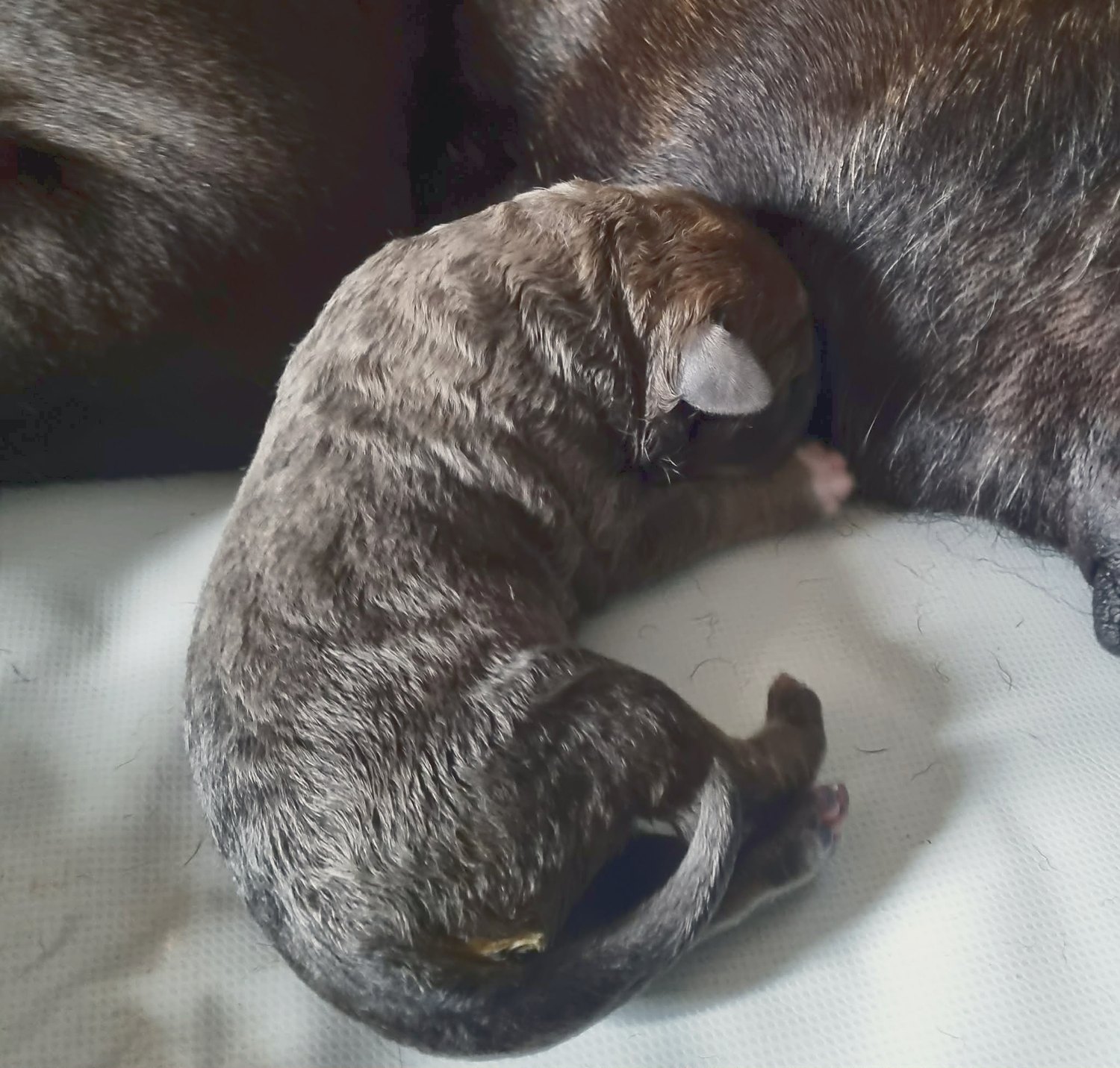
Puppies begin taking an interest in food beyond milk at around three to four weeks — the same point at which their first deciduous teeth erupt and they become mobile enough to leave the nest. This is not a coincidence. Nursing becomes less comfortable for the dam as teeth arrive, and she responds by standing up, leaving more often, and spending longer away from the litter. Weaning is therefore something you support and structure rather than initiate from nothing; the biology has already started it. The developmental context is covered in physical development of the growing litter.
Introducing the first food
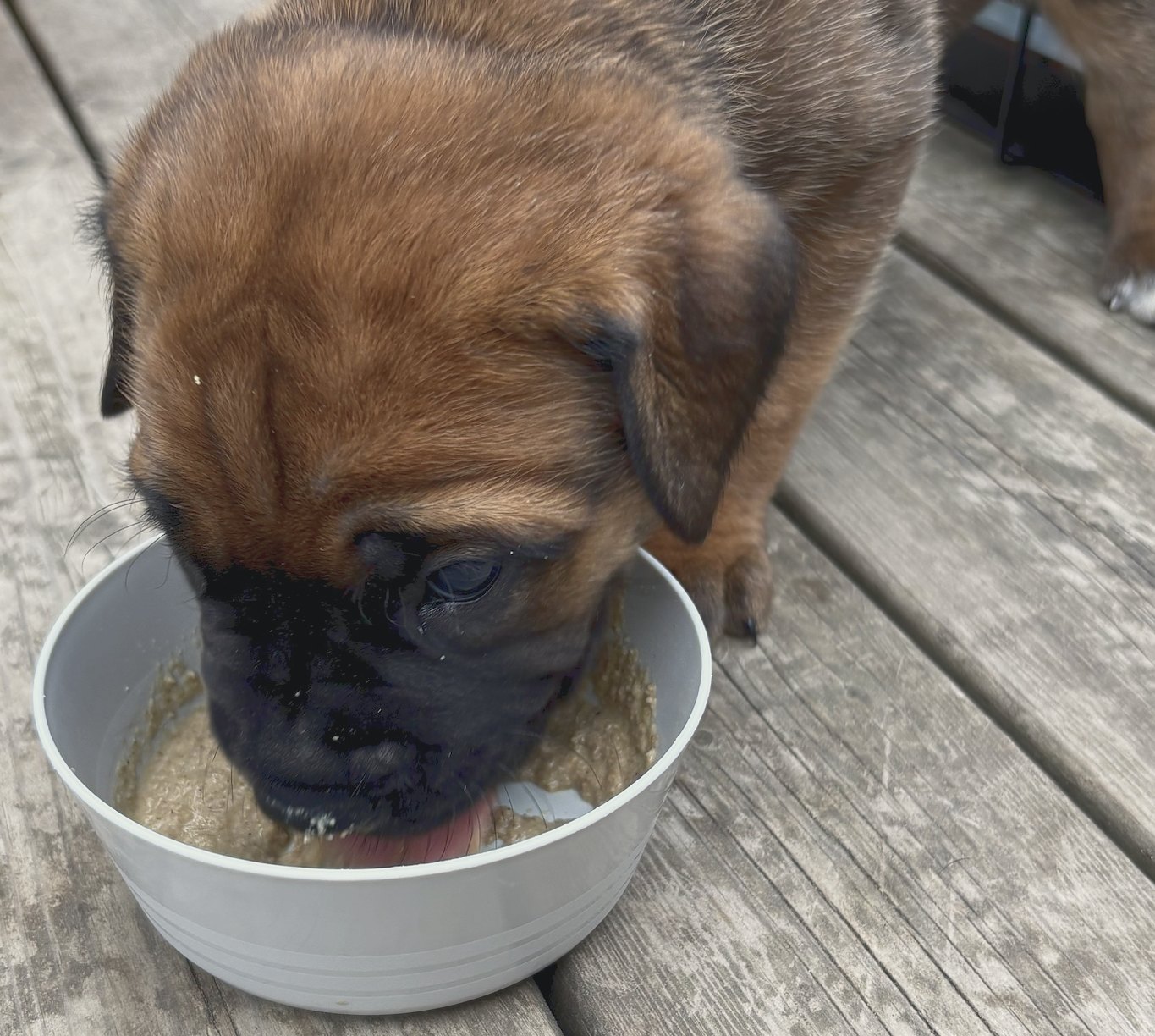
The first food should be a complete, balanced puppy food — the same one you intend the litter to grow on — served as a thin gruel. Soaking or blending kibble with warm water or puppy formula until it is lappable, roughly the consistency of a thin porridge, is the standard approach; a purpose-made puppy starter mousse thinned the same way works equally well. What matters is that puppies can manage it with almost no chewing, and that the food itself does not change again later.
Offer the first meals in one shallow communal dish, which lets you see immediately which puppies engage and which hang back, then move to individual bowls or a multi-compartment pan within a few days so that intake can be judged per puppy rather than per litter. Over the following two to three weeks, thicken the gruel progressively by using less liquid, until the litter is eating the food in its intended form.
Toy-breed puppies have very little energy in reserve. Offer small meals at short, even intervals through the day and keep them nursing alongside solid food until they are clearly eating well; weakness, trembling or unusual sleepiness can mean low blood sugar and is an emergency.
Managing the dam through the transition
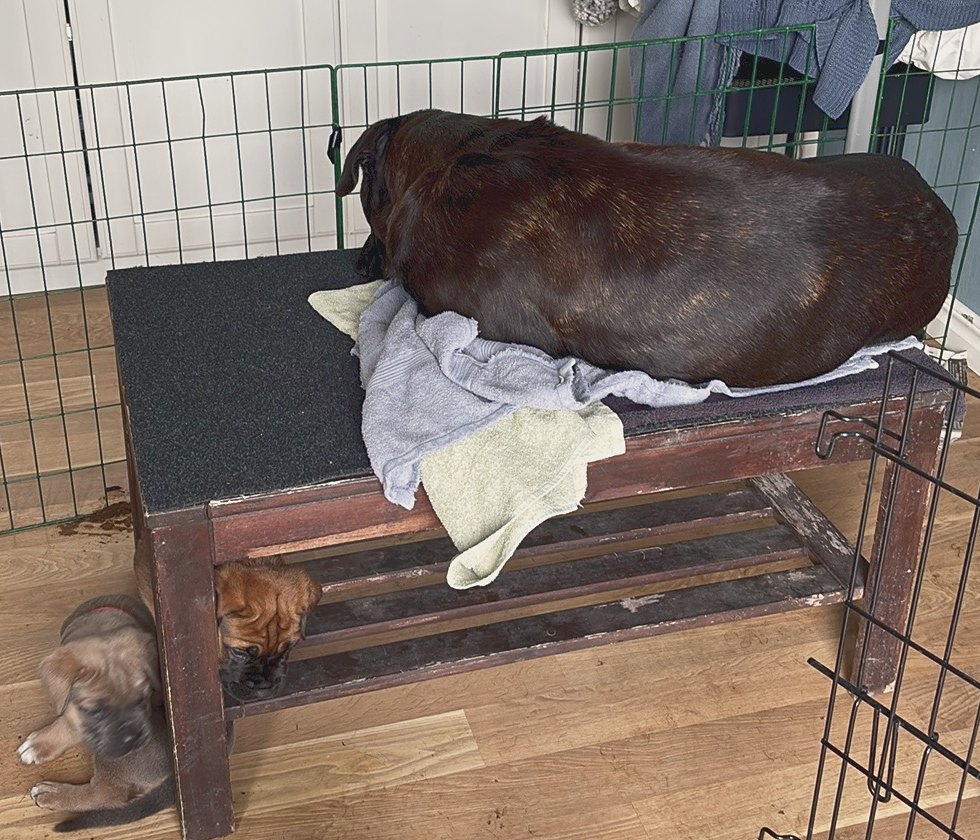
The most workable pattern is to take the dam away from the litter for a short period before each meal, so that puppies come to the food genuinely hungry, and let her back afterwards. Her milk supply falls as demand falls, which is how it should happen — medical intervention to dry a bitch off is rarely necessary in a normally progressing weaning.
Her own feeding needs to come down in step. Peak lactation is the most energy-demanding period of a bitch’s life, and the intake that supported it becomes excessive once the litter is eating solids. Taper her back toward maintenance as nursing decreases, watching her body condition rather than following a fixed schedule.
Some dams resist weaning and continue offering milk well past the point it is useful; others try to stop earlier than the litter is ready. Both are common, and both are managed by controlling access rather than by forcing the issue in either direction.
The start of weaning coincides with the dam’s peak milk production, two to three weeks after whelping, which is also when eclampsia (dangerously low blood calcium) is most likely — especially in small breeds with large litters. Panting, restlessness, trembling, a stiff or wobbly walk, or seeming disoriented are warning signs. Take the puppies off her and call your vet immediately. If it happens, your vet will advise whether the puppies can return to nursing or should be weaned or hand-reared.
Feel her mammary glands every day as nursing tapers. Some fullness is normal; a gland that becomes hot, hard, red or painful, milk that looks bloody or yellow, or a dam who seems unwell or off her food suggests mastitis and needs prompt veterinary treatment. Cutting nursing off abruptly makes this more likely, which is one more reason to wean gradually.
In practice
A breeder with a large litter finds that two puppies are consistently pushed away from the communal dish and are not gaining as well as their littermates. Switching to a multi-compartment pan — one portion per puppy — makes each puppy’s intake visible, and the two catch up within a week without any change to the food itself.
(Illustrative, composite scenario.)
What can go wrong, and what it looks like
Loose stools during weaning are usually a sign that the transition is moving too quickly, that the gruel has been thickened too fast, or that the food changed mid-way. Slowing the pace and holding the food constant resolves most cases; diarrhea that persists, or is accompanied by a flat, unwilling puppy, needs a vet rather than a diet adjustment.
Not all diarrhea at weaning is about food. Coccidia, Giardia and worms commonly show up at this age, and the stress of weaning can bring them out. If loose stools continue after you have slowed down and kept the food the same, ask your vet for a fecal test rather than changing diets again. Small puppies dehydrate quickly: a puppy that is flat, will not eat, or has diarrhea with blood or vomiting needs to be seen the same day.
The other common finding is a puppy that stops gaining. Weighing at least weekly through this period — daily for any puppy that is lagging — as described in growth and body condition in puppies, is what makes that visible early — a plateau is easy to miss by eye in a litter that otherwise looks well.
When weaning is finished
Most litters are eating independently somewhere between five and a half and seven weeks, with breed and litter size shifting that window in both directions — some litters, especially of toy breeds or large litters, take longer, and some sources put full weaning as late as eight to ten weeks. Weaning should be comfortably complete well before puppies leave for their new homes at eight weeks or later (in England, licensed breeders may not sell a puppy or permanently separate it from the dam under eight weeks; many US states set a minimum of seven or eight weeks — check your local law), so that the food, the routine and the digestion are all settled before the far bigger disruption of moving house. What happens after this point — meal frequency, portions, and growth on a complete diet — continues in feeding the growing litter.
When to call your vet
- The dam pants, trembles, walks stiffly or seems disoriented — possible eclampsia; take the puppies off her and call immediately.
- A mammary gland is hot, hard, red or painful, or her milk is bloody or yellowish.
- Diarrhea continues after slowing the transition, or comes with blood, vomiting or a flat, unwilling puppy.
- A puppy stops gaining or loses weight between weigh-ins.
- A toy-breed puppy is weak, trembling or unusually sleepy — emergency.
- The dam goes off her food or loses noticeable condition while still nursing.
- If in doubt, call — your vet would rather hear from you early.
Work on it
A few minutes here will teach you more than re-reading the article.
Ask yourself
- Have I chosen the food the litter will actually grow on, so I don’t have to change it mid-weaning?
- Can I see how much each individual puppy eats, or only how much the litter eats?
- Am I tapering the dam’s own feeding as her milk demand falls?
Find out & check
- Find out what your vet recommends for weaning pace and food choice for your breed’s size category.
Do one thing
- Weigh every puppy this week and write it down, so a plateau during weaning shows up as a number rather than an impression.
Was this article helpful?
Anonymous. We do not store your name, email or IP address.
Sources & further reading
- American Kennel Club — Closing the Milk Bar: The Puppy Weaning Process. akc.org
- VCA Animal Hospitals — Breeding for Dog Owners: Caring for Mother and Puppies After Weaning. vcahospitals.com
- Merck Veterinary Manual — Feeding Practices in Small Animals. merckvetmanual.com
- Merck Veterinary Manual — Social Behavior of Dogs. merckvetmanual.com
- Merck Veterinary Manual — Eclampsia in Small Animals. merckvetmanual.com
- Merck Veterinary Manual — Mastitis in Small Animals. merckvetmanual.com
- Companion Animal Parasite Council — Coccidia. capcvet.org
- UK Government (Defra) — Dog breeding licensing: statutory guidance for local authorities. gov.uk
Where evidence is limited, recommendations rest on established practice and expert judgment, and may be updated as knowledge develops.
Next steps
- Read next: Feeding the growing litter.
- Related: Growth and body condition in puppies.
- Return to the area hub: Raising a healthy litter.