A simple template for recording what happens during whelping, puppy by puppy — set it up before labor starts so you’re filling in fields, not trying to design a system while you’re also monitoring a birth.
The most important first
- Set this up in advance — a printed sheet or simple spreadsheet works fine, no special software needed.
- Track litter-level details (dates, temperature readings) separately from per-puppy details.
- The per-puppy fields matter most: time of birth, sex, weight, presentation, and placenta count.
- This log feeds directly into postpartum vet checks and each puppy’s ongoing individual records.
Litter-level fields
- Mating date(s)
- Confirmed pregnancy date (and method — ultrasound/palpation; an early ultrasound gives only a rough count)
- Expected number of puppies, from an x-ray taken from about day 55, with tick boxes for puppies and placentas as they arrive
- Calculated due date (see the due-date calculator)
- Pre-labor temperature readings (date, time, reading) for the final week, at least twice a day
- Whelping start time (onset of stage 1 signs) and end time (last puppy and placenta delivered)
- Time any green or black discharge is first seen (before the first puppy this is an emergency — call your vet immediately)
- Your vet’s daytime and out-of-hours phone numbers, and the address of the nearest emergency clinic
Per-puppy fields
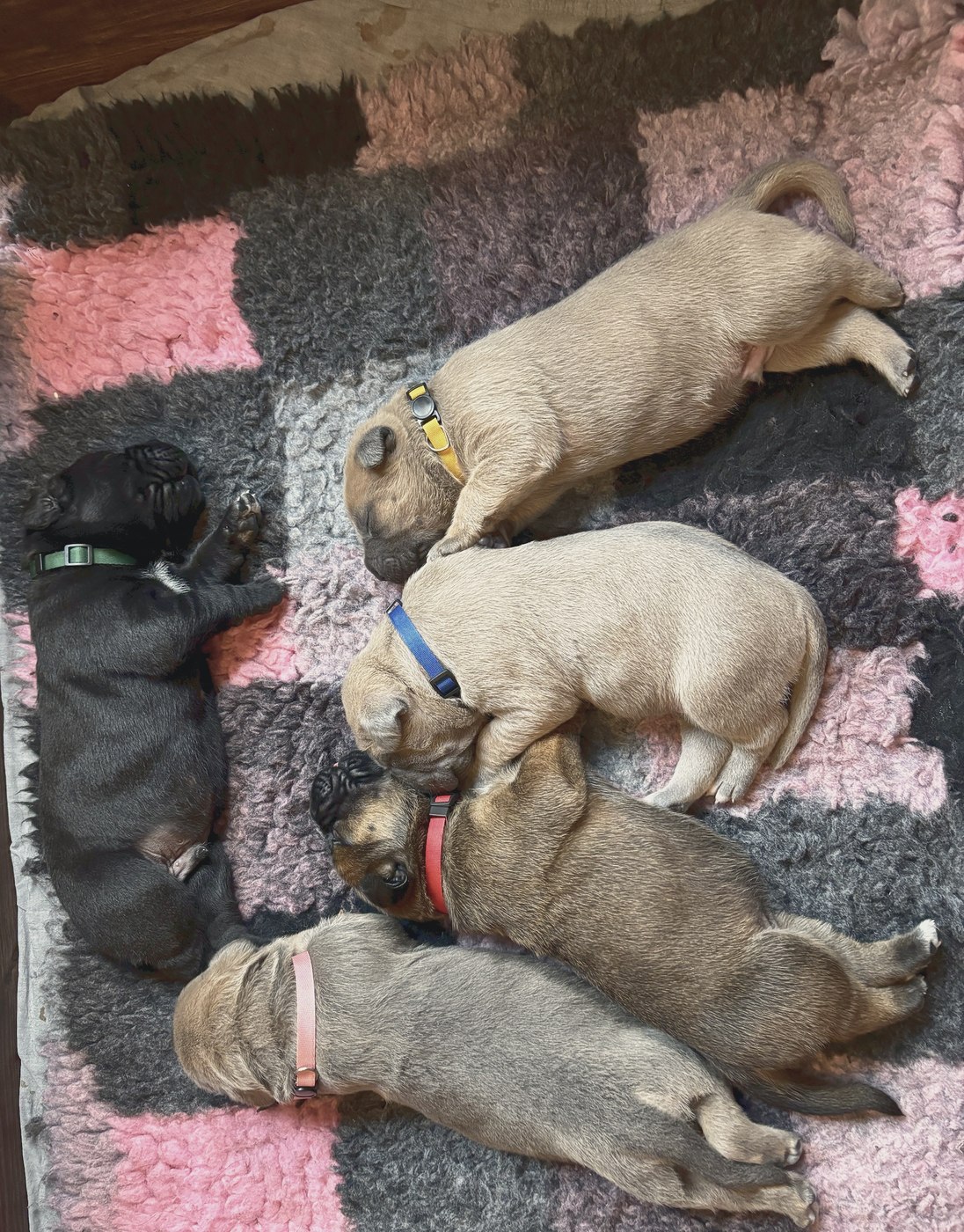
- Puppy number / collar color or ID
- Time strong straining started
- Time of birth
- Sex
- Birth weight
- Color and markings
- Presentation (head-first, hind-first, or hind-first with legs retained, a true breech)
- Placenta delivered (yes/no) and count. The dam may eat placentas or pass them unnoticed, so a lower count is not proof of retention, but mention it to your vet
- Any notes or complications observed
- Any veterinary intervention or medication given
Post-birth fields (first two weeks)
- Weight at birth, at about 12 and 24 hours, then twice a day for the first week and daily after that, with the change since the last weigh. Expect at least 1.5 times birth weight by day 7 and double by about day 10–14; a puppy losing weight after the first day, or not gaining, should be discussed with your vet the same day — see the dam’s first 24 hours and the neonatal period for what to watch for
- General condition, feeding, and activity notes per puppy, including a tick once each puppy has nursed (it must nurse within the first 24 hours to get colostrum)
- A daily row for the dam: temperature, appetite, discharge (color, amount, smell) and mammary glands
Using it well
The value of this log isn’t the template itself — it’s filling it in consistently, in the moment, rather than trying to reconstruct details afterward. Keep it within reach of the whelping box, and treat the per-puppy fields as non-negotiable even when things are moving quickly; they’re exactly the details monitoring and documenting the whelping points to as most useful if a vet needs to be called partway through.
When to call your vet
- Strong straining for 20–30 minutes with no puppy.
- Weak or on-and-off contractions for about 2 hours with no puppy — never wait more than 4 hours.
- More than about 2 hours between puppies when your x-ray count says more are expected.
- Green or black discharge before the first puppy — call immediately.
- No labor within 24 hours of the temperature drop, or about day 70 after the first mating.
- The dam has a fever above 103°F (39.5°C), heavy bleeding or a foul discharge, or a puppy is losing weight.
- If in doubt, call — your vet would rather hear from you early.
Work on it
A few minutes here will teach you more than re-reading the article.
Ask yourself
- Is my log set up and within reach before labor starts, or still just an idea?
- Do I know which fields matter most if I have to fill this in quickly?
Find out & check
- Find out if your vet has a preferred format or specific fields they’d like included.
Do one thing
- Print or set up your whelping log template today, however basic, rather than waiting until closer to the due date.
Was this article helpful?
Anonymous. We do not store your name, email or IP address.
Sources & further reading
- Cornell University Riney Canine Health Center — The Normal Whelping Process. vet.cornell.edu
- UC Davis School of Veterinary Medicine — Whelping in the Bitch. healthtopics.vetmed.ucdavis.edu
- Purdue University Extension — What to Expect When Your Dog Is Expecting (VA-29-W). extension.purdue.edu
- American Kennel Club — Best Practices for Whelping & Caring for Newborn Puppies. akc.org
- Merck Veterinary Manual — Labor, Delivery, and Postpartum Care in Bitches and Queens. merckvetmanual.com
- Cornell University Riney Canine Health Center — Dystocia in Dogs: Understanding Difficult Births. vet.cornell.edu
- Merck Veterinary Manual (Scully C) — Dystocia in Small Animals. merckvetmanual.com
- Lawler DF (2008), Theriogenology 70:384–392 — Neonatal and pediatric care of the puppy and kitten. confluence.cornell.edu
Where evidence is limited, recommendations rest on established practice and expert judgment, and may be updated as knowledge develops.
Next steps
- Related: Monitoring and documenting the whelping · The stages of labor, step by step.
- Return to the area hub: Whelping: the complete guide from first contractions to recovery.