We spend a lot of energy on feeding the pregnant and nursing bitch, and rightly so. But the condition a bitch brings to her next breeding is built in the months between litters, and a stud dog has to be in good shape all year round, not just the week before a mating. This article is about those in-between months: how to judge condition, how to help a bitch recover after a litter, what the stud dog needs, how weight affects fertility, and why supplements deserve more caution than they usually get. It does not recommend foods or brands; it is about principles you can discuss with your vet.
The most important first
- Score body condition regularly using a 9-point scale; 4–5 out of 9 is ideal for both bitches and stud dogs.
- After weaning, bring a bitch’s food back down gradually and give her time to regain lean condition before you plan the next litter.
- A complete and balanced diet suited to the dog’s life stage is the foundation. Most healthy dogs on such a diet do not need supplements.
- Weight loss in a breeding dog should be planned with your veterinarian, not done as a crash diet before a mating.
Why the months between litters matter
A bitch who goes into a pregnancy overweight or underweight starts at a disadvantage. Obesity is the most common nutrition problem in pregnant dogs, and it has been linked to longer intervals between heats, fewer eggs released at ovulation, more difficult whelpings and less milk. Underfeeding is a problem too, linked to pregnancy loss, small litters and low birth weights. The easiest time to correct either is between litters, slowly, when there is no pregnancy to protect. Our article on pregnancy feeding and body condition covers what happens once she is bred.
Body condition scoring: your most useful tool
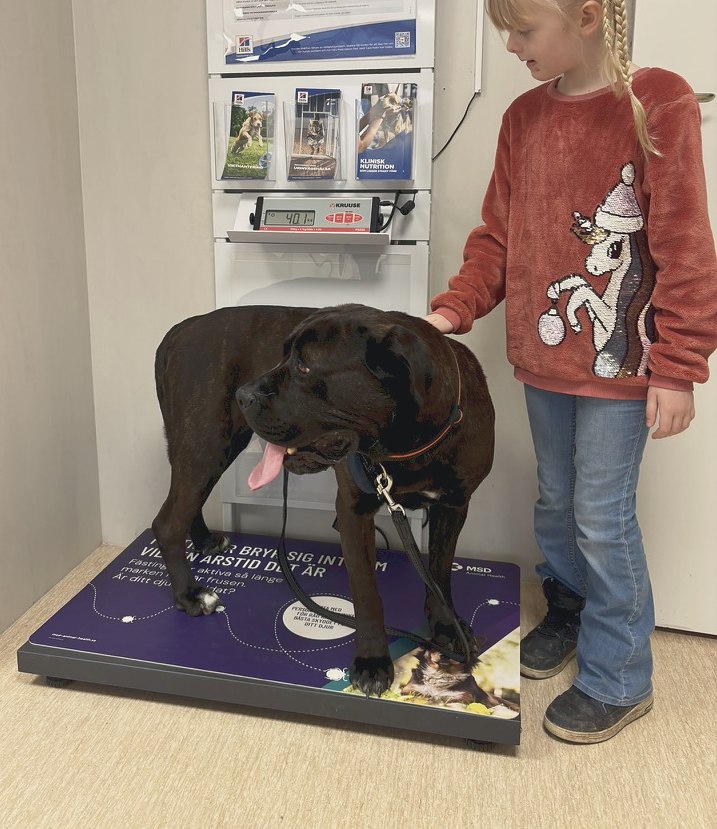
The scale is more useful than the bathroom scale. The WSAVA body condition score chart uses 9 points: 1–3 is under ideal, 4–5 is ideal and 6–9 is over ideal. You score by feel and by eye:
- Ribs: at ideal, you can feel them easily with only a thin layer of fat over them.
- Waist: looking down from above, you can see a waist behind the ribs.
- Tuck: from the side, the belly tucks up behind the ribs.
Coat can hide a lot, especially in heavily coated breeds, so always use your hands. Score each breeding dog at least monthly and write it down along with the weight. WSAVA also publishes a muscle condition score, which is worth learning: a bitch can come out of lactation at a reasonable weight but with lost muscle along her spine and hips.
Recovering condition after lactation
Lactation is the most demanding stage of a dog’s life. VCA’s guidance, written by veterinary nutritionists, notes that at peak milk production, three to five weeks after whelping, a bitch may need two to four times her normal calories, depending on litter size, and that her needs fall back to normal by about eight weeks after whelping, around the time the puppies are fully weaned.
That means two things for the weeks around weaning. First, her food must come down as the puppies eat more solid food, which also helps milk production taper off. Second, she may still be thin or have lost muscle and coat, even as her intake falls. In practice:
- Reduce her food gradually as the puppies wean, guided by body condition rather than by habit.
- Once she is back to her normal intake, move her to an adult maintenance or all-life-stages diet if she was on a growth or lactation formula.
- Score her every week or two. Thin bitches can be fed a little more on a maintenance diet; bitches who stayed heavy should not continue eating like nursing mothers.
- Bring back exercise step by step to rebuild muscle.
From experience, many bitches take a couple of months to look like themselves again, and their coat may take longer. Hold off on planning the next litter until she is back in good, lean condition.
The stud dog’s needs
A stud dog’s diet should match his activity level, while still meeting his needs for reproduction. A theriogenologist at Auburn University puts it plainly: an over-conditioned stud is as bad as an under-conditioned one. Keep him at a body condition score of 4–5 and fit, with regular exercise.
Timing matters with males. Sperm take about 62 days to develop, so any change in health, weight or diet can take around two months to show in a semen evaluation, and as long again to recover. A crash diet or an illness in the spring can affect his fertility well into the summer. Deficiencies matter too: the Merck Veterinary Manual notes that a lack of vitamin E or essential fatty acids can harm sperm production and reproduction, which is one more reason to feed a complete and balanced diet rather than an improvised one. More in caring for the stud dog.
Obesity and fertility: what we know and what we don’t
Veterinary sources agree that obesity is bad for breeding: it is linked to difficult whelpings, puppy losses and lower fertility, and an overweight bitch should lose weight before she is bred. But much of the research is limited. A Virginia Tech study now enrolling breeding bitches notes that the effects of obesity on pregnancy, whelping and puppy health in dogs are still largely unknown, which is why they are measuring them. It is fair to say that keeping your dogs lean is good practice backed by clinical experience; it is not fair to promise that weight loss will fix a fertility problem.
If a breeding dog needs to lose weight, plan it with your vet. Dogs of the same weight can differ widely in their calorie needs, so a feeding chart is only a starting point. Gradual loss, a measured amount of food and regular weigh-ins work better than cutting food sharply before a mating, which risks losing muscle and stressing the dog.
Supplements: proceed with caution
Breeders are offered a lot of supplements for fertility, coat, joints and “conditioning.” Some ingredients, such as fish oil and vitamin E, have early evidence for semen quality in dogs. But the research is small and sometimes conflicting, some minerals such as zinc and selenium can do harm in excess, and quality varies widely.
In the US, pet supplements are not reviewed and approved like drugs, and independent testing has found many products that do not contain what the label says. The American College of Veterinary Nutrition has stated that supplements are not recommended for pets eating a complete and balanced commercial diet unless a veterinarian prescribes them. Our advice: never add supplements on your own to a lactating or pregnant bitch, especially calcium, and talk to your vet about anything you give a stud dog with a fertility problem.
When to involve your vet or a board-certified veterinary nutritionist
Your regular vet is the right first step for most questions. A board-certified veterinary nutritionist is worth considering when a breeding dog has a medical condition that affects diet, when you want to feed a home-prepared diet, when a dog will not reach or hold a healthy condition despite your efforts, or when you are planning a program for several dogs. In North America, nutritionists are certified through the American College of Veterinary Internal Medicine (Nutrition), and you can find one through its specialist directory or by asking your vet for a referral.
When to call your vet
- Your bitch is still thin, or losing weight or muscle, more than a few weeks after the puppies are weaned.
- She seems weak, shaky or restless, or has muscle twitching while nursing or around weaning: this can be eclampsia and is an emergency.
- She has a poor appetite, vomiting or diarrhea for more than a day, or is drinking much more than usual.
- A dog’s body condition score stays at 6 or above, or 3 or below, despite changes to feeding.
- Your stud dog’s fertility drops, or he loses weight or condition without explanation.
- You want to start a weight-loss plan, change diet type or add any supplement.
- If in doubt, call — your vet would rather hear from you early.
Work on it
A few minutes here will teach you more than re-reading the article.
Ask yourself
- Do I know each breeding dog’s body condition score today, or do I only notice weight when it is obvious?
Find out & check
- Download the WSAVA body condition score chart and score every breeding dog this week.
- Note each dog’s current diet and any supplements, and check whether they are complete and balanced for that dog’s life stage.
Do one thing
- Start a simple log for each dog with date, weight and body condition score, and update it monthly, weekly for a bitch after weaning.
Was this article helpful?
Anonymous. We do not store your name, email or IP address.
Sources & further reading
- WSAVA Global Nutrition Committee — Body Condition Score: Dog. wsava.org
- WSAVA — Global Nutrition Guidelines (incl. nutritional assessment and muscle condition score). wsava.org
- VCA Animal Hospitals (Canadian Academy of Veterinary Nutrition) — Feeding the Nursing Dog. vcahospitals.com
- VCA Animal Hospitals (Canadian Academy of Veterinary Nutrition) — Feeding the Pregnant Dog. vcahospitals.com
- Auburn University College of Veterinary Medicine (Barrett, J., DVM) — Stud Dog Management (2019). vetmed.auburn.edu
- Merck Veterinary Manual — Nutritional Requirements and Related Diseases of Small Animals. merckvetmanual.com
- Virginia Tech Virginia-Maryland College of Veterinary Medicine — Body condition and reproduction in breeding bitches (clinical study). research.vetmed.vt.edu
- AVMA (JAVMA News) — Assessing pet supplements. atwork.avma.org
Where evidence is limited, recommendations rest on established practice and expert judgment, and may be updated as knowledge develops. This article is general information and does not replace an examination by your veterinarian. If you suspect an emergency, contact a veterinarian immediately.
Next steps
- Read next: Caring for the stud dog.
- Related: Pregnancy feeding and body condition.
- Related: The breeding dog’s life: area guide.