A working-bred litter is where breeders make their boldest claims and their least reliable predictions — the seven-week-old that “has drive” may or may not become a dog that can hold a job, and what you are reading at that age is a tendency, not a future.
The most important first
- Working aptitude is not one trait. Retrieving, herding, scent work, guarding, hauling and terrier work draw on different combinations of arousal, independence, sensitivity to the handler and tolerance of boredom.
- The best evidence on early testing is unflattering: in 630 German shepherd puppies tested at eight weeks, the tested traits showed moderate to high heritability, yet correspondence with performance at adult age was described by the authors as negligible.
- What predicts earliest in programs that measure it is not the flashy part: in one detection-dog cohort, emotional reactivity and environmental soundness predicted selection at every age tested, from three months; most measures of drive and search performance did not.
- Attrition stays high even in purpose-bred populations with professional trainers: of 261 dogs followed in one guide dog program, 90 (34.5%) were withdrawn for behavioral reasons.
- Read this after puppy aptitude tests and their limits and what puppy tests can and can’t predict; it applies the same caution specifically to function.
What “working aptitude” actually means, group by group
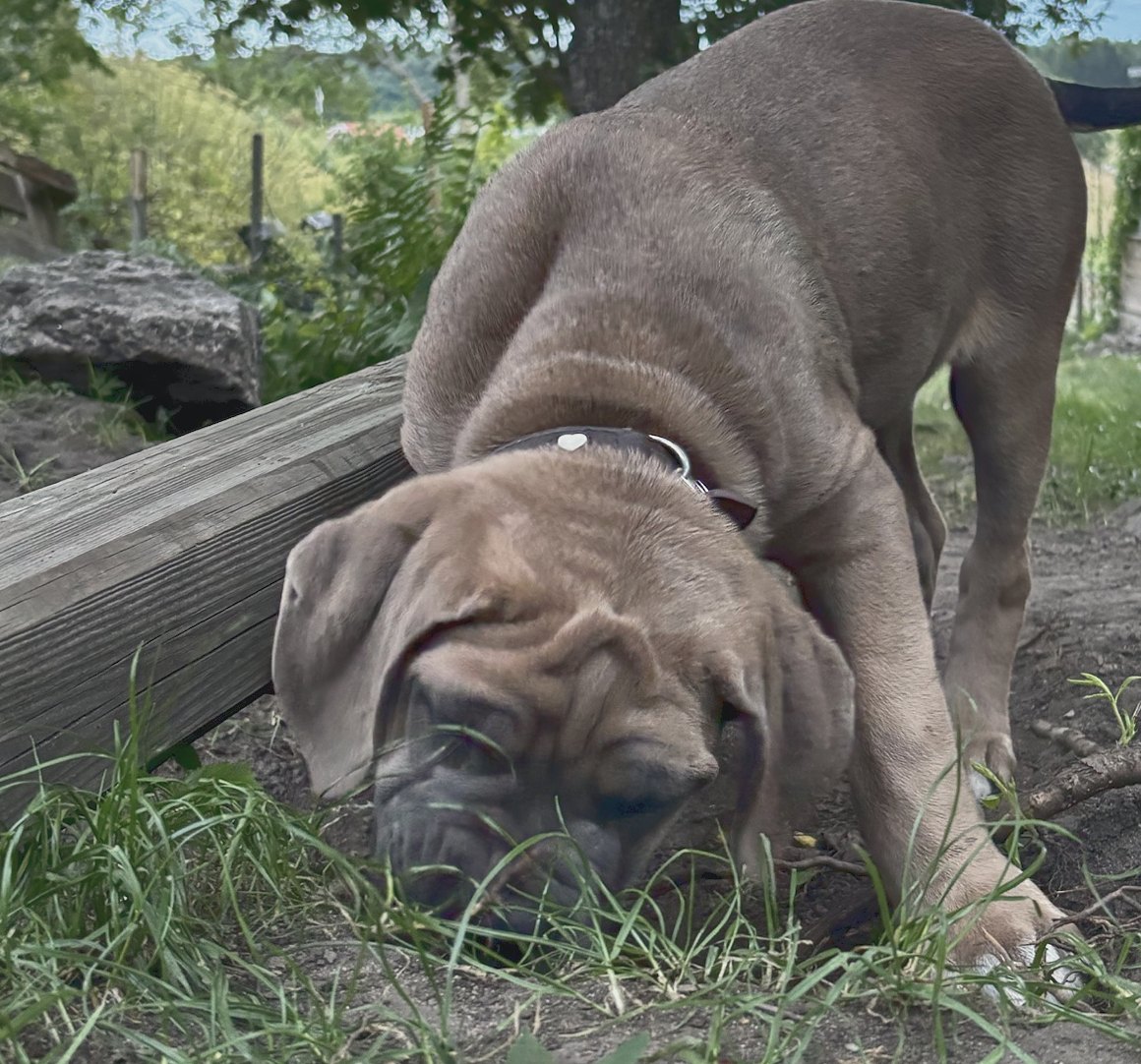
The breed groups are a shorthand for jobs. The American Kennel Club describes its Sporting group as bred to assist hunters in the capture and retrieval of feathered game, its Hound group to pursue warm-blooded quarry by sight or by scent, its Working group to pull sleds and carts and to guard flocks and homes, its Terrier group to go underground after rodents and other vermin, and its Herding group to move livestock, including sheep, cattle and reindeer. Those are not interchangeable demands, and a puppy that suits one may be actively unsuited to another.
Unpack them into behavior and the differences become obvious. A retrieving dog must want to carry something in its mouth, deliver it to a person, and work at a distance while staying in contact with the handler. A herding dog needs sustained interest in movement plus the capacity to stop — interest without an off-switch is not aptitude, it is a problem. Scent work rewards independent persistence and relative indifference to handler pressure: the dog must keep searching when nothing is happening. Guarding work needs confidence, slow escalation and enough discrimination to tell the postman from a threat. A sled dog needs appetite for pulling, sound gait and the sociability to live and work in a team. Terrier work needs tenacity, tolerance of confinement and a high pain threshold.
The practical consequence is that “high prey drive” is not a grade: the intensity that suits detection work can make for a poor candidate for stock work, and no single test scores all of these at once.
Which precursors are visible at seven to nine weeks — and which are not
Some things genuinely show at this age, and are worth recording rather than scoring: whether a puppy will pick up an object and carry it towards a person, how it responds to something moving away from it, how quickly it recovers after a startle, whether it will follow a scented article dragged out of sight, how long it persists at a mildly difficult problem, and how it copes with a few minutes alone. Record what happened and when, as in observing and documenting individual puppies.
What is not visible is most of what determines a working career. Stamina, adult structure and gait, the ability to work under distraction, hardness under real pressure, scenting ability as a skill rather than an interest, and the trainability that survives adolescence all arrive later. So does the temperament the dog will actually have: the eight-week-old profile is a snapshot of a rapidly changing animal, which is the point made in temperament and individual differences.
The heritability finding is where breeders most often go wrong. In the eight-week test of 630 German shepherd puppies, the tested traits showed moderate to high heritability — genuinely substantial. Heritable, however, describes how much of the variation between dogs in a population is genetic, and therefore how well a population can respond to selection over generations. It does not mean an individual puppy’s score forecasts its own adult behavior, and in that study it did not: the authors concluded the test was not useful for predicting adult suitability for service dog work.
The strongest early predictors in the detection-dog study — how a puppy copes with new places and recovers from a fright — are also the traits a breeder can most influence. Veterinary behaviorists stress the first three months as the key period for socialization, so varied, positive exposure to surfaces, sounds, people and places in your home and beyond is part of breeding a working dog, not separate from it.
How working-dog organizations actually select
Organizations that depend on the answer do not settle it at seven weeks; they assess repeatedly. In one validation study, 60 puppies from eight litters were tested at roughly three, five and eleven months, with a final evaluation at about fourteen months, across performance, emotional reactivity and environmental tests. Twenty-eight were selected — 23 as operational detection dogs and five as breeding animals — and 32 were not. The authors also flagged something breeders should sit with: the outcome measure is itself partly subjective and moves with supply and demand.
The guide dog figures make the same point from the other end. In a cohort of 261 dogs from one program, 171 (65.5%) qualified and 90 (34.5%) were withdrawn for behavioral reasons; the strongest predictor, distractibility, came from a questionnaire completed by the volunteer puppy raisers at about eight months — in a closed, purpose-bred population with volunteer puppy raisers, professional trainers and structured assessment throughout. If that system loses roughly a third, a breeder picking a puppy on one morning at eight weeks should claim far less.
In practice
A breeder of a working line sends the puppy with the highest retrieve score at seven weeks to a detection program and keeps the quieter littermate. At twelve months the prospect is withdrawn — not for want of drive, but because it cannot settle in an unfamiliar kennel — while the puppy kept at home passes its assessment. The breeder stops running one test day and starts keeping short notes across weeks five to nine on recovery after a startle, tolerance of being alone, and interest in a hidden article.
(Illustrative, composite scenario.)
Selecting for a job is not selecting for a title
A sport title rewards specific trained behaviors performed under judged conditions on a known day. A job requires far more tolerance of tedium: repetition, ordinary environments, long periods of nothing, and a handler whose skill varies. Selecting hard for trial results can quietly favor very high arousal and fast conditioning — demanding to live with, and not the same thing as functional soundness. Decide which you are breeding for and write it down, because it changes which puppy you keep and which homes you look for. That decision belongs in building a breeding program and designing a long-term breeding program, and it is only testable in hindsight through tracking conformation, function and working results.
Whatever the job, the FCI’s baseline applies: breed only healthy dogs with a sound temperament typical of the breed, and leave out dogs with excessive fear or unprovoked aggression, however impressive their drive.
What you can honestly promise, and what training decides
Training, handling and opportunity shape a great deal of what a puppy becomes, and early tests cannot separate those from inherited tendency — which is what the selection literature shows, not modesty on your part. So describe rather than promise. “This puppy carried a wing to hand on six occasions between seven and nine weeks and settled alone for ten minutes” is useful to a buyer; “this is your next trial dog” is not, and it sets up a disappointment that comes back to you. Pair the description with a frank conversation about what the home can offer, as in matching puppy to home and communication and setting expectations, and keep a route back for a dog in the wrong job.
The body has to hold up too
Stamina, structure and gait cannot be judged at eight weeks. Hip and elbow screening comes later — preliminary hip evaluations are possible from four months — and OFA notes that diet and exercise affect how severe hip dysplasia becomes. Ask your veterinarian about safe exercise for a growing puppy, and do not promise a working home a sound adult before the screening is done.
Talk to your vet when planning: before a working prospect starts structured training, ask about health screening and safe exercise for its age.
Work on it
A few minutes here will teach you more than re-reading the article.
Ask yourself
- Can I name the three or four behavioral demands of the job I breed for, or do I fall back on “drive”?
- Am I selecting for a job, for a title, or for whichever puppy looks most impressive on test day?
- When a puppy I placed as a working prospect did not make it, did I find out why?
Find out & check
- Contact a working-dog organization or working club in your breed and ask what they assess, at what ages, and what proportion of their intake does not complete training.
Do one thing
- Write down, for this litter, one observation per puppy that bears on function — dated, with the conditions — rather than a score.
Was this article helpful?
Anonymous. We do not store your name, email or IP address.
Sources & further reading
- American Kennel Club — AKC Breed Groups: Understanding Breed Groups at Dog Shows. akc.org
- Wilsson E, Sundgren P-E (1998), Applied Animal Behaviour Science — Behaviour test for eight-week old puppies—heritabilities of tested behaviour traits and its correspondence to later behaviour. sciencedirect.com
- Lazarowski L et al. (2021), Animals — Validation of a Behavior Test for Predicting Puppies’ Suitability as Detection Dogs. pmc.ncbi.nlm.nih.gov
- Hunt RL et al. (2020), Animals — Concurrent and Predictive Criterion Validity of a Puppy Behaviour Questionnaire for Predicting Training Outcome in Juvenile Guide Dogs. pmc.ncbi.nlm.nih.gov
- Fratkin JL et al. (2013), PLOS ONE — Personality Consistency in Dogs: A Meta-Analysis. journals.plos.org
- FCI — International Breeding Strategies. fci.be
- American Veterinary Society of Animal Behavior — Position Statement on Puppy Socialization. avsab.org
- Orthopedic Foundation for Animals — Hip Dysplasia. ofa.org
Where evidence is limited, recommendations rest on established practice and expert judgment, and may be updated as knowledge develops. The selection studies cited come from purpose-bred program populations and may not transfer to other breeds or breeding aims.
Next steps
- Read next: Evaluating puppy health before placement.
- Related: What puppy tests can and can’t predict.
- Return to the area hub: Understanding and placing each puppy.