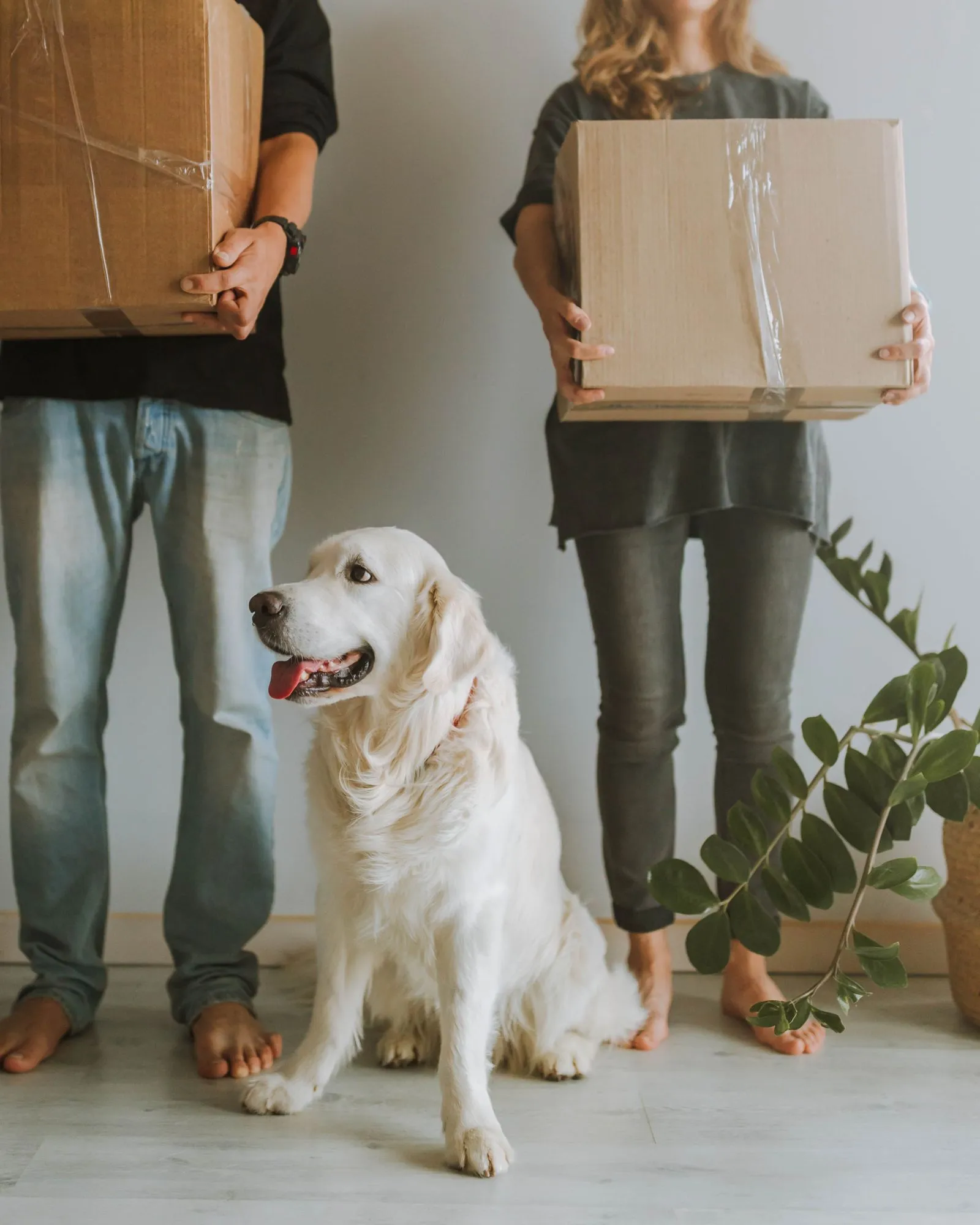
Moving is exciting for you and baffling for your dog: familiar smells disappear into boxes, strangers carry the furniture out and every door is propped open — so the two things that matter most are keeping your dog safely out of the chaos on the day, and making sure that if it does slip out, its microchip leads straight back to you.
The most important first
- Update the microchip registration and ID tag with your new address and phone number before you move.
- On moving day, keep your dog away from open doors — in a closed room, a crate or with a trusted friend.
- Check the new yard for gaps before you let your dog out, and supervise closely at first.
- Keep routines and familiar things: the same bed, blanket, bowls and walk times.
- Expect an adjustment period. Many dogs take weeks to settle.
Last updated: November 8, 2026
Why moving is a risky time
Microchips work — if the details are right. In a study of 7,704 microchipped animals entering 53 US animal shelters, Lord and colleagues (2009) found that owners were found for 74.1% of microchipped stray dogs. When owners couldn’t be found, the most common reason was an incorrect or disconnected phone number (35.4%), and only 58.1% of the animals checked with a microchip registry were actually registered in the database.
Dogs do get lost. In a US telephone survey, Weiss, Slater and Lord (2012) found that 14% of dogs had been lost at least once in the previous five years. Most (93%) were recovered, usually by searching the neighborhood or because the dog came home on its own.
In the weeks before the move
- Update your details. RSPCA Australia advises updating your dog’s address on the microchip register and its ID tag. Do it before moving day, and add a mobile number that will still work.
- Visit the new area. RSPCA Queensland suggests walking your dog in the new neighborhood, or a nearby dog park, at least weekly before the move if you can.
- Find a new vet if you’re moving far, and bring your dog’s vaccination records.
- Introduce boxes early. The ASPCA, quoted by the Ontario SPCA, suggests bringing boxes in early and keeping your pet in a familiar room you’ll pack last.
- Watch the doors. RSPCA Australia warns that viewers, buyers and tenants may leave gates or doors open in the weeks before you go.
On moving day
- Remove your dog from the chaos. Both RSPCA Australia and the ASPCA suggest a quiet room with the door shut, a crate if your dog is crate-trained, or a day with a trusted friend or boarding.
- Pack a day bag: food, water, bowls, a favorite toy, leash, waste bags and any medication.
- Travel safely in a secured crate or car harness, and never leave your dog alone in a parked car.
In practice
A family moving across town asks a friend their dog knows well to take him for the day. They put his bed, bowls and an unwashed blanket in the car last, and on arrival set up one quiet room with his familiar things before bringing him in. The front gate turns out to have a gap under it, so he stays on a long leash in the yard until it’s fixed.
(Illustrative, composite scenario.)
Settling into the new home
- Wait until it’s quiet. RSPCA Australia suggests bringing your dog into the new home after the movers have left and letting it explore at its own pace.
- Start with a home base. The ASPCA’s advice is one room with toys, treats, food and water, then gradually opening up the rest of the house.
- Check the boundaries. Walk the fence line, check gates and gaps under fences, and supervise your dog outside. RSPCA Australia warns that a fence you judged escape-proof may not be.
- Keep routines steady. RSPCA Queensland advises keeping feeding, walking and bedtime routines as consistent as possible, and keeping familiar items rather than replacing everything.
- Pet-proof the new house: hide cords, check window screens and remove poisonous plants and any pest-control baits left behind.
Give it time. There is little research on dogs moving house with their families, but studies of dogs adjusting to new homes suggest it is gradual. In a study of 158 rescue dogs adopted into German homes from abroad, Hoth-Zimak and colleagues (2026) found that the dogs’ behaviour improved steadily over the first six months. Your own dog, moving with its family, will usually adjust much faster — but a few weeks of extra patience is normal.
When to call your veterinarian
- Your dog stops eating or drinking for more than a day after the move.
- Vomiting, diarrhea or other signs of illness.
- House-soiling, destructiveness or distress when left alone that doesn’t ease after a few weeks.
- Before a long journey, if your dog is elderly, pregnant, unwell or gets very stressed in the car.
- If in doubt, call — your vet would rather hear from you early.
Work on it
A few minutes here will teach you more than re-reading the article.
Ask yourself
- Are my dog’s microchip details and ID tag up to date right now?
- Where will my dog be while the movers are working?
- Have I checked the new yard for gaps?
Find out & check
- Look up which microchip database your dog is registered with.
Do one thing
- Log in to the microchip registry today and check your phone number and address.
Was this article helpful?
Anonymous. We do not store your name, email or IP address.
Sources & further reading
- Lord LK, Ingwersen W, Gray JL, Wintz DJ (2009) — Characterization of animals with microchips entering animal shelters. Journal of the American Veterinary Medical Association 235:160–167. doi.org
- Weiss E, Slater M, Lord L (2012) — Frequency of Lost Dogs and Cats in the United States and the Methods Used to Locate Them. Animals 2:301–315. doi.org
- RSPCA Australia (2022) — Moving house with your pet. rspca.org.au
- RSPCA Queensland (2020) — Tips when moving homes with pets. rspcaqld.org.au
- Ontario SPCA and Humane Society (2025) — How to successfully move homes with your pet (ASPCA advice). ontariospca.ca
- Hoth-Zimak L, Kickstein J, Klima A, Mackensen H, Müller E, Louton H, Döring D (2026) — Behavioural adaptation of 158 rescued dogs from abroad during the first six months after adoption in Germany. Scientific Reports 16:23613. doi.org
Where evidence is limited, recommendations rest on established practice and expert judgment, and may be updated as knowledge develops. This is general information and does not replace advice from your veterinarian.
Next steps
- Read next: Snakebite in dogs: prevention, warning signs and what to do.
- Related: A first aid kit and first aid basics for dog owners.
- Return to the guide: For your puppy buyers.