Most dogs are well protected by their coat, but dogs with white or thin hair and pink skin can burn — and years of sun-worshipping on the patio are linked to skin cancer — so for at-risk dogs, shade in the middle of the day matters more than any product you can buy.
The most important first
- White, short-coated dogs with pink skin are most at risk, along with any dog that likes to lie belly-up in the sun.
- Look at the belly, groin, flanks, inner legs and the top of the nose for redness, scaling or crusts.
- Keep at-risk dogs out of strong midday sun and provide shade outdoors.
- Use only sunscreen made for pets, or one your vet approves, on thin-haired areas — some human sunscreens contain ingredients that are harmful if licked.
- See your vet about sores that don’t heal in sun-exposed skin.
Last updated: November 8, 2026
Which dogs are at risk
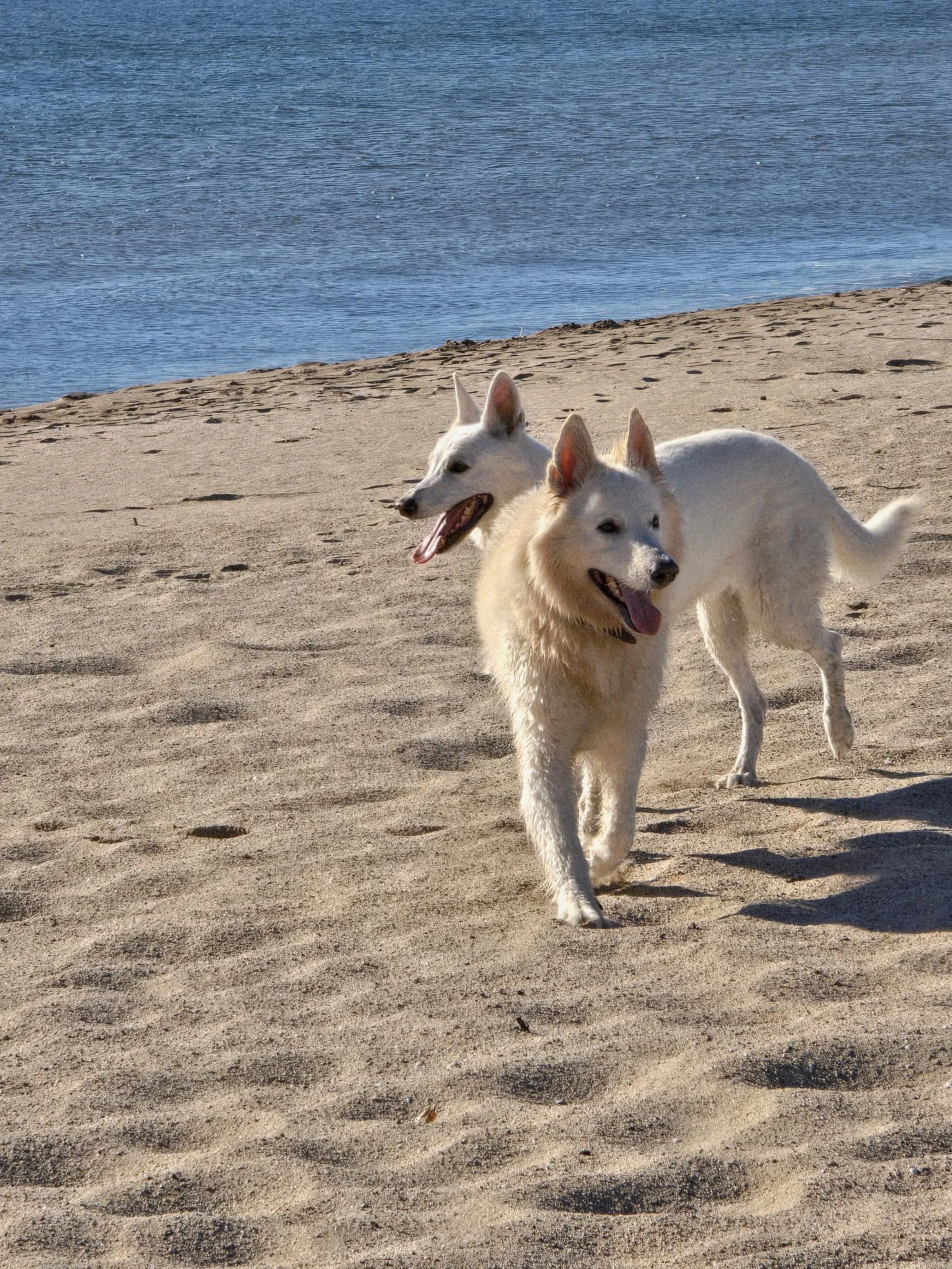
Veterinary dermatologist Kimberly Coyner explains that chronic sun damage (solar dermatitis) mostly affects short-coated dogs with white hair or unpigmented skin, including pit bull-type terriers, Staffordshire bull terriers, bull terriers, boxers, Dalmatians, American bulldogs and whippets — but any dog with white or lightly pigmented hair and skin is at risk. VCA Animal Hospitals adds beagles and Australian shepherds to the list.
The most affected areas are the thinly haired, unpigmented ones: the flanks, groin, armpits and top of the nose, and also the sides of the body and outer legs. Dogs that always lie on the same side often have worse damage on that side. The Pet Poison Helpline notes that dogs that lie on white concrete or near water can also be burned by reflected sun.
From sunburn to skin cancer
Solar dermatitis starts like a sunburn, with redness and dryness, and can become crusted and ulcerated. Over years, it can lead to cancer.
In a 2026 review, Granados-Soler and colleagues describe ultraviolet light as a recognised risk factor for skin (dermal) hemangiosarcoma and squamous cell carcinoma in dogs. These tumours often need repeated surgery because they come back or new ones appear. A 2023 review of canine hemangiosarcoma by De Nardi and colleagues notes that skin hemangiosarcoma is more common in breeds with little pigment and hair cover, and that signs of sun damage are frequent in affected dogs.
In Australia, Zhang and colleagues (2026) compared 295 dogs with skin squamous cell carcinoma to 1,180 matched dogs. Cases were concentrated in sunny coastal areas, and most tumours were on the body behind the chest. Older dogs, white or white-mixed coats and breeds such as Dalmatians, bulldogs, Staffordshire terriers and schnauzers had higher odds.
In practice
A family with a white Staffordshire bull terrier notices that she loves to sunbathe belly-up on the deck every summer afternoon. Remembering their breeder’s advice to check her pink belly skin, they spot some redness and scaling. Their vet suggests moving her sunbathing to the morning, setting up a shaded spot and using a pet-safe sunscreen on her belly, and asks them to come back if any spot crusts or doesn’t heal.
(Illustrative, composite scenario.)
How to protect your dog
- Limit midday sun. Advice varies slightly — VCA suggests keeping at-risk dogs indoors between 10 a.m. and 4 p.m. on sunny days, while Coyner and the Pet Poison Helpline say 9 a.m. to 3 p.m. — but the principle is the same: avoid the strongest sun.
- Provide shade in the yard and kennel run, and consider UV-protective film on windows where your dog sunbathes indoors.
- Consider clothing. A light T-shirt or a dog sun suit can cover the belly and flanks.
- Use sunscreen on thin-haired areas when your dog can’t avoid the sun.
What about sunscreen? Granados-Soler and colleagues conclude that sunscreen is a useful part of sun protection for at-risk pets, but that the safety of many sunscreen ingredients in dogs has hardly been studied. Sunscreens with non-nanoparticle zinc oxide appeared safe when licking and swallowing were prevented or minimised; the safety of organic UV filters is unclear. The Pet Poison Helpline warns that many human sunscreens contain aspirin-like compounds such as octyl salicylate, which can be toxic if swallowed. The safest approach is a sunscreen made and labelled for dogs, or one your vet recommends, applied where your dog can’t lick it off.

When to call your veterinarian
- Red, sore or peeling skin after time in the sun.
- Scaly, crusted or thickened patches on the belly, flanks or nose.
- A sore, lump or scab in sun-exposed skin that doesn’t heal within a couple of weeks.
- A dark red or purple spot or lump in pale skin.
- If in doubt, call — your vet would rather hear from you early.
Work on it
A few minutes here will teach you more than re-reading the article.
Ask yourself
- Does my dog have white fur or pink skin on the belly or nose?
- Where does my dog sunbathe, and at what time of day?
- Is there shade wherever my dog spends time outdoors?
Find out & check
- Ask your vet whether your dog would benefit from sunscreen and which product they recommend.
Do one thing
- Roll your dog over this week and look closely at the belly and groin skin.
Was this article helpful?
Anonymous. We do not store your name, email or IP address.
Sources & further reading
- Granados-Soler JL, Story MM, Allavena R (2026) — Ultraviolet Light-Induced Skin Cancer and the Safety of Sunscreen Use in Pets — An Important but Under Researched Aspect of Companion Animal Health. Veterinary Sciences 13:605. doi.org
- Zhang JJ, Dejene H, Granados-Soler JL, Henning J, Allavena R (2026) — Demographic and environmental factors associated with canine cutaneous squamous cell carcinoma development in Australia: a retrospective matched case-control analysis. Veterinary Research Communications 51:20. doi.org
- De Nardi AB, de Oliveira Massoco Salles Gomes C, Fonseca-Alves CE, et al. (2023) — Diagnosis, Prognosis, and Treatment of Canine Hemangiosarcoma: A Review Based on a Consensus Organized by the Brazilian Association of Veterinary Oncology, ABROVET. Cancers 15:2025. doi.org
- Coyner KS, dvm360 (2007, updated 2020) — Diagnosis and treatment of solar dermatitis in dogs. dvm360.com
- Weir M, VCA Animal Hospitals — Solar Dermatitis in Dogs. vcahospitals.com
- Pet Poison Helpline (2018, updated 2026) — Sunburn in Companion Animals – Part 1, Cats and Dogs. petpoisonhelpline.com
Where evidence is limited, recommendations rest on established practice and expert judgment, and may be updated as knowledge develops. This is general information and does not replace advice from your veterinarian.
Next steps
- Read next: Summer heat and dogs: hot pavement, hot cars and heatstroke on walks.
- Related: Seasonal allergies in dogs: itching, paws and ears.
- Return to the guide: For your puppy buyers.