Your puppies grew up in twenty different households with twenty different ideas of what a dog is for — and somewhere inside that noise is the information you need about what you bred.
The most important first
- Most of the variation between adult littermates is not additive genetic variation, which is why behavior follow-up has to be read across several litters rather than within one.
- Research finds behavior to be moderately consistent over time, more so in adults than in puppies, so adult reports are better evidence than your eight-week impressions.
- Heritability estimates for individual behavior test traits in dogs are typically low to moderate, which means selection works slowly and single cases prove nothing.
- Ask about situations and frequencies, not labels; an owner’s word for a behavior tells you more about the owner than the dog.
- Follow-up evaluates your socialization as well as your breeding, and the two are not separable from the outside. Start from what you recorded during the puppies’ first weeks.
What the homes explain, and what is left
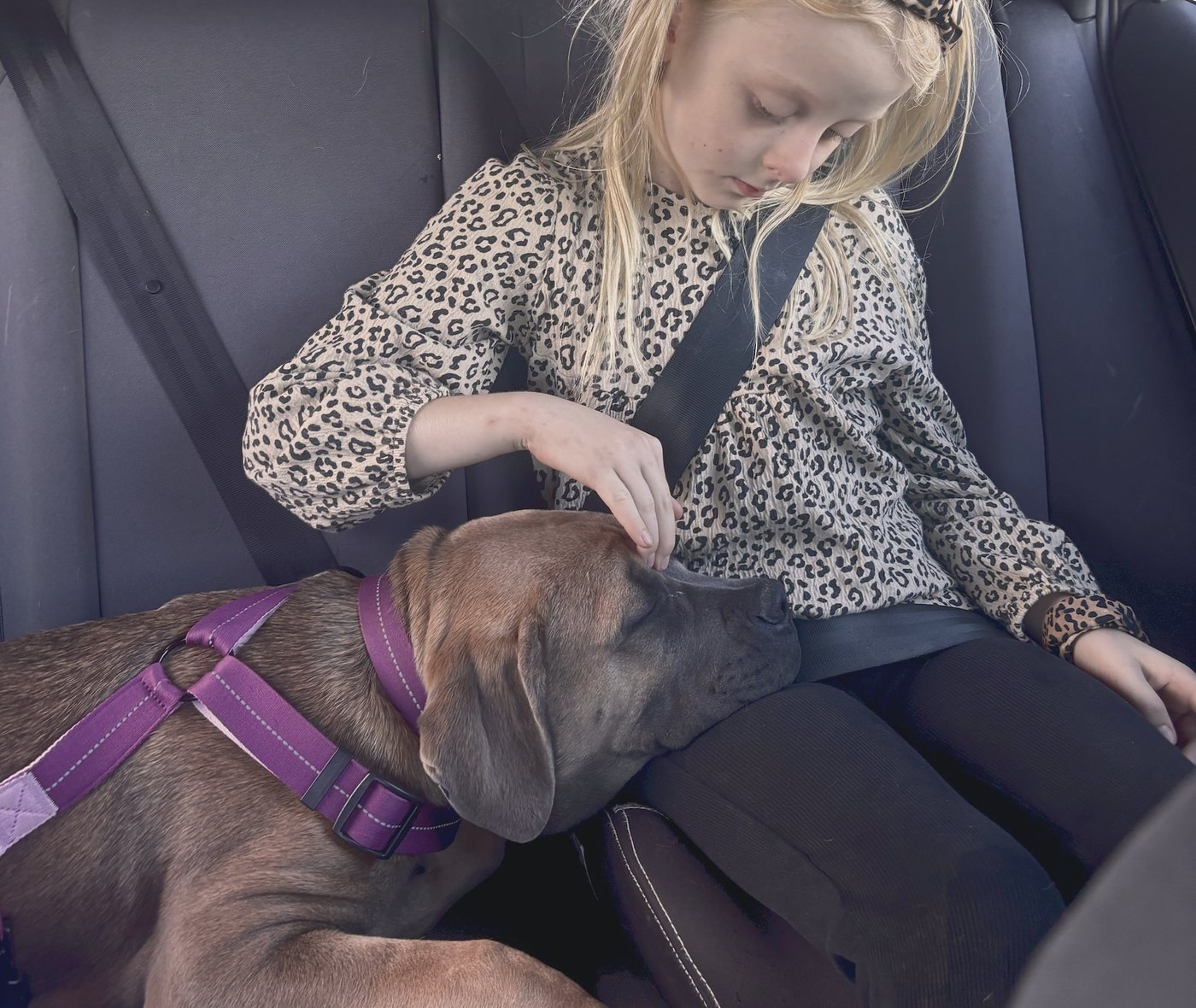
A litter of eight leaves as eight individuals and arrives, two years later, as eight dogs shaped by eight different lives. One lives with small children and a second dog; one is alone for six hours a day; one has had two trainers and a reactivity course; one belongs to somebody who finds growling funny. Any of these differences can produce behavior that looks like temperament. This is not a reason to give up on behavior follow-up, but it is a reason to be modest about what a single litter can show.
What survives the noise is repetition. A trait that appears in three offspring of one sire across two different litters, in homes with nothing in common, is worth attention in a way that the same trait in two littermates raised together is not. The method therefore runs across litters and across time, not within a single cohort, and it needs several years of data before it says anything at all.
It also helps to separate what you are asking about. Fearfulness toward unfamiliar people, noise sensitivity, dog-directed aggression, trainability, separation-related behavior and prey interest are different things with different developmental histories. Lumping them into a judgment about whether a dog has good or bad temperament destroys most of the information. The distinctions that matter in your own breed are the subject of temperament and working ability.
What research says about stability
The useful starting point is how consistent dog behavior is over time at all. A meta-analysis of 31 studies and 822 effect sizes found moderate consistency overall, with a weighted mean correlation of 0.43. Consistency was higher in adults, around 0.51, than in puppies, around 0.30. Shorter intervals between assessments gave higher correlations, but the effect was small, explaining roughly two percent of the variance; among adults, correlations fell from about 0.60 at intervals under ten weeks to about 0.32 beyond twenty-four weeks.
Two findings from that analysis matter directly for follow-up. First, dogs assessed as puppies and reassessed as adults were about as consistent as puppies reassessed as puppies, which the authors took as reason to reconsider the blanket claim that puppy tests do not work; consistency varied considerably by trait. The nuances are covered in puppy test predictive validity. Second, and most relevant in practice, consistency was much higher when the same assessment was used at both time points, 0.49, than when different assessments were used, 0.27. If you want to compare a dog at eight weeks with the same dog at three years, you have to ask comparable questions.
What this does not mean is that behavior is fixed. Moderate consistency means genuinely moderate: a dog’s relative position on a trait tends to persist, while the absolute expression can change substantially with age, training and experience.
Questions that produce usable answers
Ask about situations and frequencies rather than labels. “Is he nervous?” produces an owner’s summary. “In the last month, how often has he barked or backed away when a stranger approached him on a walk, and what did you do?” produces something you can compare with the answer from the next home. Anchor questions in observable behavior, a defined recent period, and a specific context, and avoid any wording that signals which answer you would prefer.
This is the logic behind validated owner questionnaires. The Canine Behavioral Assessment and Research Questionnaire, developed at the University of Pennsylvania, exists to give owners and professionals standardized evaluations of temperament and behavior, and it is used by working dog organizations, veterinary behaviorists, researchers, shelters and breed groups. You do not have to adopt a formal instrument, but borrowing its approach — many narrow, behaviorally anchored items instead of a few broad judgments — improves what you get back.
Three contexts are worth asking about every time, because owners rarely volunteer them: behavior when left alone, behavior toward unfamiliar dogs and people in the dog’s own home, and behavior during handling, including at the veterinary practice. These are the situations where problems concentrate, and the ones owners are most likely to have normalized.
In practice
A breeder has recorded the same eleven behavior questions at one year and at three years for four litters, twenty-nine dogs in total. Reading across the sire columns, one dog’s offspring stand out: five of nine report backing away or barking at unfamiliar people in the first question set, against three of twenty in the rest of the material. The breeder resists the obvious conclusion, because the five include three littermates from a single litter raised in two neighboring households, and because one of the two homes reported almost no outings in the dog’s first six months. What the breeder does instead is note it formally, ask the breed club whether other breeders using the same sire have seen anything comparable, and plan to keep one offspring from his next litter under direct observation.
(Illustrative, composite scenario.)
Formal instruments and official results
Standardized behavior tests and working trials give you something owner reports cannot: the same situations, assessed by someone who did not breed the dog. Several countries run organized schemes, from armed forces and working dog assessments to kennel club behavior descriptions, and participation in them is one of the few ways a breeder gets independent data. Their value for breeding has been studied directly. Analysis of 873 German shepherd dogs assessed in the Swedish Armed Forces temperament test estimated heritabilities between 0.00 and 0.28 across 38 test items and eight behavioral dimensions, concluding that the test as a whole can be used for breeding selection while some individual items would need to be measured differently to be genetically useful.
Those numbers are the realistic picture of behavior genetics in dogs: real, measurable, and modest. A heritability in that range means most of the variation you see between individuals is not additive genetic variation, that selection will move a population slowly, and that no single offspring’s test result tells you much about its parents.
If you want answers you can compare across litters, a validated questionnaire helps. The University of Pennsylvania’s C-BARQ takes owners about 15 minutes and scores 14 areas of behavior, including fear, aggression toward strangers and dogs, separation-related behavior and trainability. Some breeders and breed clubs already ask buyers to complete it one to two years after the puppy goes home, which also gives you the same instrument at the same age — the condition under which consistency in the research was highest.
Competition results carry an additional problem. They exist only for the offspring somebody chose to enter and continued to enter, which is a selected group twice over. A sire with four titled working offspring may have produced forty, and the thirty-six who never competed are part of what he produces. Treat official results as high-quality data about a biased sample, and ask separately what the untitled offspring are like in ordinary life.

When a signal is worth acting on
A reasonable threshold is repetition across independent contexts. One affected offspring is an individual. Two littermates are usually a household. The same pattern in offspring from different litters, different homes and different co-parents is the first point at which a breeding-relevant signal exists, and even then the alternative explanations deserve a hearing before the hypothesis does.
Severity changes the calculation. Behavior that endangers people, or that makes a dog’s life materially worse, warrants a cautious response on fewer cases than a mild quirk does, because the cost of waiting for confirmation is borne by dogs and their families. Caution here usually means restricting a combination or a line while you gather more information, not announcing a conclusion.
When an owner reports a sudden change — a previously friendly dog that now growls when touched, new fears, or house soiling in an adult — the first step is a vet visit, not a breeding conclusion. Veterinary behavior guidelines ask vets to rule out medical causes, including pain, before treating a behavior problem. Aggression, bites that break the skin, self-injury and severe phobias should be seen by a veterinarian, who may refer the dog to a veterinary behaviorist; they are not problems to hand to a trainer alone. Record what the vet found alongside the owner’s report.
Scale remains the limit. Across all your litters you may have forty offspring, and forty dogs cannot establish a rate for anything. The breed’s aggregated data, where behavior is recorded at all, is where patterns become measurable, which is a further argument for participating in whatever organized assessment your breed and country offer.
Your socialization is being evaluated too
The uncomfortable part of behavior follow-up is that your own work is in the results. The weeks the puppies spent with you fall inside the period that veterinary behavior guidance treats as decisive: the American Veterinary Society of Animal Behavior’s position is that the first three months of life are the primary and most important period for socialization, and that puppies should meet many new people, animals, environments and stimuli during it, safely and without overwhelming them. Most of that window is yours.
So when an adult offspring is unusually fearful of novelty, there are at least three candidate explanations, and your breeding is only one of them. The second is what you did or did not expose the litter to before eight weeks. The third is what the home did afterward. A breeder who records their own socialization program litter by litter can at least distinguish the first two over time, which is a good reason to document it as carefully as you document weights. What the exposure was, and what it is for, is covered in behavior development and differences between puppies in a litter.
When to call your vet or a veterinary behaviorist
- An offspring shows aggression toward people or other dogs, or has bitten.
- A dog’s behavior changes suddenly in adulthood (new fear, irritability when handled, house soiling, restlessness at night) — pain or illness can be the cause.
- A dog injures itself when left alone, or panics to the point of escaping or destroying doors.
- Fear is severe enough that the dog cannot cope with walks, visitors or vet visits.
- An owner has tried training help and the problem is not improving.
- If in doubt, call — your vet would rather hear from you early.
Work on it
A few minutes here will teach you more than re-reading the article.
Ask yourself
- Do you ask every home the same behavior questions, at the same ages, in the same words?
- When you last saw a worrying trait in an offspring, how many independent homes and litters did it appear in?
- Have you written down what your litters were exposed to, in enough detail to compare one litter with another?
Find out & check
- Find out which standardized behavior tests or descriptions are available for your breed in your country, at what ages, and whether the results are published.
Do one thing
- Rewrite one of your current behavior questions so that it names a situation and a time period instead of a trait.
Was this article helpful?
Anonymous. We do not store your name, email or IP address.
Sources & further reading
- Fratkin, Sinn, Patall & Gosling — Personality consistency in dogs: a meta-analysis. journals.plos.org
- University of Pennsylvania School of Veterinary Medicine — About the C-BARQ. vetapps.vet.upenn.edu
- Swedish University of Agricultural Sciences — The Swedish Armed Forces temperament test gives information on genetic differences among dogs. research.slu.se
- American Veterinary Society of Animal Behavior — Position Statement on Puppy Socialization. avsab.org
- American Animal Hospital Association — 2015 AAHA Canine and Feline Behavior Management Guidelines. aaha.org
- Hsu Y, Serpell JA (2003) — Development and validation of a questionnaire for measuring behavior and temperament traits in pet dogs, Journal of the American Veterinary Medical Association 223(9):1293–1300. PubMed
Where evidence is limited, recommendations rest on established practice and expert judgment, and may be updated as knowledge develops. Behavior follow-up by breeders has not itself been studied: the consistency and heritability figures quoted come from research populations and standardized assessments, not from owner reports gathered across scattered homes, and the thresholds suggested here for when a pattern deserves action are judgment rather than evidence.
Next steps
- Read next: Tracking conformation and working results.
- Related: Puppy tests and predictive validity.
- Return to the area hub: Closing the loop: follow-up and the next generation.