House-training is less about teaching a rule than about making sure your puppy is in the right place at the right time, again and again, until going there is simply what it does.
The most important first
- Take your puppy out first thing in the morning, last thing at night, and after every nap, meal, drink and play session — young puppies may need to go a dozen or more times a day.
- Go with it, to the same spot, and reward it the moment it finishes, with quiet praise and a small treat.
- Never punish accidents. Punishment teaches a puppy to hide from you when it needs to go, not to go outside. Clean the spot with an enzyme cleaner and take it out more often.
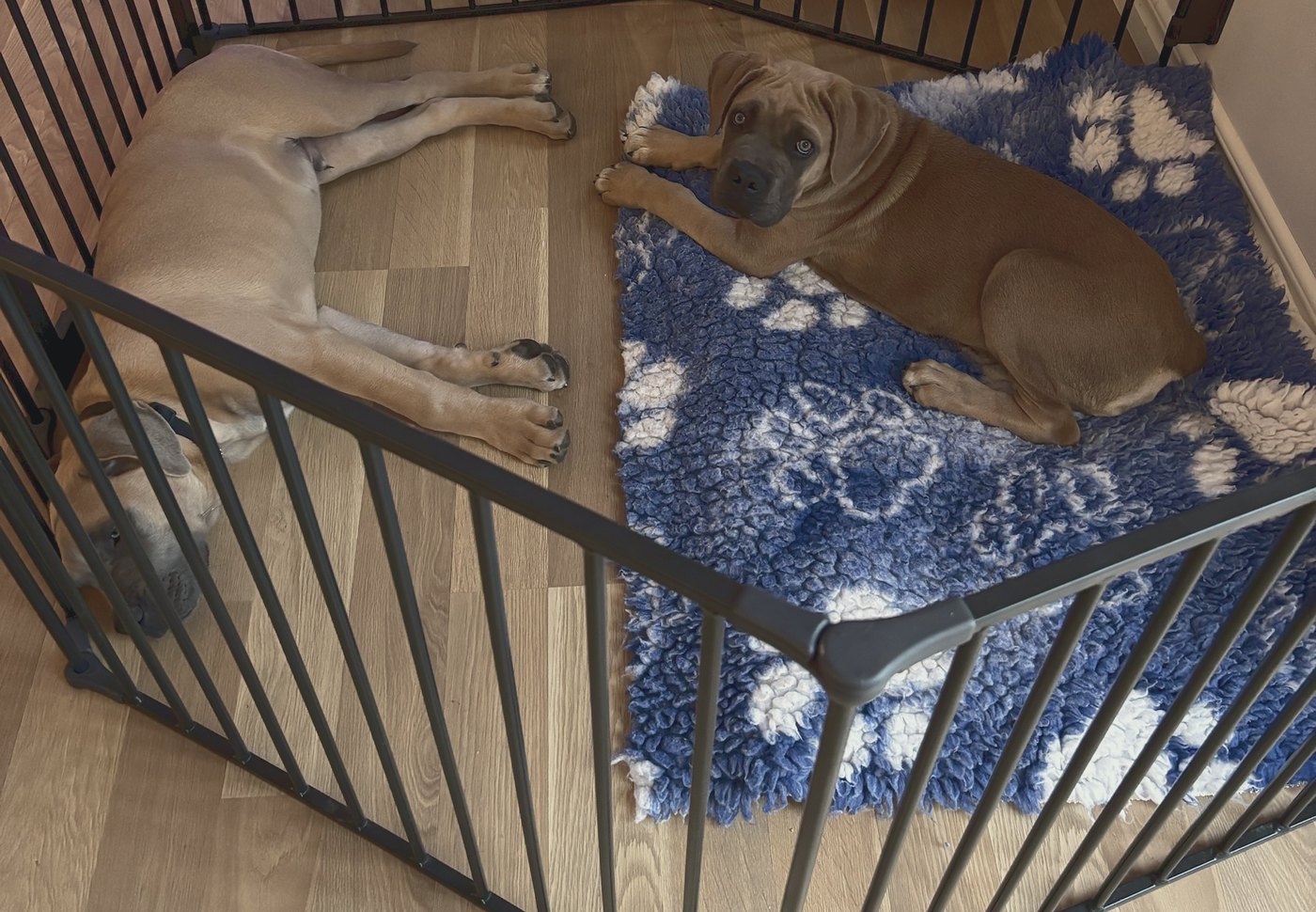
- Supervise or confine: when you cannot watch your puppy, it should be in its crate or pen, so it has no chance to go in the wrong place.
- Expect setbacks, especially around puberty, and call your veterinarian if accidents keep happening despite a good routine, or suddenly return after a dog was reliable.
Why routine does the teaching
Your breeder has probably already started: many litters learn to leave their sleeping area to go to the toilet. That instinct — most dogs avoid soiling where they sleep — is what house-training builds on. Your job is to make the right spot easy and the wrong spots impossible, for long enough that the habit sticks. The American Kennel Club recommends starting on the day your puppy comes home. Consistency matters more than any method: the same spot, the same word, the same routine, from everyone in the house.
When to take your puppy out
- First thing in the morning, before anything else.
- Within a few minutes of waking from every nap.
- After every meal and every big drink.
- After play, chewing and excitement, such as visitors arriving.
- Last thing before bed.
- Whenever you see the signs: sniffing the floor, circling, suddenly stopping play, whining or going to the door.
The San Francisco SPCA advises that puppies of eight to ten weeks usually need to go out at least once an hour while they are awake. The AKC describes a common rule of thumb that a puppy can wait roughly as many hours as its age in months, up to about nine months to a year — so a two-month-old for about two hours — but stresses that individual puppies vary. Treat it as an upper limit for quiet time, not a guide to the minutes after a meal or a game.
How to do it
Take your puppy on a leash to the same spot every time, and stand quietly. Pick a word, such as “go potty”, and say it as the puppy starts to go. The moment it finishes, praise it calmly and give it a small treat right there, not when you are back inside. Dogs Victoria advises keeping toilet trips calm and play-free, so the puppy learns that going is what earns the reward. The RSPCA adds a useful trick: after the puppy has gone, stay out a little longer for a sniff or a game, so it does not learn that going to the toilet ends its time outside. The SF SPCA suggests keeping treats for every success for the first few weeks before moving to praise alone.
Supervise, or confine
Most accidents happen when nobody is watching. Until your puppy is reliable, it should either be within sight or in its crate or pen. A crate should be big enough for the puppy to stand, turn and lie down, but not so big that it can use one end as a toilet. The SF SPCA suggests giving more freedom gradually: after two to three weeks without accidents, open up one more room at a time, still under supervision. If accidents start again, go back a step for a couple of weeks.
Accidents happen
Every puppy has accidents. If you catch it in the act, interrupt calmly — no shouting — carry it to the right spot and praise it if it finishes there. If you find an accident afterward, just clean it up: the puppy will not connect a scolding to something it did earlier. Dogs Victoria is direct about it: never hit a puppy, rub its nose in the mess, or yell at it. The RSPCA explains why: punishment does not teach a puppy where to go, only that going in front of you is risky, and it may learn to hide. Clean the spot with an enzyme cleaner, because some ordinary cleaners leave a smell that draws the puppy back. Then ask what you could have done differently — usually, take it out sooner.
In practice
A family finds a puddle on the living-room rug every afternoon. They write down every toilet trip and accident for three days and see the pattern: the accidents come twenty minutes after the children get home and play with the puppy. They add a toilet trip straight after the first game, and the afternoon accidents stop within a week.
(Illustrative scenario · Details changed.)
At night
Young puppies cannot last the whole night at first. Take your puppy out last thing before bed and keep the crate or pen near you, so you hear it when it wakes. Dogs Victoria suggests that you may need to set an alarm for a trip in the early hours during the first weeks. Keep night trips quiet and dull: out, toilet, praise, back to bed. Skip exciting games and large drinks of water just before bedtime. As the puppy grows, the gap between night trips will lengthen on its own.
Pads, paper and apartments
Puppy pads and newspaper can help if you live high up or cannot get outside quickly, but they teach the puppy that going indoors is sometimes fine, which Dogs Victoria notes usually makes reliable training take longer. If you need an indoor or balcony toilet, choose one place, use something that feels different from your floors, and move it gradually toward the door if you plan to switch to outdoors later. Whatever you choose, keep it in the same place.
How long it takes, and when to ask for help
Some puppies learn within weeks; others take months. Dogs Victoria says most puppies are fairly reliable by six to seven months, with smaller breeds often taking longer, and warns that setbacks are common around puberty, when many bitches have their first season and many males start marking. If your puppy keeps having accidents despite a consistent routine and good supervision, or a puppy that was reliable starts having accidents again, the AKC and RSPCA both advise a veterinary check first, because a urinary infection or another medical problem can be the cause. If your veterinarian finds nothing, a qualified reward-based trainer can help you find what is missing. The breeder’s side of house-training, from the whelping box onward, is in house-training and daily routines.
Work on it
A few minutes here will teach you more than re-reading the article.
Ask yourself
- Do I take my puppy out after every nap, meal and game, or only when I remember?
- When my puppy has an accident, what happened in the half hour before it?
- Does everyone at home use the same spot, the same word and the same reward?
Find out & check
- Keep a simple log for three days of every toilet trip and accident, with the time, and look for the pattern.
Do one thing
- Put a jar of small treats by the door you use for toilet trips, so you always have a reward ready.
Was this article helpful?
Anonymous. We do not store your name, email or IP address.
Sources & further reading
- American Kennel Club (Mara Bovsun) — How to Potty Train a Puppy. akc.org
- San Francisco SPCA — House-Training Your Puppy. sfspca.org
- Dogs Victoria (ANKC) — Toilet Training Your Puppy. dogsvictoria.org.au
- RSPCA (England and Wales) — Toilet training your dog. rspca.org.uk
- PDSA — Your first day (and night) with a new puppy. pdsa.org.uk
- American Animal Hospital Association (Bartges J et al.) — 2012 AAHA Canine Life Stage Guidelines. J Am Anim Hosp Assoc 48:1–11. aaha.org
Where evidence is limited, recommendations rest on established practice and expert judgment, and may be updated as knowledge develops. If accidents continue despite a consistent routine, or start again after your puppy was reliable, ask your veterinarian to check for a medical cause. This is general information and does not replace advice from your veterinarian.
Next steps
- Read next: The first day and the first week with your puppy.
- Related: Before your puppy comes home.
- Related: When to call the vet: warning signs in a young puppy.
How we choose sources, date reviews and correct mistakes: How we research and review →