Puppies become much easier to place, and far easier to be honest about, once you stop asking which of four labels each one is and start asking where it sits on several separate dimensions — because the dimensions are what actually vary, and a label conceals how much of it is still moving.
The most important first
- Score dimensions separately rather than assigning a type: boldness, sociability, sensitivity, activity and persistence can combine in any pattern, and a puppy can be bold and sensitive at the same time.
- Large-scale behavior-test data support a dimensional picture — 15,329 dogs of 164 breeds produced five narrow traits (playfulness, curiosity/fearlessness, chase-proneness, sociability and aggressiveness) plus a broad shyness–boldness factor covering all but aggressiveness.
- Heritability is real and does not make early measures predictive: a test of 630 German shepherd puppies at eight weeks yielded medium-high to high heritability for the tested traits, yet correspondence with performance at 450 to 600 days was negligible.
- Stability differs by trait. Pooling puppy studies, aggression (r = 0.51) and submissiveness (r = 0.43) held together better than fearfulness (r = 0.24) and responsiveness to training (r = 0.16).
- Individual variation within a litter is large, and most of what you can say at eight weeks is about the puppy now — the limits of testing it formally are covered in puppy aptitude tests and their limits.
Dimensions, not labels
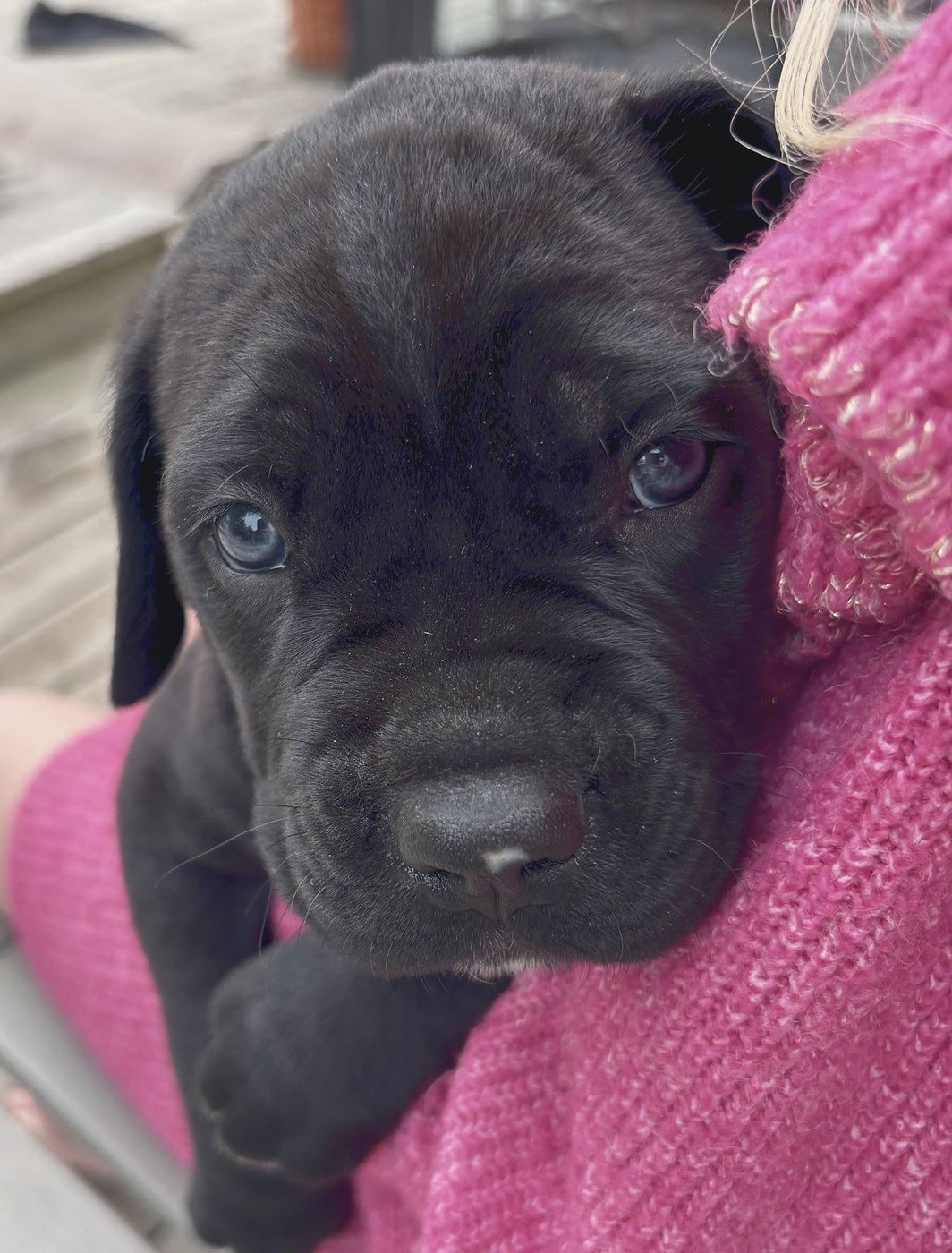
The language most breeders inherit is typological: the bold one, the shy one, the pushy one, the thinker. It is memorable and it loses most of the information. A puppy that approaches a stranger quickly and a puppy that recovers quickly from a dropped bowl are not showing you the same thing, and the two often come apart.
It is more useful to keep five or so axes and to score each separately. Boldness, meaning readiness to approach and investigate something unfamiliar. Sociability, meaning interest in people and in other dogs, which is not the same axis. Sensitivity, meaning how much stimulus it takes to produce a reaction — to noise, touch, surfaces, movement. Activity, meaning how much the puppy does per hour and how readily it stops. Persistence, meaning how long it keeps working at something that is not immediately solved, which is the axis most visible in frustration tolerance and problem-solving.
The research broadly supports splitting things up this way. Analysis of Swedish behavior-test records from 15,329 dogs of 164 breeds identified five narrow traits — playfulness, curiosity/fearlessness, chase-proneness, sociability and aggressiveness — and found a broad factor influencing behavior across situations, comparable to the shyness–boldness axis described in other species, to which every trait except aggressiveness contributed. The same structure appeared within eight of the Fédération Cynologique Internationale’s ten breed groups, which suggests these are general features of dogs rather than descriptions of particular breeds. Note what that also means: aggressiveness sat outside the general axis, so a bold puppy is not thereby a more aggressive one.
Where the differences come from
Temperament is heritable, and breed exists for a reason: generations of selection have shifted the average position of populations along these axes, which is why a breed’s typical behavior is a legitimate thing to breed for and to warn buyers about.
The part that gets skipped is how much room is left over. Averages describe populations; puppies are individuals, and the spread within a single well-bred litter is routinely wide enough that two littermates suit genuinely different households. Effects that have nothing to do with the puppies’ own genotypes also show up in early measurements: the eight-week German shepherd test found maternal effects on its results, and in one small study of 105 seven-week-old puppies, described by its authors as preliminary, litter size was associated with social attraction and following scores, puppies from smaller litters doing better on tasks involving people. Your dam’s behavior, her experience, her litter size and your own management are all inside what you are measuring.
Then there is everything still to come. Behavior keeps developing through adolescence and is not fully settled until social maturity, often between one and three years, and the experience a puppy accumulates in its new home will move it along most of these axes. That is the honest reason a good early read is not a forecast.
How stable early traits really are
Be plain about this with buyers and with yourself. The meta-analysis of 31 studies and 822 effect estimates found overall consistency of r = 0.43 across dog personality measures, but that pooled figure hides a developmental split: r = 0.30 in puppies against r = 0.51 in adults. Consistency also fell as the interval lengthened — in adults, r = 0.60 for gaps under ten weeks against r = 0.32 for gaps over twenty-four weeks.
Within puppyhood, the traits are not equally stable. Aggression was the most consistent measure in puppies (r = 0.51), followed by submissiveness (r = 0.43), while responsiveness to training (r = 0.16) and fearfulness (r = 0.24) were the least. That ordering is worth carrying around, because it is almost the reverse of what breeders usually feel most confident predicting. The puppy you are surest will be easy to train, and the puppy you have written off as timid, are the two calls most likely to be wrong.
The prediction studies point the same way. The eight-week German shepherd test produced medium-high to high heritability estimates and negligible correspondence with adult working performance — a demonstration that heritable and predictable are different properties. A study of Border collies adds a further example: of ten traits measured at 40 to 50 days, only exploration showed a clear link to behavior at a year and a half to two years.
A puppy’s behavior keeps developing well after it leaves you, and veterinary references stress that developmental ages are guidelines, not fixed dates. Individual dogs within a breed also differ about as much as breeds differ from each other. Your breed’s reputation is a starting point, and the puppy in front of you is the evidence.
In practice
A breeder describes a litter to waiting buyers using four words — bold, steady, busy, soft — and finds every conversation turning into an argument about which family deserves the steady one. For the next litter the breeder scores five axes weekly instead, and discovers that the puppy she would have called soft is the one with the highest persistence and the lowest sociability with strangers. It goes to a quiet single-person household with an interest in scentwork rather than being passed over as the shy one, and the word “soft” is not used.
(Illustrative, composite scenario.)
Describing a puppy without overselling it
If early measures are weakly predictive, the responsible move is to change what you claim rather than to stop observing. Three things are defensible. What this puppy did repeatedly, with dates. What it has and has not yet encountered. And what its current position on each axis implies about the support it will need in the first six months — a highly sensitive puppy needs a quieter introduction to the world, a high-activity puppy needs a household that can supply structured outlets, a low-persistence puppy needs training broken into smaller pieces.
What is not defensible is a promise: this one will be good with children, this one will make a competition dog, this one will never be reactive. Those are claims about a dog at three years old made from data gathered at eight weeks, and the consistency figures do not support them. Say instead what you saw and what you would watch for. Buyers accept that better than breeders expect, and it is the version you can stand behind if a dog turns out differently — which is also why the material in fear, recovery and building resilience belongs in the handover conversation rather than in a label.
Sensitivity is not a fault, but a sensitive puppy needs a home that will go at its pace. Tell buyers what the puppy finds hard. If it becomes more fearful after it goes home, rather than less, they should talk to their veterinarian early instead of waiting for it to grow out of it.
Not every difference is temperament. Extreme or persistent fear, real aggression in a young puppy, or a puppy that is quiet because it is unwell all need a vet’s view first. Rule out pain or illness before you describe a puppy as shy or placid.
Work on it
A few minutes here will teach you more than re-reading the article.
Ask yourself
- Am I describing these puppies with types, or with separate scores on things I have actually watched?
- Which puppy in this litter am I most confident about, and which of the least stable traits is that confidence built on?
- Have I distinguished what is typical of my breed from what is true of this individual puppy?
Find out & check
- Find out whether your breed’s national club or registry runs a standardized behavior or temperament assessment, at what age, and what it measures.
Do one thing
- Score every puppy in your current litter from one to five on boldness, sociability, sensitivity, activity and persistence today, and date it — then do it again next week without looking at this week’s sheet.
Was this article helpful?
Anonymous. We do not store your name, email or IP address.
Sources & further reading
- Svartberg, K. & Forkman, B., Applied Animal Behaviour Science 2002;79(2):133–155 — Personality traits in the domestic dog (Canis familiaris). sciencedirect.com
- Fratkin, J. L. et al., PLOS ONE 2013;8(1):e54907 — Personality Consistency in Dogs: A Meta-Analysis. journals.plos.org
- Wilsson, E. & Sundgren, P.-E., Applied Animal Behaviour Science 1998;58(1–2):151–162 — Behaviour test for eight-week old puppies: heritabilities of tested behaviour traits and its correspondence to later behaviour. sciencedirect.com
- Riemer, S. et al., PLOS ONE 2014;9(7):e101237 — The Predictive Value of Early Behavioural Assessments in Pet Dogs – A Longitudinal Study from Neonates to Adults. journals.plos.org
- Alberghina, D. et al., PLOS ONE 2020;15(7):e0236271 — Behavior test for seven-week old puppies. journals.plos.org
- Merck Veterinary Manual — Social Behavior of Dogs. merckvetmanual.com
- American Veterinary Society of Animal Behavior — Position Statement on the Use of Dominance Theory in Behavior Modification of Animals. avsab.org
Where evidence is limited, recommendations rest on established practice and expert judgment, and may be updated as knowledge develops. Heritability estimates and consistency coefficients describe populations and averages; they do not predict the adult behavior of any individual puppy.
Next steps
- Read next: Puppy aptitude tests and their limits.
- Related: Observing and documenting individual puppies.
- Return to the area hub: Understanding and placing each puppy.