You don’t need a genetics degree to breed responsibly, but you do need the handful of concepts that make DNA test results, pedigrees and breeding advice actually make sense. This guide covers the essential vocabulary and ideas — genes, alleles, genotype and phenotype — as a breeder needs them, not as a textbook would present them.
The most important first
- A gene is an instruction; an allele is one version of that instruction.
- Genotype is what’s in the DNA; phenotype is what you can see or measure.
- Two dogs can look alike (same phenotype) but carry different genes (different genotype).
- Most breeding-relevant traits involve many genes, not one.
- These basics are what make DNA test reports and pedigrees interpretable.
Genes and alleles
A gene is a specific instruction, located at a specific place in the DNA, for one part of how a dog is built or functions — coat color, a particular protein, susceptibility to a specific disease. Most genes come in more than one version, called alleles, inherited one copy from each parent. Which combination of alleles a dog carries at a given gene is its genotype for that gene; what actually shows up in the dog — the coat color you see, whether a disease develops — is its phenotype. The relationship between the two is not always simple: some alleles are dominant and mask the other copy, some are recessive and only show when paired with another copy of the same allele, and for many traits, environment and other genes influence the outcome too.
Dogs have 78 chromosomes, in 38 matching pairs plus the X and Y sex chromosomes. Each puppy gets one set from its sire and one from its dam, so it carries two copies of almost every gene.
Why genotype and phenotype can disagree
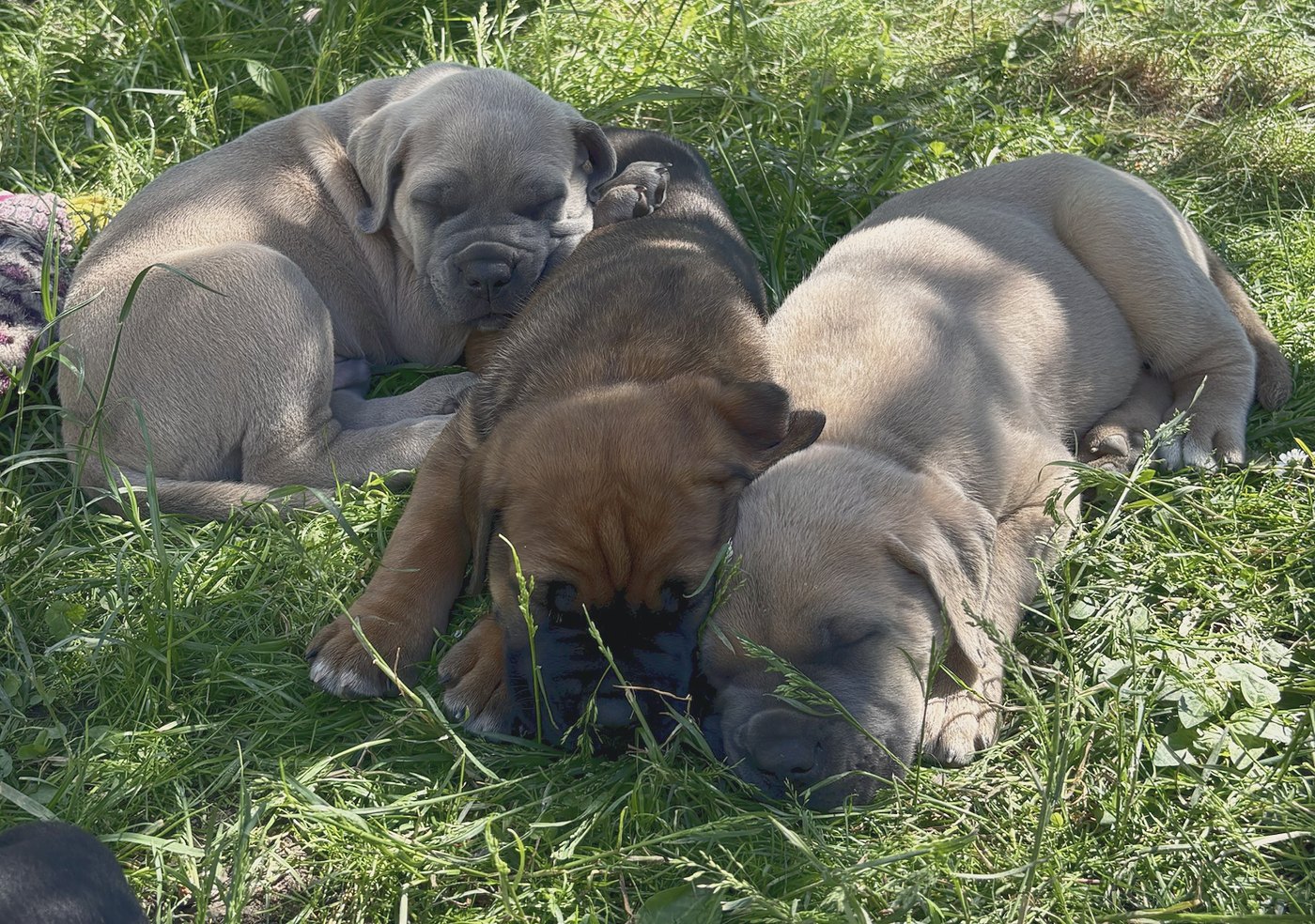
The gap between genotype and phenotype is where a lot of breeding confusion lives. A dog can look completely normal — a healthy phenotype — while carrying one copy of a recessive disease allele it will never show symptoms of, but can pass to puppies. Two dogs that look alike can carry different genes underneath, and two full siblings can inherit quite different combinations from the same parents, because each parent passes on only one of their two copies at each gene, effectively at random. This is precisely why DNA testing exists: it reads the genotype directly, rather than inferring it from what you can see.
The odds apply to each puppy, not to the litter. A carrier-to-carrier mating gives every puppy the same one-in-four chance of being affected, so a litter can have none, or several.
In practice
A breeder’s stud dog is a picture of health and has never shown any sign of a disease known in the breed. A DNA test reveals he’s a carrier of a recessive form of it — invisible in his own phenotype, but relevant to every mating he’s used in. Nothing about how he looks would ever have told the breeder that.
(Illustrative, composite scenario.)
Not every condition is recessive
Most DNA results breeders see are for recessive conditions, where a dog needs two copies to be affected. Some conditions are dominant, so a single copy is enough and there are no hidden carriers — and “dominant” does not mean common or desirable. Others sit on the X chromosome, so males and females inherit them differently. A few tests report “risk” rather than a yes or no, because not every dog with the variant becomes ill. Always check which pattern applies before you interpret a result.

Most traits involve more than one gene
It’s tempting to think of traits as switches — a dog either has the gene for something or doesn’t — because that’s how the simplest single-gene diseases work. But most of what breeders actually care about — height, structure, temperament traits, and many common health conditions — are shaped by multiple genes acting together, often alongside environment and chance. That’s the subject of the next guide on polygenic and complex traits, but it’s worth knowing from the start: a clean single-gene DNA test result answers a specific, narrow question, not “will this trait or disease appear?” in general.
Work on it
A few minutes here will teach you more than re-reading the article.
Ask yourself
- Could I explain the difference between genotype and phenotype to someone new to breeding?
- Do I understand why a healthy-looking dog can still carry a disease allele?
- Am I clear on which of my breed’s traits are single-gene and which are polygenic?
Find out & check
- Find out which single-gene traits or diseases have known genotype–phenotype relationships in your breed.
- Check a DNA test report you have on file and confirm you understand exactly what genotype it reports.
Do one thing
- Write, in your own words, a two-sentence explanation of genotype versus phenotype you could give a new puppy buyer.
Was this article helpful?
Anonymous. We do not store your name, email or IP address.
Sources & further reading
- American Kennel Club (Claire Wiley, VMD, DACVIM) — Understanding Genetic Modes of Inheritance: an Introduction. akc.org
- VCA Animal Hospitals — Genetics Basics: Modes of Inheritance. vcahospitals.com
- PennGen, University of Pennsylvania School of Veterinary Medicine — Genetics for Breeders. vet.upenn.edu
- American Kennel Club (Matthew Breen, PhD) — Canine Genetics for Dog Breeders: Part 1. akc.org
- UC Davis School of Veterinary Medicine — What Genetic Testing Can and Can’t Tell You About Your Pet. synergy.vetmed.ucdavis.edu
- The Royal Kennel Club — Breeding advice for DNA test results. royalkennelclub.com
Where evidence is limited, recommendations rest on established practice and expert judgment, and may be updated as knowledge develops.
Next steps
- Read next: Modes of inheritance: dominant, recessive and sex-linked.
- Related: Pedigree and family analysis · Understanding Canine Genetics: A Beginner’s Guide for Breeders.
- Return to the area hub: Genetics and inherited health.