The research on dog bites keeps pointing at the same place: not the strange dog in the park, but the family dog at home, with a child nearby and no adult watching — which means the breeder, who meets every family before the puppy moves in, is in an unusually good position to prevent bites.
The most important first
- Most bites to children come from a dog they know. In one UK emergency department study, about 80% were from familiar dogs and most happened indoors.
- Supervision is active, not just “being in the house.” Never leave a young child alone with any dog, including a puppy.
- Give the puppy a place no one disturbs — its bed, crate and food bowl are off limits to children.
- Teach the family to read early warning signs, so they step in before a growl or snap.
- Your part starts in the litter: varied handling, calm routines and careful matching of puppy to home.
Last updated: November 8, 2026
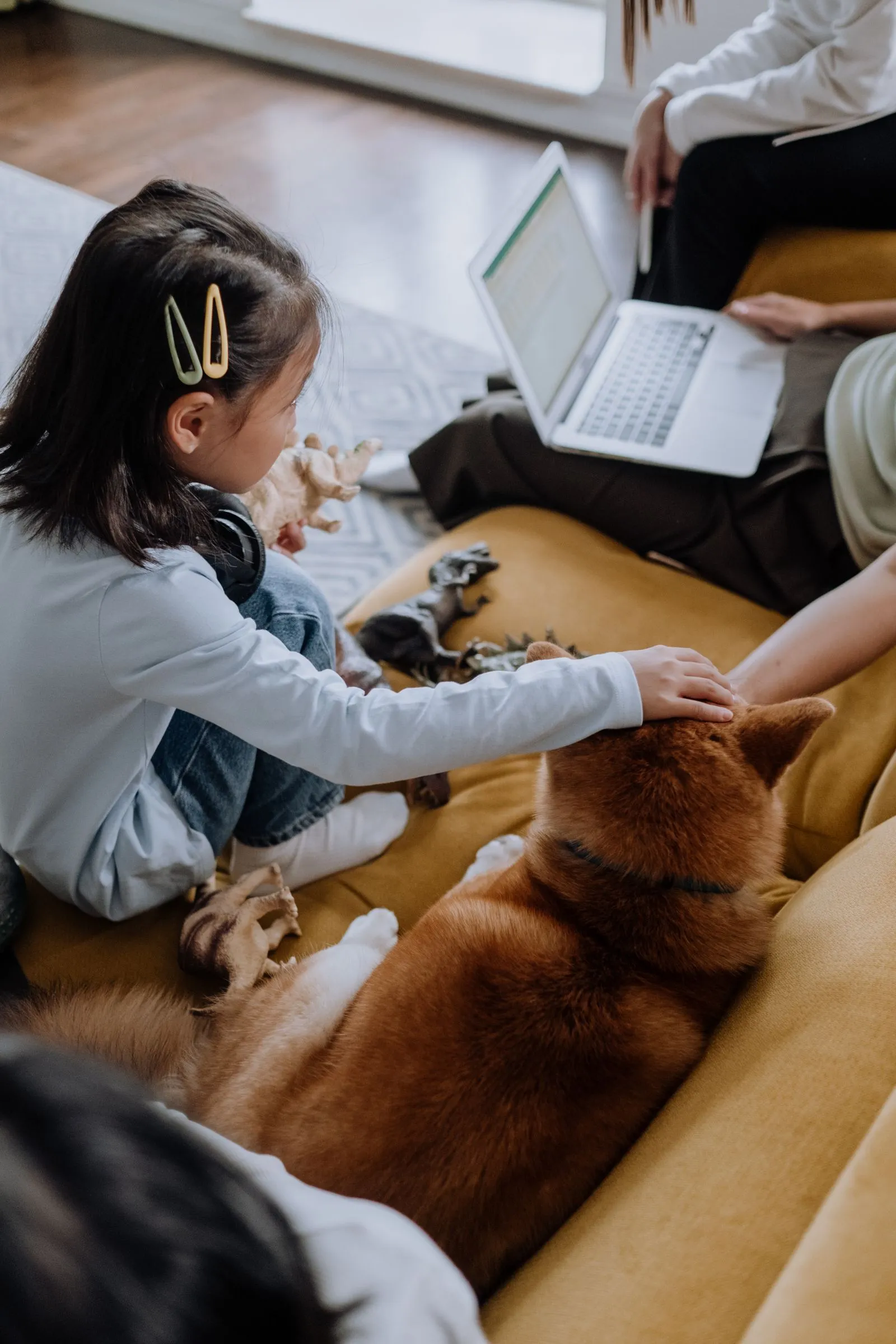
What the evidence says about who gets bitten
The American Veterinary Medical Association (AVMA) notes that about half of dog bite victims in the United States are children, and that any dog can bite. AVMA marks National Dog Bite Prevention Week in the second full week of April, a natural moment to share advice with your puppy buyers.
Where bites happen is just as telling. In a 2025 review of 172 children treated for dog bites at an emergency department in Blackpool, England, Maduemem and colleagues found that 76.7% of injuries happened indoors, 79.7% were caused by a dog the child knew, and 51.2% involved the face. A clear provocation was recorded before 44.2% of the bites.
Population studies add useful nuance. In a 2018 community survey in northwest England, Westgarth, Brooke and Christley found that 24.78% of respondents had been bitten at some point in their lives, and that more than half of bites (54.7%) came from a dog the person had never met. Adults and children are bitten in different settings, so for families with young children the home deserves the most attention.
What children and adults are doing at the time matters too. In a 2026 survey of dog owners in Thailand, Wongtawan and colleagues found that bite and scratch injuries were associated with activities such as grooming or medicating a dog, taking away food or toys, breaking up fights and hugging or kissing the dog. Many of these are exactly the things children love to do.
In practice
A breeder places a calm eight-week-old puppy with a family of four. At the home visit she notices the toddler following the puppy into its crate. She shows the parents how to put a baby gate across the corner where the crate stands and suggests a simple rule: “When the puppy goes to bed, we leave it alone.” Three months later, the parents tell her the gate is the most useful thing they own.
(Illustrative, composite scenario.)
What breeders can influence before the puppy leaves
A 2023 evidence review by Baslington-Davies and colleagues looked at early-life experiences linked to human-directed aggression in adult dogs. Factors that came up included where the dog came from, the age at rehoming, the reason it was acquired, the owner’s experience, socialisation, consistent husbandry and management, training, litter sex ratio and a history of aggression in the pedigree. The authors concluded that early experiences that limit a dog’s ability to develop effective coping strategies and routines may be especially important. The evidence is uneven, but several of those factors are in the breeder’s hands:
- Socialisation and handling. Gentle, varied handling and calm exposure to everyday sights and sounds — see early learning and first training.
- Breeding choices. Temperament belongs in your breeding goals alongside health and conformation.
- Matching. A boisterous puppy and a family with a toddler and little time is a hard combination. See matching each puppy to the right home.
- Asking the right questions. Find out about the children’s ages, visiting grandchildren and daily routine when assessing puppy buyers.
What to teach families
Supervision that actually works. AVMA’s advice is clear: never leave a young child alone with a dog. Supervision means an adult is watching and can step in — not an adult in another room. When no one can watch, use a gate, crate or closed door.
A place of its own. The puppy needs a bed or crate where it can rest without children climbing in, and a quiet place to eat. Children should not take food, chews or toys away from the puppy; an adult trades instead.
The “no” list for children. No hugging, kissing or lying on the puppy, no waking it, no chasing it, no pulling ears or tail, and no approaching a dog they don’t know without asking the owner first.
Reading the dog. Teach families the quieter signs that come before a growl: turning the head away, freezing, lip licking, yawning, showing the whites of the eyes, a tucked tail, moving away. A growl is information, not disobedience — punishing it removes the warning, not the feeling behind it.
Education works best when it’s practical. In a 2017 meta-analysis of programmes to teach children dog safety, Shen and colleagues found that education improved children’s knowledge moderately and their behaviour around dogs more strongly; videos worked best for knowledge and instruction with live dogs for behaviour. The quality of the evidence was poor, and no study showed fewer bites. So education helps, but it never replaces adult supervision and good management.

Building it into your placement process
- At the first contact: ask about children, grandchildren and visitors.
- At the visit: show the family how you handle the puppies and how they rest; let children practise calm, seated interaction on the floor.
- In the puppy pack: a one-page home safety sheet with the “no” list, warning signs and a plan for gates and crates. See the puppy sales and transition guide.
- After placement: check in at one week and again around the adolescent months, when many families struggle.
When to call your veterinarian
- The puppy growls, snaps or stiffens when handled in a particular spot — pain is a common cause.
- Guarding of food, toys or resting places that is getting worse.
- A sudden change in behaviour, at any age.
- Any bite that breaks the skin of a person: seek medical care for the person, and contact the vet about the dog.
- If in doubt, call — your vet would rather hear from you early.
For persistent behaviour concerns, ask your vet about referral to a veterinary behaviourist or qualified behaviour professional.
Work on it
A few minutes here will teach you more than re-reading the article.
Ask yourself
- Do I ask every family about children and visiting grandchildren?
- Does my puppy pack explain warning signs and supervision?
- Do I know which of my puppies would struggle in a busy family home?
Find out & check
- Look up National Dog Bite Prevention Week (second full week of April) and plan a post for your puppy families.
Do one thing
- Write a one-page “children and puppies” sheet and add it to your puppy pack.
Was this article helpful?
Anonymous. We do not store your name, email or IP address.
Sources & further reading
- American Veterinary Medical Association — Dog bite prevention. avma.org
- Maduemem K, Hey C, Anakebe K, Boorenie M, Watkinson L (2025) — Burden of Paediatric Dog Bite Injuries on the Emergency Department of an English Coastal Town. Cureus 17:e84307. doi.org
- Westgarth C, Brooke M, Christley RM (2018) — How many people have been bitten by dogs? A cross-sectional survey of prevalence, incidence and factors associated with dog bites in a UK community. Journal of Epidemiology and Community Health 72:331–336. doi.org
- Wongtawan T, Sungkatavat P, Yurachai O, Waran N, Boonhoh W (2026) — When Affection Becomes Risk: Human-Dog Interactions Associated with Bite and Scratch Injuries in a Survey of Dog Owners’ Knowledge, Attitudes, and Practices in Thailand. Animals 16:1809. doi.org
- Baslington-Davies A, Howell H, Hogue TE, Mills DS (2023) — An Assessment of Scientific Evidence Relating to the Effect of Early Experience on the Risk of Human-Directed Aggression by Adult Dogs. Animals 13:2329. doi.org
- Shen J, Rouse J, Godbole M, Wells HL, Boppana S, Schwebel DC (2017) — Systematic Review: Interventions to Educate Children About Dog Safety and Prevent Pediatric Dog-Bite Injuries: A Meta-Analytic Review. Journal of Pediatric Psychology 42:779–791. doi.org
Where evidence is limited, recommendations rest on established practice and expert judgment, and may be updated as knowledge develops. This is general information and does not replace advice from your veterinarian or a qualified behaviour professional.
Next steps
- Read next: Matching each puppy to the right home.
- Related: Assessing puppy buyers · Early learning and first training.
- Return to the guide: Puppy sales and transition guide.