The drive home and the first few days are the steepest change a puppy has faced in its life — new people, new smells, no littermates, no mother — and while the buyer runs them, the breeder decides a surprising amount of how they go.
The most important first
- Plan the journey with the buyer in advance: who drives, who sits with the puppy, how it is secured, how long it takes and where they will stop.
- Secure the puppy. The UK Highway Code, for example, requires animals in a vehicle to be suitably restrained, naming seat belt harnesses, pet carriers, dog cages and dog guards as ways to do it. Other countries have their own rules.
- Time the last meal and toilet break so the puppy has eaten and been to the toilet before it leaves, as the American Kennel Club advises for puppies flying home.
- At home, start small: a toilet spot first, then one safe area, then the rest of the house; family one at a time; lots of sleep.
- Contact the buyer that evening, and again in the first days — briefly, with a question they can answer.
The journey
A puppy that has been in a crate in a moving car before, as described in preparing for the handover, is already halfway there. What remains is logistics, and it is worth settling in writing before the day. Ideally two adults travel: one to drive, one to keep the puppy company without taking it out of its crate. The puppy travels secured — in a crate fixed in place, or in a harness designed for vehicles — rather than loose on a lap. The UK Highway Code states the reason plainly: an animal should be restrained so that it cannot distract the driver or injure anyone, itself included, if the car stops quickly. Veterinary guidance recommends a crash-tested harness that attaches to a seat belt, or a crate big enough for the puppy to stand, turn and lie down in, secured so it cannot slide or tip.
Give the puppy its last meal early enough that it has digested and been to the toilet before it leaves. Put a piece of blanket that smells of the litter in the crate, with absorbent bedding underneath. For long journeys, plan breaks at private, quiet places rather than busy rest-stop dog areas; the American Kennel Club advises avoiding public pet relief areas with an under-vaccinated puppy for the same reason. Never leave a puppy alone in a parked car, at any outside temperature — a heat problem develops far faster than most people expect.
A parked car heats up fast. In about 10 minutes the inside can be around 20°F (11°C) warmer than outside, and more than 40°F (22°C) warmer within an hour, on mild days as well as hot ones. Cracking the windows does not help. If anyone has to leave the car, someone stays with the puppy. Heavy panting, drooling, weakness, vomiting or confusion are signs of heatstroke: start cooling the puppy with cool (not ice-cold) water and go to the nearest vet immediately.
If the puppy is flying rather than driving, the rules multiply and change with the airline. The American Kennel Club advises checking the specific airline’s regulations on carrier size, weight and fees, practicing with the travel bag in advance, and keeping the puppy in the carrier as much as possible during layovers. International journeys are a separate subject, covered in export and international sales.
Arriving home
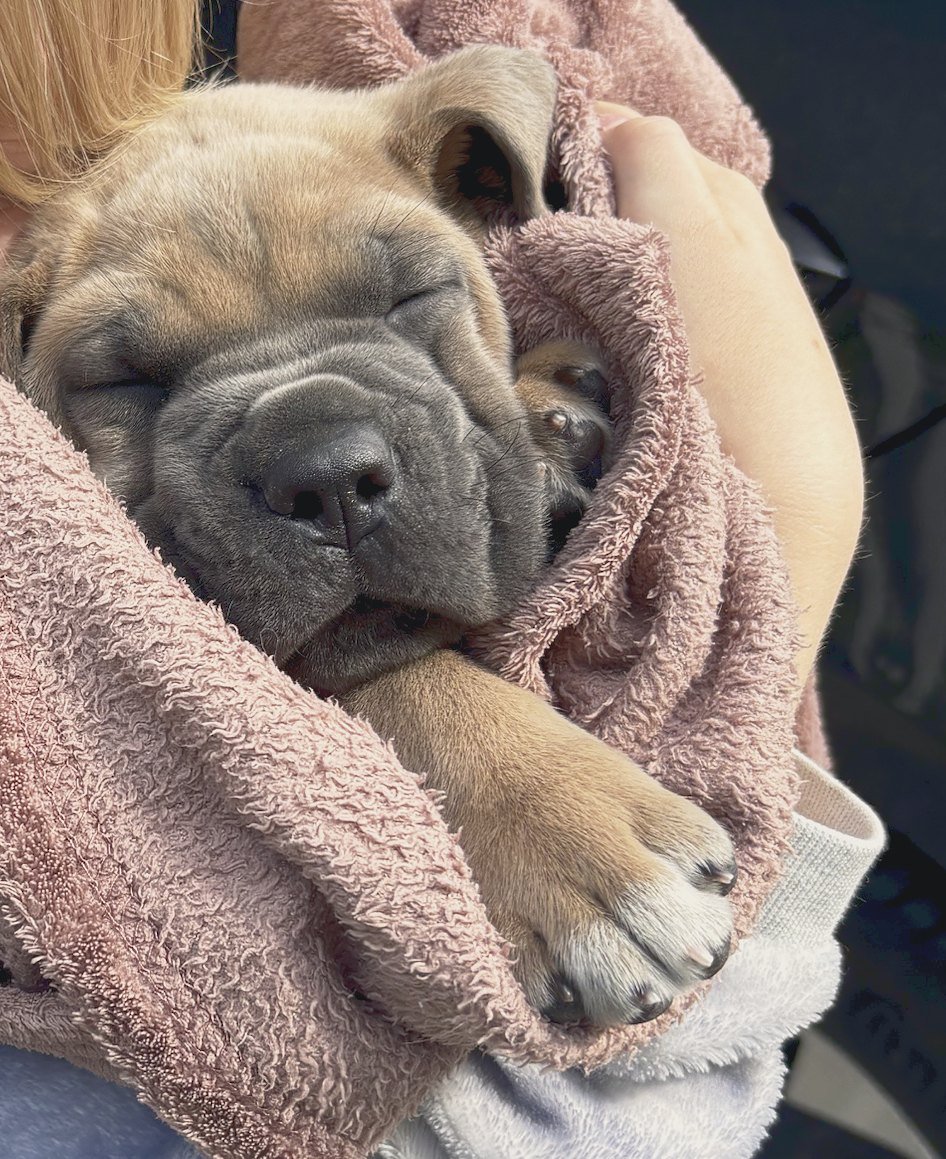
The first half hour sets the pattern. The American Kennel Club recommends taking the puppy straight to its outdoor toilet spot, then to a single puppy-proofed area, and only later letting it explore the rest of the house. Family members should meet it one at a time rather than all at once, however difficult that is with the excitement. Other pets are introduced calmly, in a controlled space, with the puppy free to retreat.
Then let it sleep. Puppies need, by the same source, fifteen to twenty hours of sleep a day, and a new home is tiring. The crate or bed should already be where the puppy will sleep, and the buyer should guide it there whenever it seems ready for a nap.
The first night
Most first nights go better when the puppy sleeps close to a person — in a crate beside the bed, or with someone sleeping near its pen for the first few nights — and is moved gradually to its permanent place later. A puppy that has never slept alone should not have to learn it on the night it has lost its littermates. The scent blanket helps. So does a last toilet trip just before bed and a quiet, matter-of-fact trip out if it wakes, without play. The buyer should expect some crying and not treat it as failure.
The first days
The aim of the first days is predictability, not variety. The American Kennel Club puts it simply: the more structured and consistent a puppy’s day, the better adjusted it will be. Keep the food, meal times and toilet routine exactly as they were in your house — the reason you sent them home in writing — and change nothing for several days. A few days later, variety can begin again at the puppy’s pace, as set out in educating your puppy buyers.
Visitors should be few and calm at first, then gradually more varied, because socialization does not pause: the American Veterinary Society of Animal Behavior calls the first three months the most important time for it. The buyer’s first veterinary visit, booked within the first days, is also the puppy’s first experience of a clinic, and a good moment to confirm the vaccination and deworming schedule with the practice that will now carry it on.
Some changes are normal and some are not. Slightly soft stools, a little less appetite for a meal or two, and more sleep than usual are common with the stress of moving. A puppy that is lethargic, repeatedly vomiting, has persistent diarrhea, will not eat, or simply seems unwell needs its veterinarian promptly — young puppies can deteriorate quickly. Make sure the buyer knows this before they leave, and knows where their practice’s after-hours service is.
Small and toy-breed puppies have very little reserve. Stress, a long journey, getting cold or a missed meal can drop their blood sugar. Trembling, weakness, wobbliness, unusual sleepiness or a seizure need a vet straight away. Offer small, regular meals at the times the breeder used. The first days also fall in the age band most at risk from parvovirus (about six weeks to six months), and signs can appear up to two weeks after exposure. Lethargy, refusing food, vomiting or diarrhea (especially with blood) in a young puppy should go to the vet the same day, not be watched overnight.
In practice
A buyer calls at six the next morning, distressed: the puppy cried for an hour after being put in a crate in the kitchen and then again at three. The breeder asks where the puppy had been sleeping at home — in a pile of littermates, in a room where the breeder slept nearby. They agree that for the next few nights the crate moves beside the buyer’s bed. Two days later the buyer reports a quiet night, and over the following two weeks the crate moves back to the kitchen a step at a time.
(Illustrative, composite scenario.)
The breeder’s part after the car pulls away
Send a short message that evening, and again on the second day and at the end of the first week. Ask a specific question — how did the puppy eat, where did it sleep, has it met the neighbors’ children — rather than “all well?”, which invites a reply of yes regardless of the truth. The early days are when problems are small and easily solved; a buyer who has already heard from you will call before they become large. This is also the start of the record you will keep through staying in contact with puppy buyers.
When to call your vet
- If the puppy is lethargic, refuses two meals in a row, or vomits more than once.
- If there is diarrhea with blood, or diarrhea together with vomiting or listlessness.
- If a small puppy trembles, wobbles, seems weak or unusually sleepy, or has a seizure: go immediately.
- If, after the journey, the puppy pants heavily, drools, is weak or confused: start cooling it and go now.
- If it coughs, has a runny nose or eyes, or breathes with effort.
- If in doubt, call — your vet would rather hear from you early.
Work on it
A few minutes here will teach you more than re-reading the article.
Ask yourself
- Do my buyers know exactly how the puppy will be secured in the car, and have I asked them?
- Where has each of my puppies been sleeping in its last week here — and does the buyer’s plan for the first night bear any resemblance to it?
- Do my buyers know which signs mean they should call their veterinarian rather than me?
Find out & check
- Find out what the rules are where you and your buyers live on restraining animals in vehicles, and whether the buyer’s veterinary practice offers an after-hours service or refers elsewhere.
Do one thing
- Write a one-page journey-and-first-night sheet for the puppy folder, and send it to the next buyer a week before collection.
Was this article helpful?
Anonymous. We do not store your name, email or IP address.
Sources & further reading
- American Kennel Club — Bringing a Puppy Home: Help Your Puppy Adjust to a New Home. akc.org
- American Kennel Club — Puppies Flying Home? Help Your New Owners Prepare for the Trip!. akc.org
- GOV.UK — The Highway Code: Rules about animals (47 to 58). gov.uk
- American Veterinary Medical Association — Pets in vehicles. avma.org
- Cornell University College of Veterinary Medicine, Riney Canine Health Center — Heatstroke: a medical emergency. vet.cornell.edu
- American Kennel Club — Hypoglycemia in Dogs. akc.org
- Merck Veterinary Manual — Canine Parvovirus. merckvetmanual.com
- American Veterinary Society of Animal Behavior — Position Statement on Puppy Socialization (2008). avsab.org
Where evidence is limited, recommendations rest on established practice and expert judgment, and may be updated as knowledge develops. Road and airline rules differ between countries and carriers, and the Highway Code is quoted as one example. Any puppy that seems unwell should be seen by a veterinarian promptly; nothing here replaces that advice.
Next steps
- Read next: Buy-back, returns and rehoming.
- Related: Crate, travel and short separations.
- Related: Puppies and swallowed objects: choking, blockages and bag suffocation.
- Return to the area hub: From first inquiry to settled puppy.
- Flying instead of driving: Flying dogs and puppies: the IATA crate rules (CR82).