A practical template for tracking each puppy in a litter through the first days — set it up before whelping so you’re filling in numbers, not designing a system while also caring for newborns.
The most important first
- One row or section per puppy, tracked consistently from birth through the first couple of weeks.
- Weigh at birth, 12 hours, 24 hours, then daily to two weeks, then every 2–3 days.
- A small dip on day one is common; a loss approaching 10%, or any loss continuing into day two, should be flagged. After that, expect roughly 5–10% gain per day.
- Check rectal temperature at least daily, alongside the Apgar score at birth.
Per-puppy fields
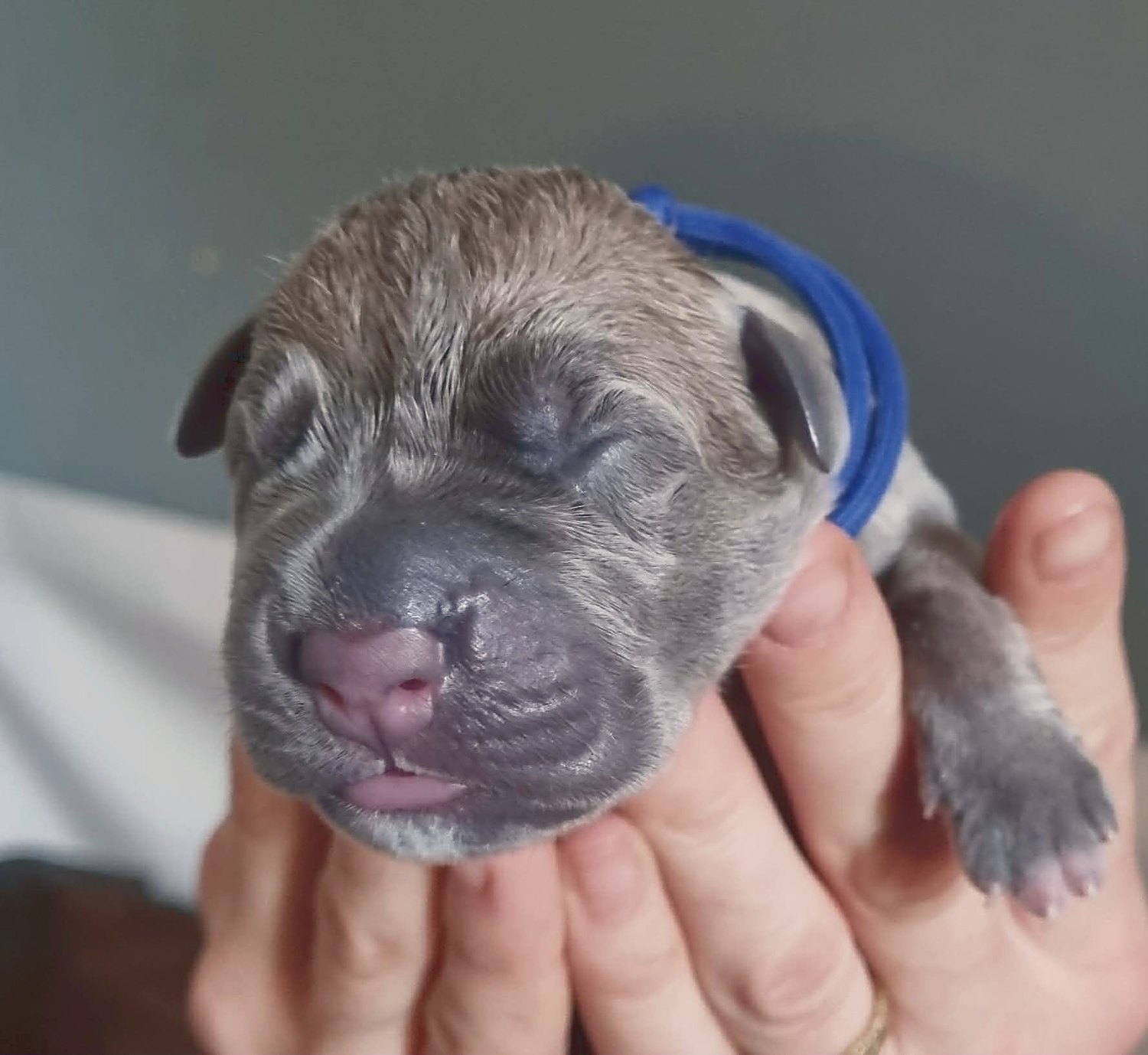
- Puppy ID / collar color
- Apgar score at 5 minutes and at 60 minutes (see the first assessment)
- Weight: birth, 12h, 24h, then daily to 2 weeks, then every 2–3 days
- Rectal temperature: daily, minimum
- Reflexes checked (rooting, suckle, righting) — normal / concern noted
- Nursing observed (yes/no, which teat, any difficulty)
- % change since last weighing: (today’s weight − previous weight) ÷ previous weight × 100 — this makes a slowing puppy stand out even when its weight still looks reasonable next to its littermates
- Urine color (pale is normal, dark yellow is a concern) and gum color (pink and moist is normal)
- Time of first nursing and type of birth (natural or cesarean)
- Notes: color, activity, any concerns
Reading the numbers
A weight loss of up to roughly 10% in the first 24 hours can be a normal part of adjusting to life outside the womb, though 10% is the upper limit rather than the norm: losses above roughly 4% on day one, or any loss in a small or low-birth-weight puppy, are linked to higher mortality and deserve close watching. Ideally there is no loss at all over the first two days, and any loss continuing into day two should be flagged. From there on, a healthy puppy should be gaining steadily — roughly 5 to 10% of its body weight per day. A puppy that’s losing weight after the first day, or not gaining at the expected rate, is one to flag for closer attention and a vet call if it continues, covered in more detail in weighing and tracking growth.
Using it well
The value here, as with the whelping log, is consistency — filling this in for every puppy, every check, rather than only when something seems off. A puppy that’s quietly falling behind is often easiest to catch through the numbers, before it’s obvious by eye.
The dam
Add one row a day for the dam: appetite, any vaginal discharge (a small amount is normal; foul-smelling, green or heavy bleeding is not), her temperature if you are taking it (call your vet above 103 °F / 39.5 °C), and whether her mammary glands are soft or hot, hard and painful. Puppies’ problems often start with hers.
When to call your vet
- Rectal temperature below about 95–96 °F (35–35.5 °C) in the first week, or a puppy that feels cool.
- Weight loss of more than 10% in the first 24 hours, or any loss after the second day.
- Less than 1.5 × birth weight by day 7, or birth weight not roughly doubled by about day 10–14.
- An Apgar score of 6 or below that isn’t improving at the one-hour check.
- Dark yellow urine, or gums that look pale, gray or bluish.
- A puppy that hasn’t nursed within the first hours — colostrum must go in within the first 24 hours.
- Don’t wait for a second abnormal reading if the puppy also looks or behaves unwell.
- If in doubt, call — your vet would rather hear from you early.
Work on it
A few minutes here will teach you more than re-reading the article.
Ask yourself
- Is my tracking sheet set up and ready before the litter arrives?
- Am I checking every puppy consistently, not just the ones that seem to need it?
Find out & check
- Find out if your vet wants copies of these records at the first litter check.
Do one thing
- Set up this sheet — paper or digital — today, ready for the next litter.
Was this article helpful?
Anonymous. We do not store your name, email or IP address.
Sources & further reading
- Merck Veterinary Manual — Management of the Neonate in Dogs and Cats. merckvetmanual.com
- Royal Canin Veterinary Academy (Vannucchi C.) — A quick guide to intensive care of newborn puppies. academy.royalcanin.com
- Mugnier A, Gaillard V, Chastant S — Relative Impact of Birth Weight and Early Growth on Neonatal Mortality in Puppies, Animals 2023;13(12):1928. mdpi.com
- Royal Canin Veterinary Academy (Chastant S., ENV Toulouse) — Dealing with the sick newborn puppy. academy.royalcanin.com
- Veronesi MC, Panzani S, Faustini M, Rota A — An Apgar scoring system for routine assessment of newborn puppy viability and short-term survival prognosis, Theriogenology 2009;72:401–407. air.unimi.it
- Dogs NSW (Hedberg K., BVSc) — Care of puppies birth to 10 days. dogsnsw.org.au (PDF)
- American Kennel Club — Raising Newborn Puppies. akc.org
- Veronesi MC et al. (2022), Animals 12(13):1664 — Refining the APGAR Score Cutoff Values and Viability Classes According to Breed Body Size in Newborn Dogs. pmc.ncbi.nlm.nih.gov
Where evidence is limited, recommendations rest on established practice and expert judgment, and may be updated as knowledge develops.
Next steps
- Related: The first assessment: Apgar-style scoring · Weighing and tracking growth.
- Return to the area hub: The neonatal period.