The three weeks from birth are the highest-stakes stretch in a puppy’s life — most neonatal losses happen in the first week, and most of the biggest risks are things a well-prepared breeder can actively manage.
The most important first
- Reported neonatal mortality runs roughly 9–26%, with the heaviest losses concentrated in the first week of life. Roughly nine in ten deaths before two months happen in the first three weeks.
- Puppies can’t regulate their own body temperature independently until around 4 weeks old — warmth management is the single biggest early risk factor.
- Colostrum’s window for absorbing maternal antibodies closes by about 24 hours after birth, making early, effective nursing time-critical.
- Birth weight is the strongest single predictor of survival, and early growth adds to it: good growth in the first days lowers, but does not cancel, the extra risk of a low birth weight — which is why growth tracking runs throughout this whole area.
- This area picks up directly where whelping ends and hands off to litter health and care once puppies are past roughly three weeks old.
What this area covers
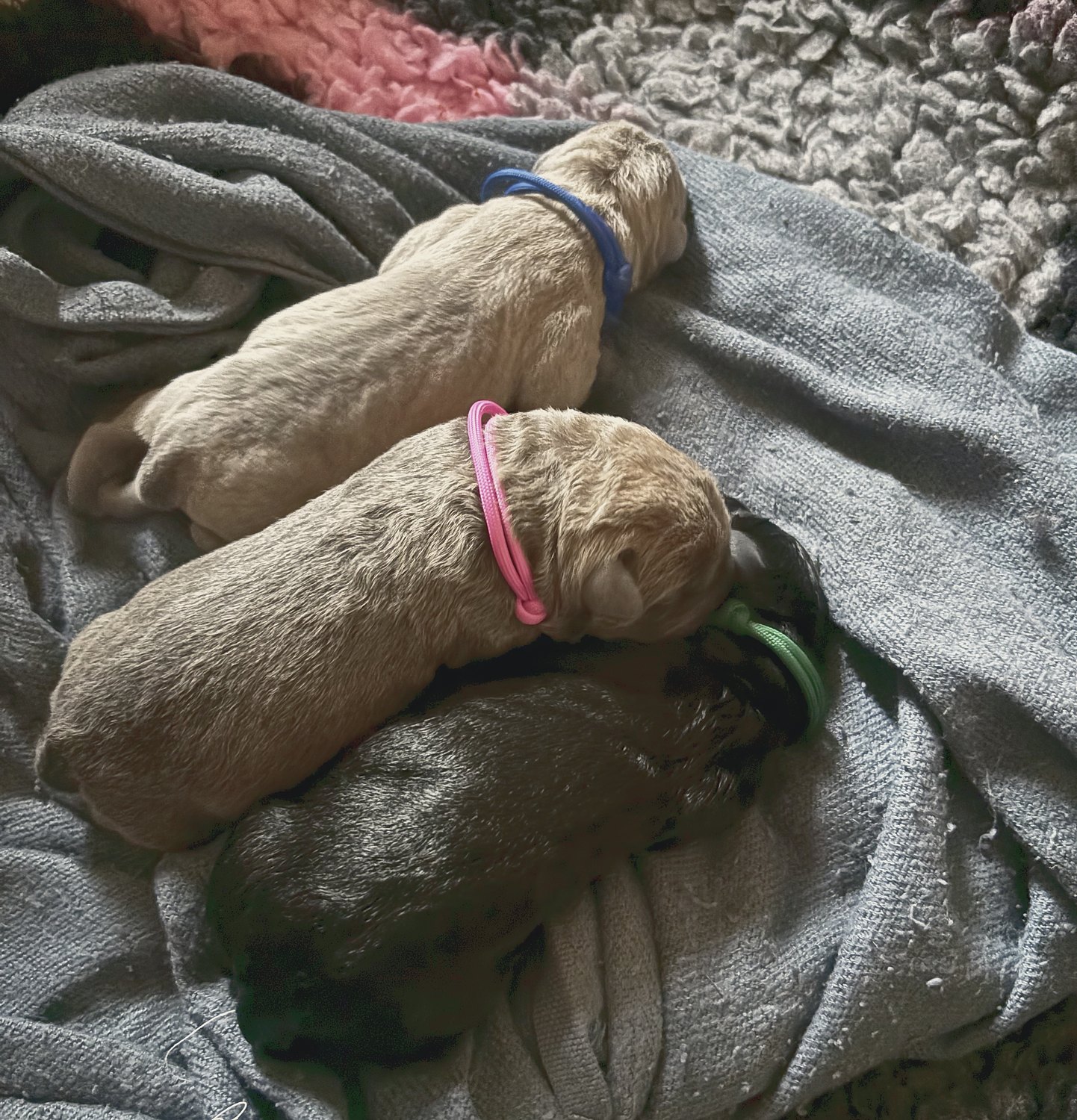
This area moves from the newborn’s first moments through the following three weeks: what a normal newborn puppy looks like and does, the first assessment (Apgar-style scoring) used to check viability right after birth, warmth and the whelping-box microclimate, colostrum and passive immunity, and nursing and monitoring milk intake. It then covers the practical tracking side — weighing and tracking growth — before moving into more advanced territory: fluids, energy and blood sugar, supplemental and tube feeding, caring for weak and orphaned puppies, congenital abnormalities, neonatal infections and illness, hygiene and biosecurity, and finally the neonatal emergencies — hypothermia, hypoglycemia, and fading puppy syndrome — that every breeder needs to recognize instantly.
Why this period carries so much risk
Newborn puppies arrive with very little physiological reserve: they can’t regulate body temperature on their own for weeks, their immune system depends entirely on antibodies absorbed from colostrum in a narrow early window, and their energy reserves are minimal, making blood sugar crashes a real risk if nursing falls behind. In plain terms, the three most common threats are chilling, low blood sugar and dehydration. They often occur together, and each makes the others worse. None of this is meant to be alarming for its own sake — it’s the reason this area exists as a distinct, detailed competence area rather than a short addendum to whelping, and why several articles here (like neonatal emergencies) are written for fast reference in the moment, the same way parts of the whelping area are.
How this area connects to what comes before and after
This area follows directly from whelping — newborn resuscitation at birth leads straight into the first assessment covered here. Once puppies are past the most fragile early weeks and moving into physical development, weaning, and the broader business of raising a healthy litter, litter health, nutrition and care takes over as its own area.
Spotting a puppy in trouble
A newborn puppy has very little reserve, so an illness that would be minor in an older dog can become life-threatening within hours. Treat any of the signs in the box below as a reason to call your veterinarian the same day, and straight away if several appear together.
Veterinary research shows that most puppies that die in their first month show signs only a few days beforehand, which is why daily weighing and a quick look at every puppy, every day, matter so much. When you go to the vet, take the dam and the rest of the litter too: the cause often affects more than one puppy.
When to call your vet
- A puppy won’t suckle, suckles weakly, or keeps getting pushed off the teat.
- Constant crying, or a puppy lying apart from the litter.
- A puppy that feels cool to the touch — normal body temperature in week one is only about 95–99 °F (35–37.2 °C), so anything colder is a warning.
- Weight that stalls or drops after the first day, or less than 1.5 × birth weight by day 7.
- Weakness or floppiness, labored or open-mouthed breathing, a swollen or painful belly, diarrhea, or bleeding from the umbilicus.
- A puppy that has not nursed within the first hours of life — colostrum must go in within the first 24 hours.
- If in doubt, call — your vet would rather hear from you early.
Work on it
A few minutes here will teach you more than re-reading the article.
Ask yourself
- Do I know the three biggest early risks (temperature, colostrum timing, blood sugar) well enough to actively manage them, not just recognize them afterward?
- Do I have a plan for tracking each puppy’s weight daily from birth?
- Do I know where in this area to go quickly if a puppy seems to be struggling?
Find out & check
- Check that your whelping box setup can maintain the temperatures each article in this area specifies for the puppies’ age.
Do one thing
- Read the normal newborn puppy and the first assessment before your next litter arrives, not after.
Was this article helpful?
Anonymous. We do not store your name, email or IP address.
Sources & further reading
- Merck Veterinary Manual — Management of the Neonate in Dogs and Cats. merckvetmanual.com
- Mugnier A, Gaillard V, Chastant S — Relative Impact of Birth Weight and Early Growth on Neonatal Mortality in Puppies, Animals 2023;13(12):1928. mdpi.com
- Lawler DF — Neonatal and pediatric care of the puppy and kitten, Theriogenology 2008;70:384–392. confluence.cornell.edu (PDF)
- Royal Canin Veterinary Academy (Chastant S., ENV Toulouse) — Dealing with the sick newborn puppy. academy.royalcanin.com
- Chastant-Maillard S. et al. — Timing of the intestinal barrier closure in puppies, Reproduction in Domestic Animals 2012;47 Suppl 6:190–193. doi.org
- The Royal Kennel Club — Whelping your first litter. royalkennelclub.com
- American Kennel Club — Raising Newborn Puppies. akc.org
Where evidence is limited, recommendations rest on established practice and expert judgment, and may be updated as knowledge develops. This is general information, not a substitute for individualized veterinary care.
Next steps
- Read next: The normal newborn puppy.
- Related: Whelping: the complete guide from first contractions to recovery · Fluids, energy and blood sugar in the newborn · Warmth and the whelping-box microclimate.
- This area follows Whelping, and precedes Litter Health, Nutrition & Care.