Toxic blue-green algae can turn a summer swim into an emergency within an hour, and you can’t always tell by looking at the water — so the safest rule is the simplest one: when in doubt, keep your dog out, and if your dog has been in suspect water, rinse it off and call the vet.
The most important first
- Keep your dog out of water that looks scummy, discolored, foamy or smells bad, and away from mats on the shore.
- Signs can start within minutes to hours, and dogs can die quickly. There is no antidote.
- If your dog has been in suspect water, rinse it with clean tap water straight away and stop it licking its coat.
- Go to the vet immediately for vomiting, drooling, weakness, stumbling, tremors or seizures.
- Check local warnings before you go, and report suspected blooms.
Last updated: November 8, 2026

What blue-green algae are
Blue-green algae are cyanobacteria — microscopic organisms that can grow rapidly (“bloom”) in fresh water, and less often in salt or brackish water, and some produce toxins. North Carolina State University toxicologist Dave Dorman explains that warm weather, still water and fertilizer runoff encourage toxic growth.
The US Centers for Disease Control and Prevention (CDC) explains that dogs are exposed by swallowing contaminated water, eating algae, licking algae off their fur or eating contaminated fish, and occasionally by skin or eye contact or breathing in spray. Signs can appear within minutes to hours, and dogs can become severely ill or die within minutes to days. The CDC adds that there is no clinical test for these toxins and no antidote — treatment is supportive.
Why you can’t always see it
Some blooms turn water green, blue-green, brown or red, or form scum, mats or paint-like films. New York Sea Grant describes blooms that look like pea soup or spilled paint, and mats that wash up on windward shores, where dogs may eat them or be drawn by the smell. But visual checks can’t confirm whether a bloom is toxic — and some toxic cyanobacteria grow out of sight.
In Swiss rivers, Zhioua and colleagues (2026) describe how Microcoleus, a cyanobacterium that grows in mats on riverbeds and produces the nerve toxin anatoxin, has caused several dog deaths. In Austin, Texas, Brower and colleagues (2026) found cyanobacteria in all seven urban creeks they sampled in 2024, along with toxins. Dorman’s advice is blunt: you can’t trust your eyes.
How dangerous is it?
New York Sea Grant notes that in severe cases signs can start within minutes and a dog can die within an hour, and that without treatment these poisonings are usually fatal. The CDC warns that in dogs, the gap between a dose that causes no signs and a lethal dose is narrow — up to 90% of a lethal dose may cause no visible signs.
Reported cases are probably the tip of the iceberg. When New York piloted a surveillance system in 2015, Figgatt and colleagues (2017) found more reported illnesses in one summer than the state had ever recorded in a year, including three dogs.
In practice
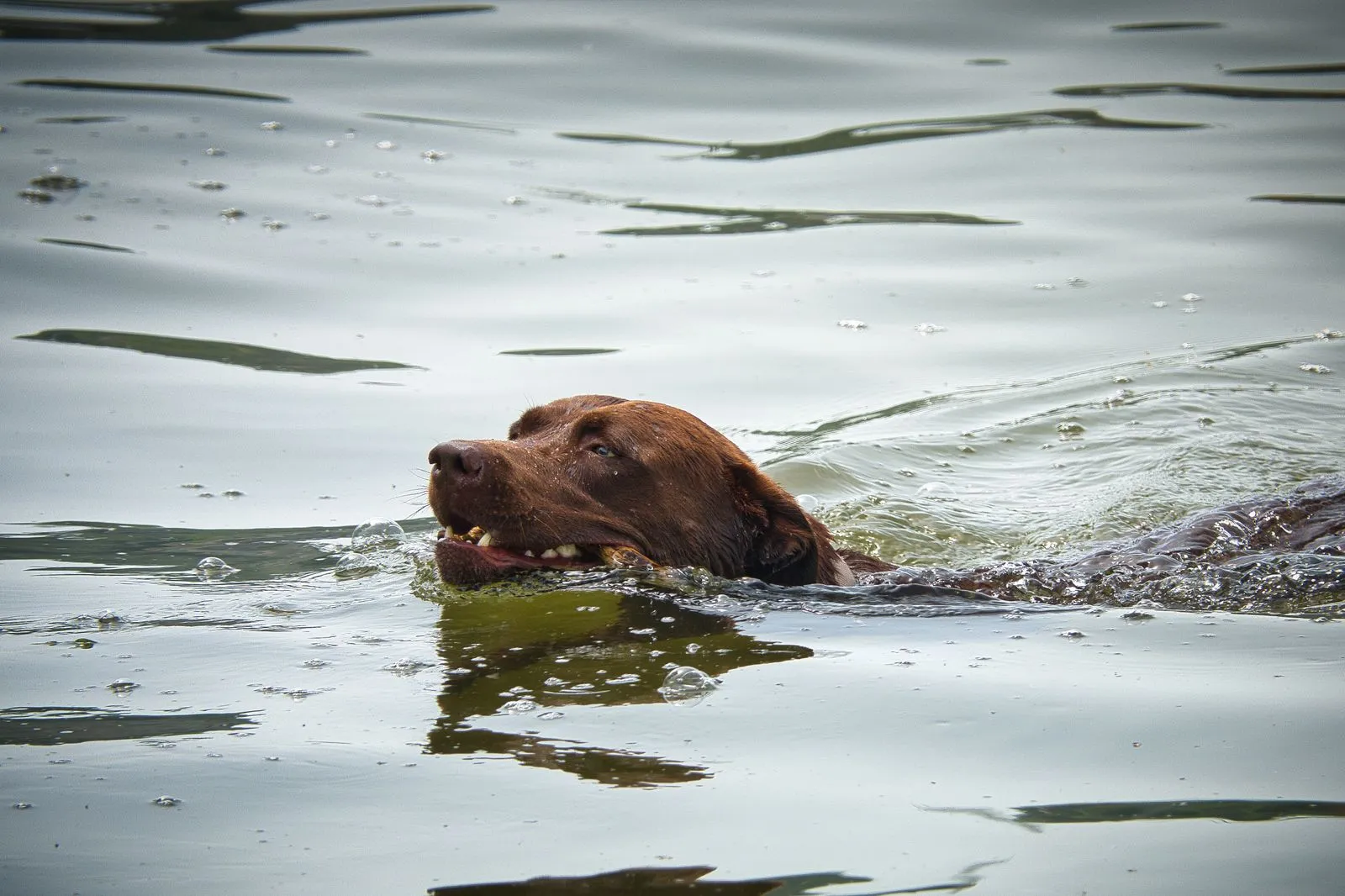
On a hot August afternoon, a family’s Labrador splashes into a pond with a green film along one edge before they can stop him. They leash him, rinse him with bottled water and the hose at a nearby house, wearing gloves, and call their vet, who asks them to come in straight away rather than wait for signs.
(Illustrative, composite scenario.)
If your dog has been exposed
- Get your dog out of the water immediately and stop it licking its fur or paws.
- Rinse with clean tap or bottled water, as the CDC advises, or wipe off algae with a towel. New York Sea Grant suggests wearing gloves and washing your hands afterwards.
- Call your vet straight away, even if your dog seems fine. You can also contact a pet poison helpline.
- Report the bloom to your local or state health or environment agency.
Signs to watch for
The CDC lists signs by toxin type:
- Liver and kidney toxins: drooling, vomiting, diarrhea, foaming at the mouth, yellowing skin, dark urine, lethargy and loss of appetite.
- Nerve toxins: muscle twitching, stumbling, loss of coordination, tremors and paralysis.
- Skin toxins: rash or hives.
Blue-green staining on the fur is a clue that your dog was in a cyanobacteria bloom.
Prevention
- Check local advisories before you swim or walk by lakes and rivers.
- Keep your dog on a leash near shorelines with possible blooms, and away from mats and dead fish or birds.
- Bring fresh water so your dog isn’t tempted to drink from ponds and lakes.
- Rinse your dog after swimming in natural water.
When to call your veterinarian
- Immediately after any swim or drink in water you suspect has a bloom — don’t wait for signs.
- Vomiting, diarrhea, drooling or foaming at the mouth.
- Weakness, stumbling, tremors, seizures or trouble breathing.
- Yellow gums or skin, or dark urine, in the days after a swim.
- If in doubt, call — your vet would rather hear from you early.
Work on it
A few minutes here will teach you more than re-reading the article.
Ask yourself
- Do I know where to check for algae warnings near me?
- Does my dog drink from lakes and ponds?
- Would I know how to rinse my dog off quickly?
Find out & check
- Find your local or state agency’s algae bloom map or advisory page.
Do one thing
- Keep a large bottle of fresh water and a towel in the car all summer.
Was this article helpful?
Anonymous. We do not store your name, email or IP address.
Sources & further reading
- Centers for Disease Control and Prevention (2024) — For Veterinarians: Harmful Algal Bloom-Associated Illnesses. cdc.gov
- MacNeill D, New York Sea Grant (2014) — Dogs and Harmful Algal Blooms (HABs). extapps.dec.ny.gov
- NC State College of Veterinary Medicine — Toxic Algae Blooms Harmful to Pets (Dorman D). news.cvm.ncsu.edu
- Zhioua S, Mangia N, Cailleau G, Gonzalez D, Junier P (2026) — Spatiotemporal dynamics of benthic Microcoleus in a Swiss lotic system. Frontiers in Microbiology 17:1769963. doi.org
- Brower H, Mahmood S, Ruiz-Escobar J, et al. (2026) — Cyanobacterial Bloom and Toxin Identification in Austin, TX, USA Creeks. microPublication Biology. doi.org
- Figgatt M, Hyde J, Dziewulski D, et al. (2017) — Harmful Algal Bloom–Associated Illnesses in Humans and Dogs Identified Through a Pilot Surveillance System — New York, 2015. MMWR 66:1182–1184. cdc.gov
Where evidence is limited, recommendations rest on established practice and expert judgment, and may be updated as knowledge develops. This is general information and does not replace advice from your veterinarian.
Next steps
- Read next: Water safety for dogs.
- Related: Road trips and camping with your dog · A first aid kit and first aid basics for dog owners.
- Return to the guide: For your puppy buyers.