A road trip or camping weekend can be the highlight of a dog’s summer, and most of what makes it safe happens before you leave: a secure way to travel in the car, a plan for heat and car sickness, ID that works far from home, and knowing in advance where dogs are actually allowed.
The most important first
- Restrain your dog in the car with a crash-tested harness or a secured crate.
- Never leave your dog in a parked car, even for a quick stop.
- Check ID before you go: collar tag with your mobile number, and microchip details up to date.
- Check the rules where you’re going. Many parks require a leash no longer than 6 feet and limit where dogs can go.
- Know where the nearest vet is at your destination, and pack a dog first aid kit.
Last updated: November 8, 2026
In the car
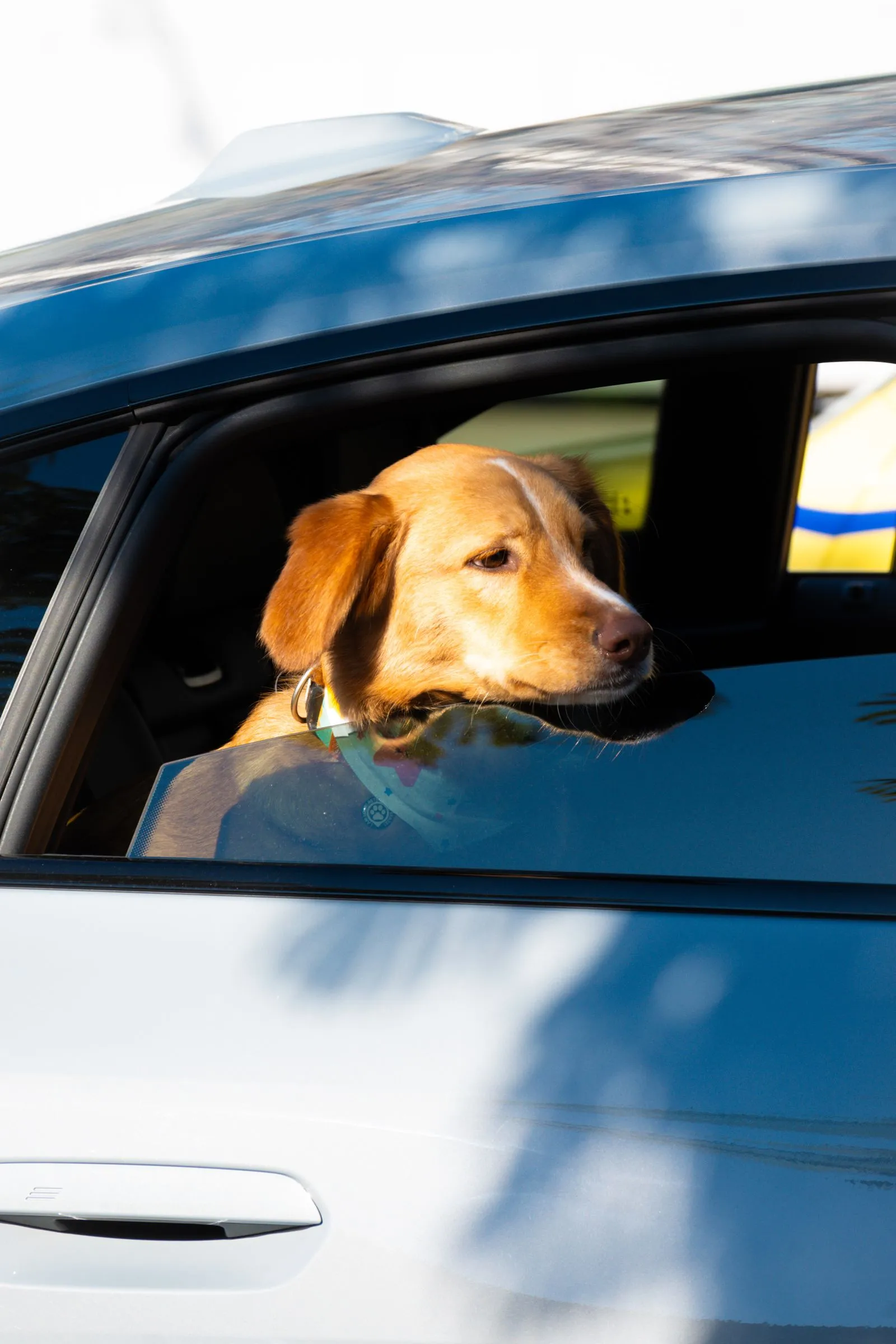
Restraint. The American Veterinary Medical Association (AVMA) recommends a crash-tested vehicle harness or a secured crate large enough for your dog to stand, turn around and lie down, and advises against letting dogs hang their heads out of windows. The Center for Pet Safety, a US non-profit, has crash-tested travel harnesses since a 2011 pilot study and publishes a list of harnesses it has certified.
Heat. AVMA reports that a parked car’s interior heats up by about 19°F in 10 minutes and 43°F in an hour, and that cracking the windows makes no difference. Plan stops where someone can stay with the dog, or where dogs are welcome inside.
Car sickness. The Merck Veterinary Manual describes motion sickness in dogs as nausea, drooling and vomiting, sometimes with yawning, whining, restlessness or diarrhea, usually stopping when the car stops. Fear of the car can play a part, and some dogs learn to feel ill even before the car moves. Some dogs can be conditioned to travel, and your vet can prescribe medication to prevent motion sickness.
Don’t expect long trips to “toughen up” an anxious traveller on their own. In a study of transport-naive Beagles, Herbel and colleagues (2020) found clear stress responses during one- and two-hour road trips, with no sign of the dogs getting used to it over three weekly trips, and noted that some may have been car sick. Short, positive practice trips and a talk with your vet before a long journey are a better plan.
Keep ID working away from home
In a US survey by Weiss, Slater and Lord (2012), 14% of dogs had been lost at least once in five years; most were found by searching the neighborhood or came home on their own — much harder in an unfamiliar place. Before you leave:
- Put your mobile number on the tag, not just your home address.
- Check the microchip registration is current.
- Take a recent photo of your dog on your phone.
At the campsite and on the trail
The US National Park Service’s B.A.R.K. rules sum up good manners anywhere:
- Bag your dog’s poop.
- Always wear a leash, no longer than 6 feet (about 2 meters).
- Respect wildlife — keep your distance.
- Know where you can go — pets are allowed in many park areas, but not all.
The Park Service notes that a leash also protects your dog from getting lost and from hazards such as porcupines.
Other summer hazards follow you outdoors: snakes, ticks, grass seeds, standing water and heat. Plan hikes for the cool of the day, carry water for your dog, and check paws, ears and coat each evening.
In practice
A family plans a week of camping with their young retriever. Before leaving, they buy a crash-tested harness and practice short drives, add a tag with a mobile number, and look up the nearest emergency vet to the campsite. At the national park they discover dogs aren’t allowed on most trails, so they choose a nearby national forest for their hikes instead.
(Illustrative, composite scenario.)
Pack for your dog
- Food, bowls, plenty of water and a collapsible bowl for walks
- Leash, spare collar with tag, and a long line for the campsite
- Bed or blanket that smells of home
- First aid kit and any regular medication, with vaccination records
- Waste bags, towel and a tick remover
- Shade: a tarp or tent the dog can lie under
When to call your veterinarian
- Before a long trip, if your dog gets car sick or very anxious in the car.
- Repeated vomiting, heavy panting, weakness or collapse during travel or in the heat.
- Any snakebite, deep wound, or suspected poisoning while away.
- Lameness, a swollen paw or head shaking after hikes.
- If in doubt, call — your vet would rather hear from you early.
Work on it
A few minutes here will teach you more than re-reading the article.
Ask yourself
- How does my dog travel in the car now — is it restrained?
- Does my dog’s tag have a number I’ll answer while I’m away?
- Are dogs actually allowed where we’re going?
Find out & check
- Look up the nearest emergency vet to your destination and save the number.
Do one thing
- Take your dog on three short, fun car trips before the big one.
Was this article helpful?
Anonymous. We do not store your name, email or IP address.
Sources & further reading
- American Veterinary Medical Association — Pets in vehicles. avma.org
- Center for Pet Safety — Harness test results. centerforpetsafety.org
- Neer TM, Merck Veterinary Manual (2026) — Motion Sickness in Dogs. merckvetmanual.com
- Herbel J, Aurich J, Gautier C, Melchert M, Aurich C (2020) — Stress Response of Beagle Dogs to Repeated Short-Distance Road Transport. Animals 10:2114. doi.org
- Weiss E, Slater M, Lord L (2012) — Frequency of Lost Dogs and Cats in the United States and the Methods Used to Locate Them. Animals 2:301–315. doi.org
- US National Park Service — BARK Ranger. nps.gov
Where evidence is limited, recommendations rest on established practice and expert judgment, and may be updated as knowledge develops. This is general information and does not replace advice from your veterinarian.
Next steps
- Read next: Summer heat and dogs: hot pavement, hot cars and heatstroke on walks.
- Related: Snakebite in dogs · Grass seeds and foxtails · A first aid kit and first aid basics for dog owners.
- Return to the guide: For your puppy buyers.