A dog’s due date sounds simple — 63 days — but which date you’re counting 63 days from makes a real difference to accuracy. This guide explains why, and how to get the most reliable estimate.
The most important first
- The most accurate method is 63 days from ovulation, not from the mating date.
- Counting from mating alone is typically off by up to about a week either way, sometimes more, because sperm can survive many days in the tract.
- Ovulation timing is best pinned down using progesterone testing or LH surge detection.
- With good hormone data, due-date accuracy improves substantially compared to counting from mating.
- Even without ovulation data, ultrasound and X-ray staging can narrow the estimate, though less precisely.
Free interactive tool
Put this into practice: enter your dates and get her due window and a week-by-week plan. Open the due date calculator →
Why the mating date alone isn’t reliable
A bitch’s heat lasts around three weeks on average, with wide individual variation, and sperm can remain viable in her reproductive tract for about a week, sometimes longer, after mating — meaning a single observed mating could, in principle, result in a due date anywhere across a wide window depending on exactly when ovulation actually happened relative to that mating. This is why counting a fixed 63 days from a mating date alone is the least accurate way to estimate a due date, typically off by up to about a week either way and sometimes more. Counted from the first accepted mating, normal whelping can fall anywhere from roughly 58 to 72 days later.
The accurate method: counting from ovulation
The standard, most accurate approach is 63 days from ovulation itself, with ovulation timing established through progesterone testing — either from an LH surge detected directly, or interpreted from the progesterone rise pattern your vet tracked during timing. With one or two well-timed hormone measurements, this calculation can be quite precise, which is exactly why the progesterone timing log kept during mating pays off again here, well after the mating itself.
Most vets report the LH-surge day or the first progesterone rise rather than “ovulation” itself, so check which reference point your results represent before you count. Adding 63 days to an LH date would make your estimate about two days early.
| What you know | Expected whelping |
|---|---|
| LH surge (day 0) | about 65 days later (range 64–66) |
| First rise in progesterone | about 64–66 days later |
| Ovulation (about 2 days after the LH surge) | about 63 days later (range 62–64) |
| First accepted mating only | anywhere from about 58 to 72 days later |
In practice
A breeder without progesterone records counts 63 days from the single observed mating and prepares for a due date that turns out to be five days early. Because the actual ovulation happened several days after that mating — sperm having survived in the reproductive tract in the meantime — the whelping preparation checklist was rushed to finish in time. Having kept a progesterone log from the original timing would have given a due date within a day or two of accurate, rather than a week off.
(Illustrative, composite scenario.)
When ovulation data isn’t available
If ovulation wasn’t precisely tracked, an ultrasound scan around the end of the first month, with the puppies measured by an experienced vet, can date the pregnancy to within a day or two in most bitches. This works best if you plan the scan rather than leaving it until late, because measurements taken late in pregnancy are much less accurate. X-rays later in pregnancy are better for counting puppies (from about day 55) and confirming they are mature, for example by seeing their teeth, than for pinpointing the date. This matters more than it might seem: puppies’ lungs are not reliably mature until the very end of pregnancy, which is why vets avoid a planned cesarean before about day 62 unless the date has been confirmed by hormone timing. Precision matters most if your breed is at high risk of a difficult birth or a cesarean is planned.
When the due date passes
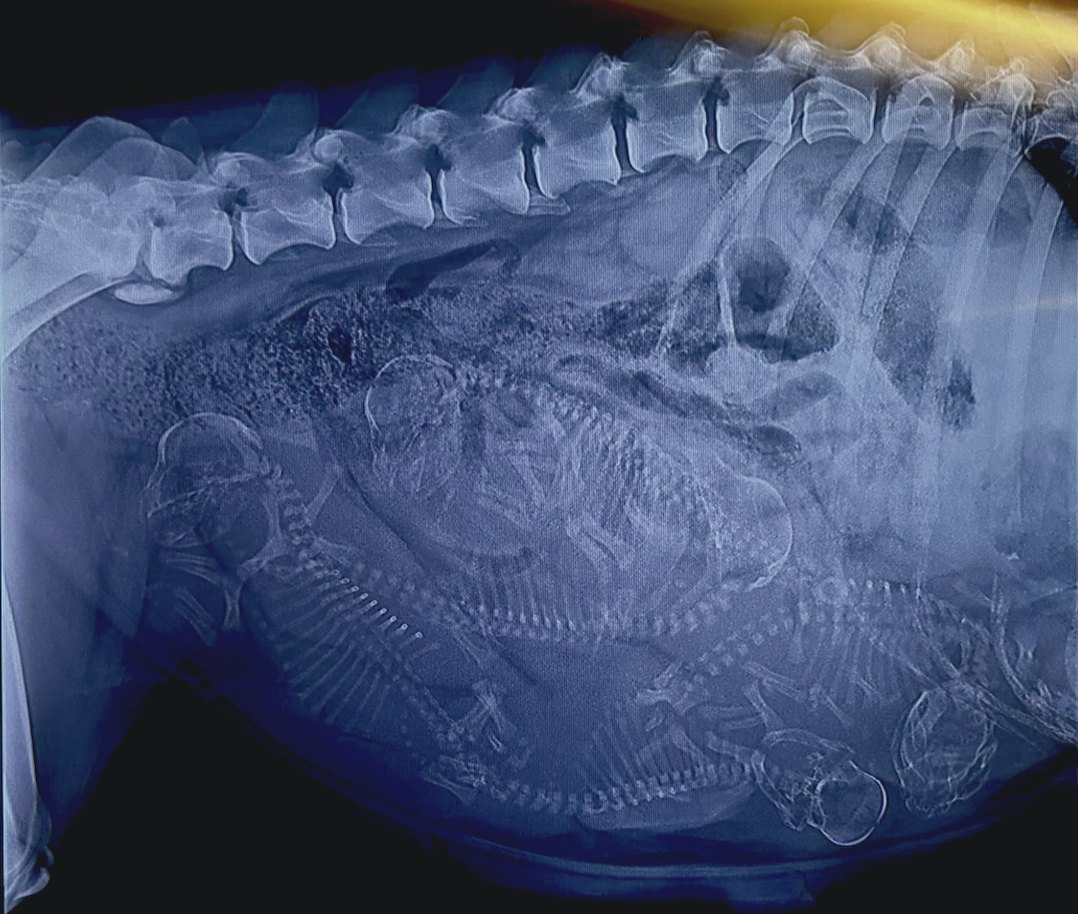
A bitch whelping a day or two either side of the predicted date is normal. If you have hormone-timed dates and she is past about day 66 from the LH surge without signs of labor, call your veterinarian. Do the same if you only know the mating dates and she reaches about 70 days from the first mating. Your vet may check the puppies’ heart rates by ultrasound or measure her progesterone: it falls to low levels in the day before labor, and if it has dropped but she still does not start, that needs attention. Don’t wait it out at home, because puppies can be lost in an overdue pregnancy.
When to call your vet
- She is past about day 66 from the LH surge (or about 70 days after the first mating) with no labor.
- Her temperature has dropped and labor has not started within 24 hours of the drop.
- Green or black discharge before the first puppy — this is an emergency, call your vet immediately.
- Strong straining for 20–30 minutes with no puppy.
- A planned cesarean, or a high-risk breed: agree the timing with your vet using hormone dates, not the mating date alone.
- If in doubt, call — your vet would rather hear from you early.
Work on it
A few minutes here will teach you more than re-reading the article.
Ask yourself
- Do I have ovulation timing data (progesterone or LH surge results) for this pregnancy, or only a mating date?
- Am I aware that a due date calculated from mating alone could be off by up to a week or more?
- Have I used a due-date calculator or worked through this with my vet?
Find out & check
- Find out whether your progesterone testing results from timing this mating are still on hand.
- Check with your vet how they’d like to refine the due-date estimate as pregnancy progresses.
Do one thing
- Calculate your best-estimate due date now, using ovulation data if available, and mark it clearly.
Was this article helpful?
Anonymous. We do not store your name, email or IP address.
Sources & further reading
- Merck Veterinary Manual — Whelping and Queening in Bitches and Queens. merckvetmanual.com
- Cornell University, Riney Canine Health Center — The Normal Whelping Process. vet.cornell.edu
- Concannon P.W., IVIS (2000) — Canine Pregnancy: Predicting Parturition and Timing Events of Gestation. ivis.org
- American Kennel Club — How Long Are Dogs Pregnant? Dog Gestation Period. akc.org
- Merck Veterinary Manual — Pregnancy Determination in Bitches and Queens. merckvetmanual.com
- Kutzler M.A. et al., Theriogenology (2003) — Accuracy of canine parturition date prediction using fetal measurements obtained by ultrasonography. experts.umn.edu
- Merck Veterinary Manual — Dystocia in Small Animals. merckvetmanual.com
Where evidence is limited, recommendations rest on established practice and expert judgment, and may be updated as knowledge develops.
Next steps
- Read next: Due-date calculator (tool).
- Related: Timing the mating: finding the fertile window · From fertilization to fetal development: the pregnancy timeline.
- Return to the area hub: Pregnancy: managing the pregnant bitch week by week.