A dog’s world is built from different information than ours. Its nose does far more of the work, its eyes trade sharpness and color for motion and dim light, and its ears pick up sounds we cannot hear at all. Knowing roughly how your dog senses things makes it easier to understand what it reacts to, and why.
The most important first
- Dogs do see color. They have two types of cone in the retina instead of the three most people have, so they see fewer colors, not none.
- Dogs see less sharply than people but are likely better in dim light, have a wider field of view and may be better at detecting movement.
- The canine nose is built for scent: hundreds of millions of sensory cells, and an airflow pattern during sniffing that carries odors to them in a way the human nose does not.
- Dogs hear much higher sounds than people: their approximate range reaches about 45,000 Hz, roughly twice the upper limit of human hearing.
- “Dogs can smell fear” has some support: in small studies, dogs reacted differently to sweat collected from frightened people and could tell apart breath and sweat samples taken before and after a stressful task.
Last updated: November 8, 2026
Smell: the sense dogs rely on most
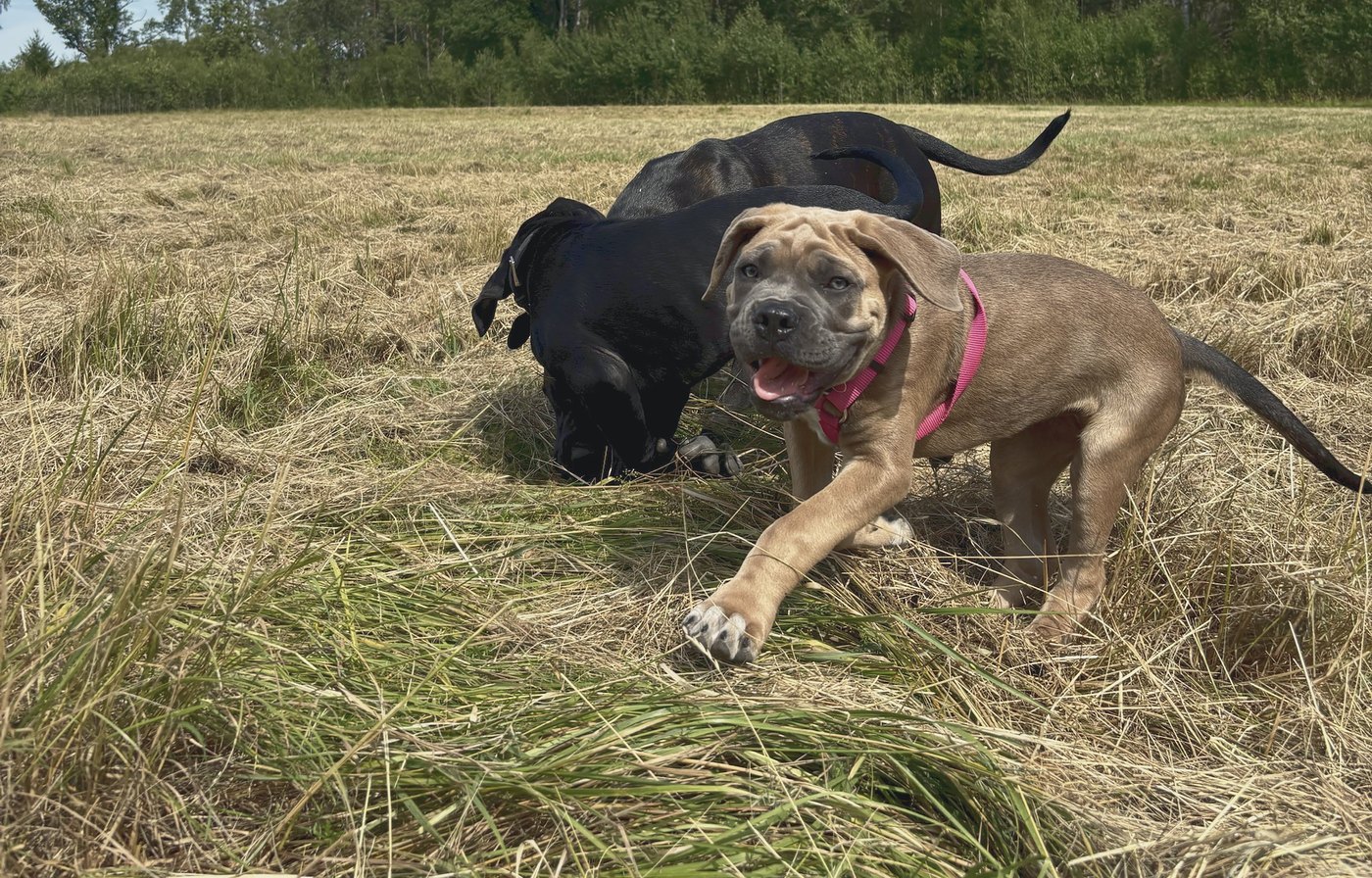
The canine nasal cavity holds hundreds of millions of sensory neurons, packed into the olfactory epithelium that lines the folded turbinates at the back of the nose. Size is only part of the explanation for how good dogs are at smelling. Craven and colleagues reconstructed the inside of a dog’s nose from MRI scans and simulated the airflow during sniffing. They found that each nostril picks up its own separate odor sample, which may help a dog compare the strength of a smell on each side and locate where it comes from, and that the airflow inside the nose is shaped to carry odors to the scent-sensing area. Nasal airflow in people works very differently.
For a dog, sniffing is gathering information. A walk where the dog is allowed to stop and sniff is not wasted time, and a new home, a new visitor or a new dog is first “read” through the nose. Our article on reading your dog’s body language covers what the rest of the body tells you while the nose is busy.
Can dogs smell fear?
Two studies suggest that dogs can pick up something from the way people smell when they are stressed or afraid. D’Aniello and colleagues collected underarm sweat from men in conditions of happiness and of fear, and exposed Labrador and Golden Retrievers to the samples while their owner and a stranger were in the room. With the “fear” odor, the dogs showed more stress behaviors and had higher heart rates than with the “happy” odor or no odor.
Wilson and colleagues took breath and sweat samples from 36 people before and after a stressful mental arithmetic task, and trained four dogs to find the stress sample. Presented with a person’s stress sample, the same person’s sample from before the task and a blank, the dogs chose the stress sample in about 94% of trials.
These are small studies, so they show that dogs can detect and react to these odor changes, not that every dog notices every time someone is nervous.
Sight: fewer colors, more motion
Neitz and colleagues tested three dogs in a series of color discrimination experiments and found that the dog retina has two classes of cone pigment, with peaks at about 429 nm and 555 nm. Dogs therefore have dichromatic color vision: they see colors, but fewer than most people.
In a review of canine vision, Miller and Murphy describe a trade-off. Compared with people, dogs have less overlap between the fields of view of the two eyes, fewer colors, less ability to change focus and less sharp vision. They are probably better at seeing in dim light, at registering rapid changes in an image (flicker), at telling shades of gray apart, and perhaps at detecting motion, and they have a wider field of view. Lind and colleagues tested whippets, pugs and a Shetland Sheepdog and found that, in both bright and dim light, people could make out patterns from roughly three times the distance that dogs could, with large differences between individual dogs.
In practice, a dog may not recognize you at a distance until you move or speak, and a toy that stands out to you may be hard for a dog to find by sight on grass.
Hearing: higher than ours
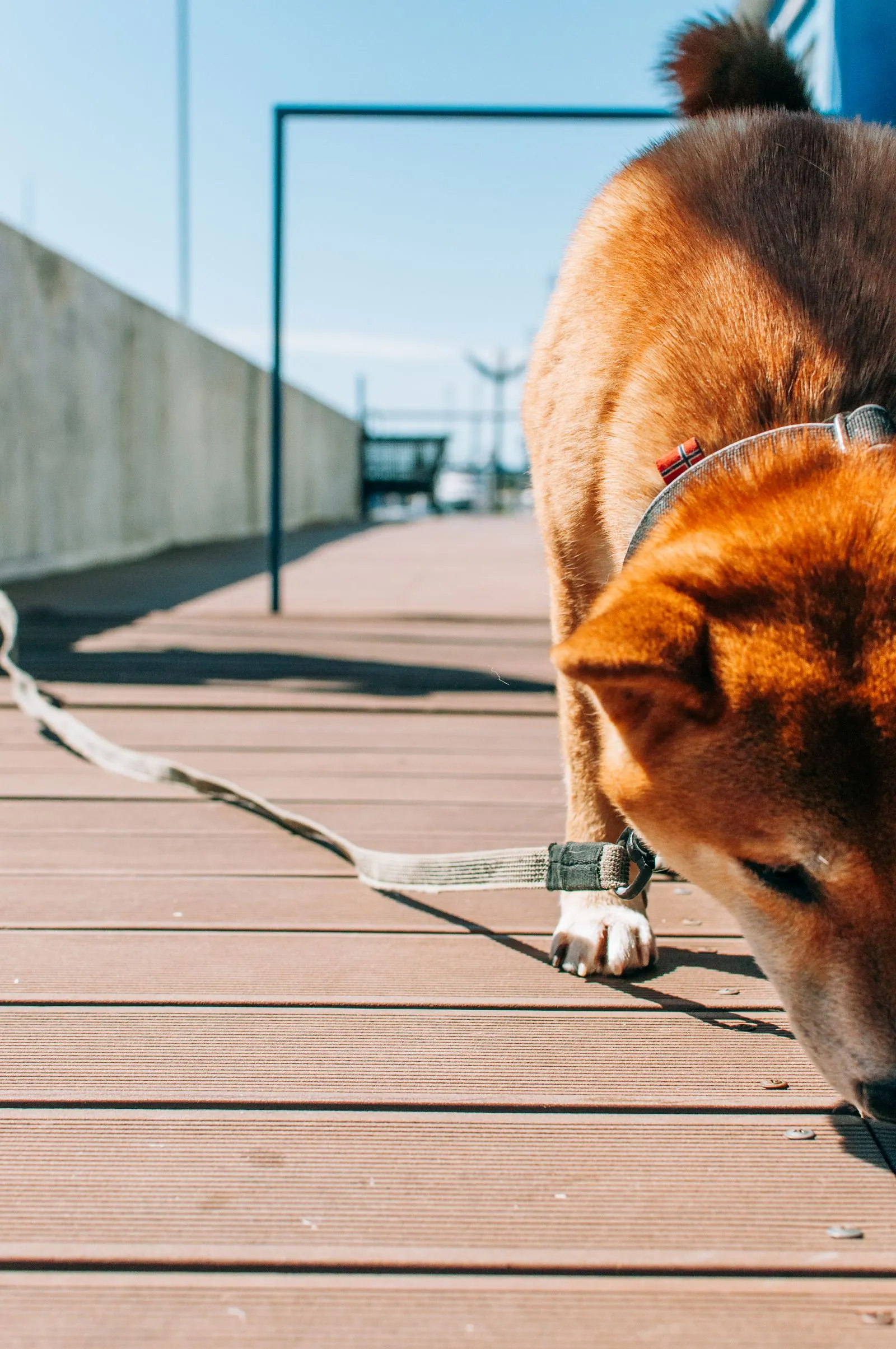
The approximate hearing range of the dog runs from about 67 to 45,000 Hz, compared with about 64 to 23,000 Hz for people, according to the deafness resource of Louisiana State University’s School of Veterinary Medicine. Dogs hear high-pitched sounds that people cannot, so a dog may react to a sound you cannot hear at all.
Hearing can be lost before birth or later in life. In a review of deafness in dogs and cats, Strain describes inherited congenital deafness, which in most breeds follows the loss of a blood-vessel layer in the inner ear around the time of birth and appears to be linked to the absence of pigment cells there. Later-onset hearing loss can come from drugs or chemicals that damage the inner ear, from aging, and from chronic ear infections. For breeders, congenital deafness can be present in a puppy that otherwise looks and acts normally, so it is worth asking your vet or breed club whether hearing testing is recommended in your breed.
Puppies’ senses develop over the first weeks
How a puppy’s senses come online over the first weeks is covered in physical development of the growing litter, and how breeders use that period in puppy socialization.
In practice
A family’s young dog barks at a neighbor every evening when he comes home along the dark path, but greets him happily once he speaks. The family realizes the dog cannot make out who he is in dim light at a distance. They ask the neighbor to say hello as he approaches, and the barking stops within a week.
(Illustrative, composite scenario.)
When to call your veterinarian
- Your dog suddenly bumps into things, hesitates on stairs or in dim light, or its eyes look cloudy, red or painful.
- Your dog stops responding to sounds it used to react to, or shakes its head, scratches its ears or has a smell or discharge from the ears.
- Your dog loses interest in food or sniffing, or has a nosebleed or discharge from the nose.
- If in doubt, call — your vet would rather hear from you early.
Work on it
A few minutes here will teach you more than re-reading the article.
Ask yourself
- Does my dog get time to sniff on walks?
- Does my dog react to sounds I can’t hear, or to people it can’t yet see clearly?
- If I breed, do I know whether congenital deafness occurs in my breed?
Find out & check
- Ask your breed club or vet whether hearing testing of puppies is recommended in your breed.
Do one thing
- Give your dog one walk this week where it chooses the pace and stops to sniff as often as it likes.
Was this article helpful?
Anonymous. We do not store your name, email or IP address.
Sources & further reading
- Craven BA, Paterson EG, Settles GS. The fluid dynamics of canine olfaction: unique nasal airflow patterns as an explanation of macrosmia. Journal of the Royal Society Interface 2010. doi.org
- D’Aniello B, Semin GR, Alterisio A, Aria M, Scandurra A. Interspecies transmission of emotional information via chemosignals: from humans to dogs (Canis lupus familiaris). Animal Cognition 2018. doi.org
- Wilson C, Campbell K, Petzel Z, Reeve C. Dogs can discriminate between human baseline and psychological stress condition odours. PLoS ONE 2022. doi.org
- Neitz J, Geist T, Jacobs GH. Color vision in the dog. Visual Neuroscience 1989. doi.org
- Miller PE, Murphy CJ. Vision in dogs. Journal of the American Veterinary Medical Association 1995. pubmed.ncbi.nlm.nih.gov
- Lind O, Milton I, Andersson E, Jensen P, Roth LSV. High visual acuity revealed in dogs. PLoS ONE 2017. doi.org
- Strain GM. Aetiology, prevalence and diagnosis of deafness in dogs and cats. British Veterinary Journal 1996. doi.org
- Louisiana State University School of Veterinary Medicine — How well do dogs and other animals hear? lsu.edu
Where evidence is limited, recommendations rest on established practice and expert judgment, and may be updated as knowledge develops. This is general information, not veterinary advice: talk to your veterinarian about your own dog.
Next steps
- Read next: Reading your dog’s body language.
- Related: Physical development of the growing litter · Puppy socialization.