Between three and eight weeks, puppies transform from barely mobile newborns into coordinated, dog-like puppies — knowing the typical order of milestones helps you tell normal development from something worth a closer look.
The most important first
- Touch, warmth, taste and smell work from birth; the eyes usually open at around 10–14 days and the ears at around two to three weeks, and full sight and hearing take several more weeks.
- First (deciduous) teeth erupt around three weeks (from about two and a half to four weeks), right around when weaning naturally begins.
- Puppies typically attempt to stand around two weeks, climb out of the whelping box around three weeks, and walk, run, and play by around four weeks.
- Puppies start eliminating on their own at around two to three weeks, and by about four weeks almost all manage without help.
- By eight weeks, coordination is markedly more adult-like and many puppies mostly use the toilet area — but full bladder and bowel control takes months.
- Weight is the milestone you can measure: at least 1.5 × birth weight by day 7, and doubled by about day 10–14.
Sensory development
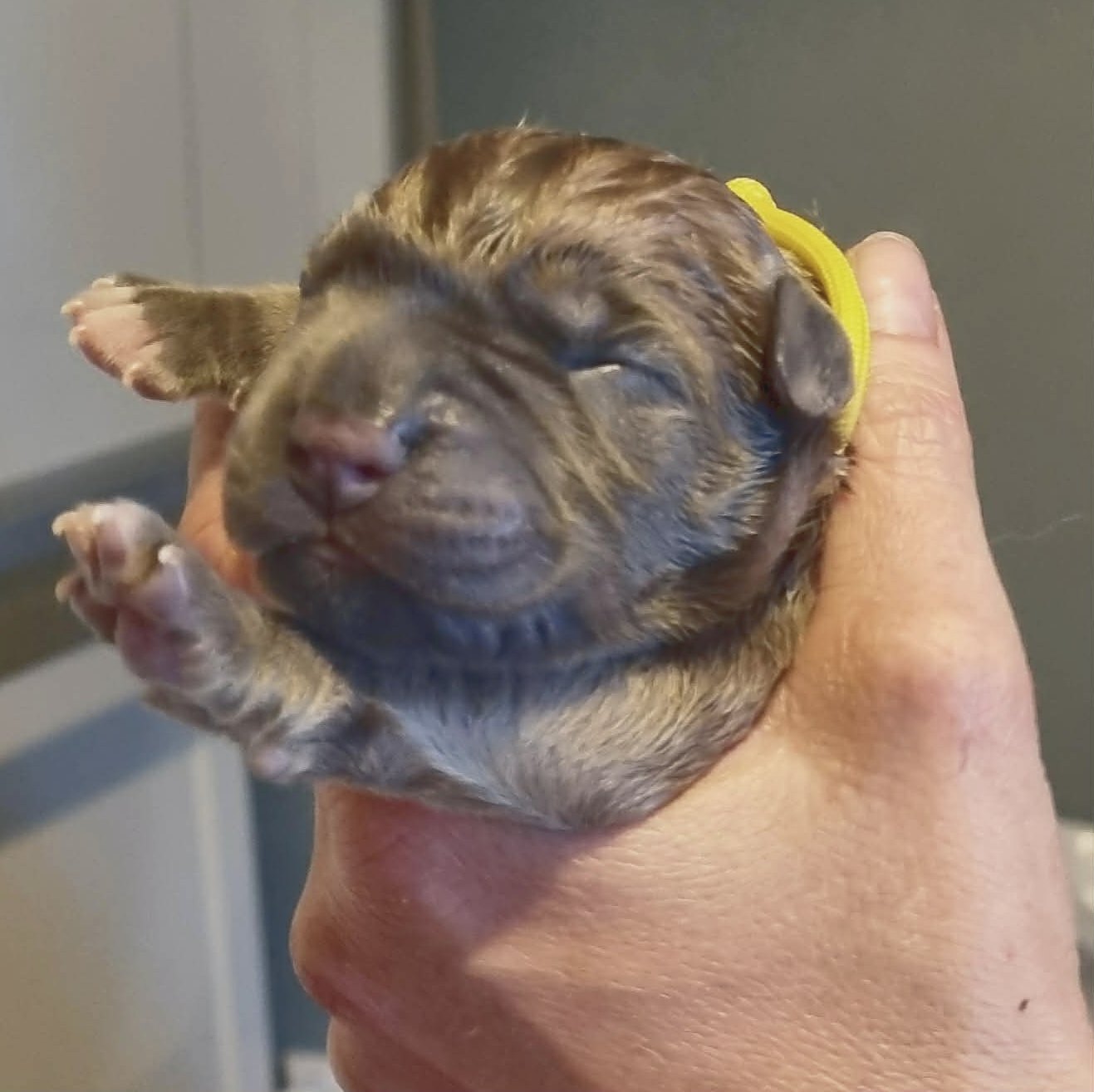
Newborn puppies are not without senses. Touch, warmth, taste and smell work from birth — that is how a puppy finds the teat and the warmth of its littermates. What is missing is sight and hearing. The eyes usually open at around 10–14 days and the ears at around two to three weeks, and both take several more weeks to work fully. This ties into why the neonatal period treats these early weeks as such a distinct, high-dependency stage.
If a puppy’s eyes have not begun to open by about two weeks, or you see swelling, bulging or discharge behind the closed lids, call your vet promptly — infection under the lids needs treatment.
Teeth and the start of weaning
The first deciduous teeth erupt at around three weeks of age (eruption can begin from about two and a half weeks), and this coincides closely with the start of natural weaning behavior — puppies begin showing interest in something beyond milk right around when they have the teeth to manage it. This is covered in more practical detail in from nursing to weaning.
Movement milestones
A rough order to expect: puppies attempt to stand at around two weeks, climb out of the whelping box by around three weeks, and are walking, running, and playing by around four weeks. Coordination continues improving steadily from there through to eight weeks, when movement becomes noticeably more adult-like.
Temperature control develops alongside movement: puppies cannot fully regulate their own body temperature until about four weeks, so keep supplementary warmth available until then, with a cooler area they can move to.
How fixed are these ages?
These ages are averages, not deadlines. Development varies by breed and by individual — studies have found, for example, that some toy and spaniel breeds reach behavioral milestones at different ages from larger breeds — and much of the research behind the classic timelines is decades old and based on small numbers of dogs. Judge each puppy against its littermates and its own progress, and ask your vet when something seems clearly behind rather than slightly slower.
In practice
A breeder is surprised at how wobbly and uncoordinated a three-week-old puppy still looks compared to how confidently it moves just a few weeks later. Understanding that coordination develops progressively over these weeks — rather than arriving all at once — helps the breeder judge a given puppy’s development against the expected timeline rather than against an unrealistic, more mature standard.
(Illustrative, composite scenario.)
Elimination and independence
Puppies start to urinate and defecate on their own during the transitional period, at around two to three weeks, and by about four weeks almost all manage without help. Until then the dam — or you, if hand-rearing — stimulates them after meals. By eight weeks, many puppies in a well-designed pen will mostly use the toilet area, a sign of how much spatial awareness and mobility has developed — but full bladder and bowel control takes months, so tell buyers to expect accidents.

Weight: the milestone you can measure
Weight is the most objective sign that development is on track. A healthy puppy should reach at least one and a half times its birth weight by day 7 and roughly double it by about day 10–14, then keep gaining steadily. A puppy that stops gaining, loses weight or falls clearly behind its littermates should be seen by a vet within 24–48 hours — in very young puppies, decline can be fast. Weighing is covered in more detail in growth and body condition in puppies.
When to call your vet
- A puppy’s eyes have not started to open by about two weeks, or there is swelling or discharge behind the lids.
- A puppy loses weight, stops gaining, or is clearly smaller and slower than its littermates — within 24–48 hours.
- A puppy is not attempting to stand by about three weeks, or cannot walk by about four weeks.
- A puppy is not eliminating, strains, or has a swollen belly.
- A puppy’s legs splay out to the sides and it cannot get them under its body.
- A puppy is less active, less responsive or cooler than its littermates.
- If in doubt, call — your vet would rather hear from you early.
Work on it
A few minutes here will teach you more than re-reading the article.
Ask yourself
- Do I know the rough order of movement milestones well enough to notice if a puppy is meaningfully behind?
- Would I judge a wobbly three-week-old puppy against the right developmental stage, not an unrealistic one?
- Am I tracking when each puppy starts managing elimination independently?
Find out & check
- Find out whether your vet wants to know about any puppy that seems meaningfully behind these general milestones.
Do one thing
- Note this week’s expected milestones for your litter’s current age, and check the litter against them.
Was this article helpful?
Anonymous. We do not store your name, email or IP address.
Sources & further reading
- Merck Veterinary Manual — Social Behavior of Dogs. merckvetmanual.com
- Lawler DF (2008), Theriogenology 70:384–392 — Neonatal and pediatric care of the puppy and kitten. confluence.cornell.edu
- Purdue University Center for Animal Welfare Science — Puppy Developmental Stages. caninewelfare.centers.purdue.edu
- VCA Animal Hospitals — Breeding for Dog Owners: Caring from Birth to Weaning. vcahospitals.com
- American Kennel Club — A Puppy Growth Timeline: Transitions in Puppyhood. akc.org
- McEvoy V, Baqueiro Espinosa U, Crump A, Arnott G (2022), Animals 12(21):2895 — Canine Socialisation: A Narrative Systematic Review. mdpi.com
- Dogs NSW — Care of Puppies, Birth to 10 Days. dogsnsw.org.au
Where evidence is limited, recommendations rest on established practice and expert judgment, and may be updated as knowledge develops.
Next steps
- Read next: Growth and body condition in puppies.
- Related: From nursing to weaning.
- Return to the area hub: Raising a healthy litter.