Exporting a puppy removes the two things your placement process quietly depends on — the home visit and the ability to take the dog back — and replaces them with a chain of documents in which one missing item can leave a young animal in a holding facility at somebody else’s airport.
The most important first
- Age minimums can end the conversation before anything else: the US Centers for Disease Control and Prevention requires dogs to be at least six months old at the time of entry or return to the United States, a rule in force since August 1, 2024. Because a puppy is being sold, US Department of Agriculture rules for dogs imported for resale apply as well.
- Most official pet-travel rules cover non-commercial moves only — no sale, no change of ownership. A sale is usually a commercial movement with different rules. As a baseline, EU pet-travel timings stack: a pet dog must be at least 12 weeks old before its first rabies vaccination, then wait at least 21 days before traveling, and entry from outside the EU needs an EU animal health certificate from an official state vet issued not more than 10 days before arrival.
- Everything above is jurisdiction-specific and changes. Treat it as an illustration of the shape of the problem, and confirm the actual requirements with the destination country’s competent authority and an official veterinarian close to the travel date.
- Transport has its own rulebook: IATA container dimensions derive from the individual animal’s measurements, snub-nosed breeds need a container 10% larger, and airlines limit how many animals travel per flight.
- Registry paperwork is a separate chain from the health paperwork, and a buy-back clause you cannot enforce across a border must be replaced with something you can — the subject of buy-back, returns and rehoming.
Rules last checked: November 1, 2026
Checked against the listed official sources (CDC, USDA APHIS, European Commission and Your Europe, GOV.UK, IATA, Royal Kennel Club) on the date above. Entry rules change often and depend on whether a movement is commercial. Confirm the rules with the destination authority and an official veterinarian before you accept a deposit, and again close to the travel date.
The buyer you cannot visit
Everything in interviewing and selecting buyers still applies, but you have lost your best instruments. What replaces them is slower: a long written exchange, a video call in which the buyer walks you through the house rather than sitting in front of a bookcase, and references you actually contact — their veterinary practice, their breed club, the breeder of their previous dog. Someone in an active national breed club there will often know them.
Set the standard higher, not lower, because your ability to intervene later is close to nil. Two questions do most of the filtering: who in that country would take the dog if their circumstances changed, and whether they will stay in contact for its whole life, in writing, in a language you both manage.
Age, rabies and the paperwork chain
Most official pet-travel pages describe non-commercial travel, meaning a dog moving with its owner, with no sale and no change of ownership. Selling a puppy abroad is a commercial movement in most systems, and different rules apply. In the EU, dogs that do not meet the non-commercial conditions enter under the animal health rules of Delegated Regulation (EU) 2020/692. In Great Britain, the “Balai” rules apply whenever a dog is being sold, rehomed or transferred to a new owner. Treat the timings below as the minimum baseline, and confirm the commercial route with the official veterinarian and the destination authority before you take a deposit.
The order of operations is generally fixed even where the details are not. A permanent identifier comes first, because the rabies vaccination must be recorded against it — in the EU, a microchip meeting the technical requirements of the pet traceability rules. The vaccination follows, and cannot be given before a minimum age. Then a waiting period before travel. Then examination and certification by a veterinarian authorized by the state to issue it, within a short window before arrival. Some destinations add a rabies antibody test with its own waiting period, some an import permit the buyer must obtain in advance, some a tapeworm treatment before arrival.
Two examples show why no single schedule can be published as universal. For a pet dog moving into the EU from outside it, the union’s guidance for citizens sets the rabies vaccination no earlier than 12 weeks of age, a wait of at least 21 days afterwards, and an EU animal health certificate from an official state vet issued no more than 10 days before arrival — putting the earliest realistic arrival around fifteen or sixteen weeks of age, before any country-specific additions. For the United States, the CDC’s requirement that a dog be at least six months old at entry makes an eight-week placement to an American buyer impossible, whatever the contract says. And rules written for an owner traveling with their own pet do not cover a sale, as set out above; confirm with the authorities in both countries which commercial route your transaction falls under.
Because the puppy is being sold, US Department of Agriculture rules for dogs imported for resale apply as well as the CDC rules. The dog must be at least six months old, vaccinated against rabies at least 30 days before arrival, vaccinated against distemper, hepatitis, parvovirus, parainfluenza and leptospirosis, and must travel with an English-language health certificate and an import permit issued by USDA APHIS.
So fix the timetable before you accept a deposit, work backwards from the flight to the vaccination date, and build in slack: an official veterinarian’s appointment inside a ten-day window, in a week containing a public holiday, is the kind of detail that strands a puppy.
Transport, and the welfare question that stays yours
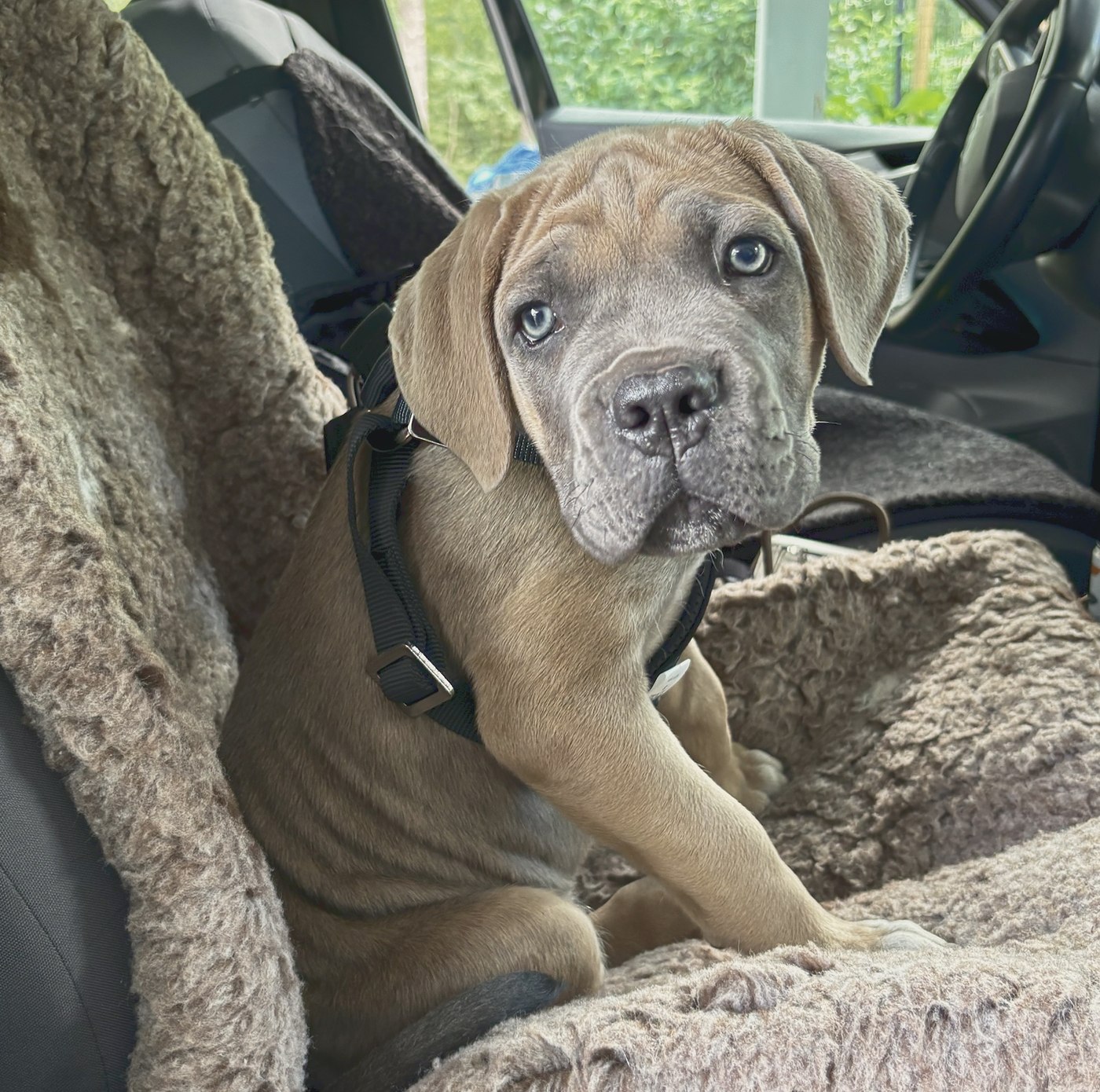
An exported puppy travels in the cabin, as baggage or as cargo, and the rules differ. IATA publishes the Live Animals Regulations airlines work to, and the container standard is specific: length from the animal’s nose to the base of its tail, plus half the height from the ground to its elbow, width twice the shoulder width, height its standing height plus bedding, and 10% more for snub-nosed breeds. Airlines restrict numbers per flight, so book early and reconfirm at least 48 hours before departure.
None of that is the welfare question. That is whether this individual puppy, at this age, is ready for a journey of that length, and whether you have prepared it — crate-conditioned rather than crate-introduced the night before, used to being alone, eating and drinking away from its litter, habituated to noise and movement. The groundwork is in crate, travel and short separations and the first journey and the first days at home. A direct flight beats a transfer, an accompanied dog beats unaccompanied cargo, and a heat embargo can cancel the plan outright. The exporting country has rules too. In Australia, for example, Dogs Australia requires members to comply with all current Department of Agriculture export requirements, and the importing country’s conditions decide which certificate the official vet issues.
Pedigree documents and registration abroad
The health chain gets a puppy into the country. It does nothing about its papers. Registries that recognize each other’s pedigrees require a document from the exporting club, and applying for it takes time. The Royal Kennel Club, for example, issues an export pedigree: not needed for the dog to leave the country, but what allows most overseas clubs to register it as an imported dog. Most receiving clubs want a certified three-generation export pedigree and ownership certificate, and processing typically takes twenty-eight days. Before you apply, transfer the dog into the new owner’s registered ownership, and lift any “export pedigree not allowed” (X) endorsement if you have placed one, because an export pedigree cannot be issued while it stands.
So ask, before the sale is agreed, what your registry issues, how long it takes and what the receiving club requires. Apply early, and make sure the buyer knows that screening and DNA results may need resubmitting to be recognized there, and that a restriction you placed at home may not carry across.
In practice
A breeder agrees to export a ten-week-old puppy, the buyer arranging flights. Checking the destination’s requirements two weeks out, the breeder finds a rabies antibody test is required, that it cannot be taken until thirty days after vaccination, and that a further three-month wait follows: the puppy would be nearly seven months old before it could travel. Rather than push the family into a worse plan, the breeder offers a place on the next litter with the timetable built in from the mating, and keeps the puppy — four more months it had not budgeted for.
(Illustrative, composite scenario.)
Follow-up, buy-back, and when to decline
A return clause is only as good as your ability to act on it. Across a border, name a person or organization in the destination country who has agreed in advance to take the dog if the placement fails — a breed club contact, a breed rescue, a breeder you trust — and say who pays for what. Commit to a realistic follow-up rhythm rather than a vague promise, and keep collecting what you would at home, as in staying in contact with puppy buyers and collecting health and longevity data.
And be willing to say no. Decline when the timetable would mean the puppy travels at an age or in a way you would not accept for your own dog; when you cannot verify the buyer to the standard you use at home; when you cannot name anybody in that country who would help the dog; or when you do not understand the destination’s requirements well enough to be sure they will be met. Declining is not a failure of generosity. It is the judgment you apply to a local placement, made without the safety net.
Talk to your vet when planning: before you accept a deposit, ask your vet or an official veterinarian to map the vaccination, titer and certificate timeline for that destination.
Work on it
A few minutes here will teach you more than re-reading the article.
Ask yourself
- For the last export I considered, did I work the paperwork timetable backwards from the flight — or forwards from the puppy’s age and hope?
- Who, by name, would take one of my dogs in each country I have placed into?
- Am I assessing an overseas buyer to the same standard as a local one, or a lower one because they are keen and far away?
Find out & check
- Look up the destination country’s current requirements on its own government or competent-authority website, then confirm them with an official veterinarian authorized to certify exports from your country — and do it again close to the travel date.
Do one thing
- Write your export refusal criteria down in five lines today, before an inquiry arrives that makes you want to bend them.
Was this article helpful?
Anonymous. We do not store your name, email or IP address.
Sources & further reading
- US Centers for Disease Control and Prevention — Entry Requirements for Dogs from Dog-Rabies-Free or Low-Risk Countries. cdc.gov
- USDA APHIS — How To Bring Dogs into the United States for Commercial Sale or Adoption. aphis.usda.gov
- European Union — Your Europe: EU rules on travelling with pets and other animals in the EU. europa.eu
- European Commission — Movement of pets. food.ec.europa.eu
- GOV.UK — Bring your pet dog, cat or ferret to Great Britain. gov.uk
- International Air Transport Association — Traveler’s Pet Corner. iata.org
- The Royal Kennel Club — Overseas registration. royalkennelclub.com
- Dogs Australia — Code of Practice (July 2023). dogsaustralia.org.au
Where evidence is limited, recommendations rest on established practice and expert judgment, and may be updated as knowledge develops. Rabies vaccination timings, health certification, identification and import permits are set by each destination country and are revised frequently: nothing here is a schedule to travel on, and every requirement must be confirmed with the destination country’s authority and an official veterinarian close to the date. This is general information, not legal or financial advice: requirements differ between countries and change over time — have your own documents reviewed by a qualified professional in your jurisdiction.
Next steps
- Read next: Preparing for the handover.
- Related: Buy-back, returns and rehoming · Breeding and selling puppies in the United States: federal, state and local rules.
- Return to the area hub: From first inquiry to settled puppy.
- Also: Flying dogs and puppies: the IATA crate rules (CR82).