Milk supply is judged less by how much you can see and more by how the puppies are actually doing — knowing what to track, and what genuinely signals a problem, saves a lot of unnecessary worry.
The most important first
- Colostrum is normally modest in volume — don’t mistake a small amount for a supply problem. What matters is that every puppy nurses within the first 24 hours.
- The best sign of adequate supply is steady daily puppy weight gain from 24 hours old onward, not how much milk you can visibly see.
- Peak lactation demand hits around 3–5 weeks postpartum, when a dam may need 2–4 times her normal adult calories.
- True agalactia (no milk at all) is uncommon — most low-supply cases have an identifiable underlying cause.
- Milk letdown is driven by nursing itself, so frequent, effective nursing is what sustains supply, not the other way around.
Colostrum and the first hours
Colostrum — the first milk, rich in maternal antibodies — isn’t produced in large volumes, and that’s normal; a modest amount in the first hours and days shouldn’t be mistaken for a lack of milk. What matters most in this window is that puppies are actually latching and nursing, since colostrum’s antibody transfer is time-limited: absorption starts within hours of birth and has largely stopped by about 24 hours.
Make sure every puppy nurses within the first few hours, and certainly within the first 24 hours. If a puppy has not fed by the time it is about 12 hours old, ring your vet: they can give serum that provides some of the same protection.
Judging supply by the puppies, not the milk
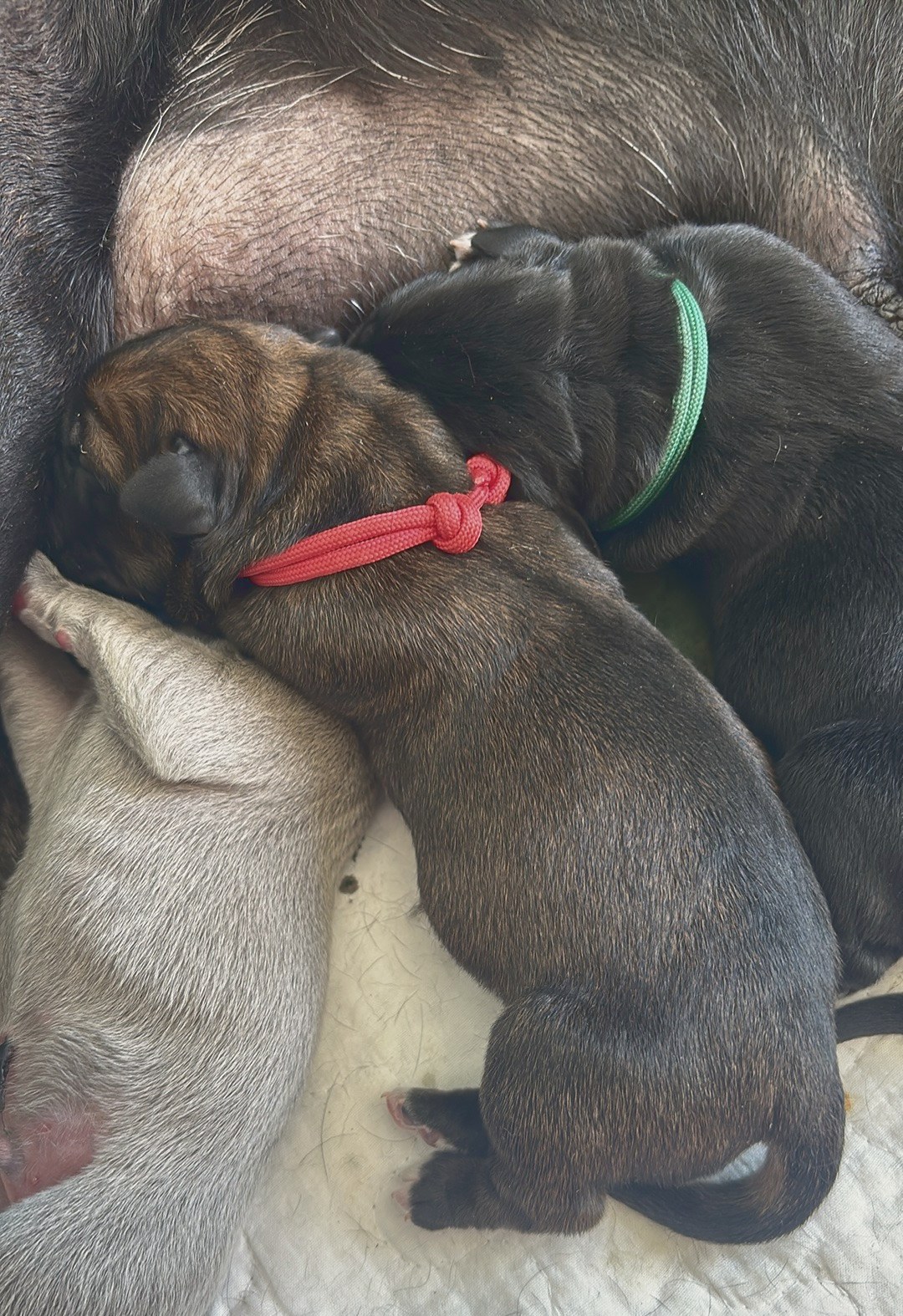
Rather than trying to judge supply visually, the most reliable sign of adequate milk is steady daily weight gain in the puppies from about 24 hours old onward, alongside puppies that settle and sleep contentedly between feeds rather than crying persistently. This is part of why daily weighing, tracked in your whelping log, matters as much in the days after whelping as during it.
Weigh each puppy at birth and then at least once a day, ideally twice a day in the first week, on kitchen scales that read in grams. A small loss on the first day (up to about 10% of birth weight) is acceptable. After that, puppies should gain roughly 5–10% of their body weight every day, reaching at least 1.5 times their birth weight by day 7 and about double it by day 10–14. A puppy that is losing weight, or not gaining, after the first 24 hours needs attention that day. Contact your vet; do not wait to see whether it catches up.
In practice
A new breeder worries because they can’t see much milk when gently expressing a teat, despite puppies nursing regularly and gaining weight normally. Because puppy weight gain — not visible milk volume — is the reliable indicator, this is reassuring rather than concerning; visual checks of milk volume are a poor substitute for tracking actual puppy weights.
(Illustrative, composite scenario.)
Nutritional needs of a nursing dam
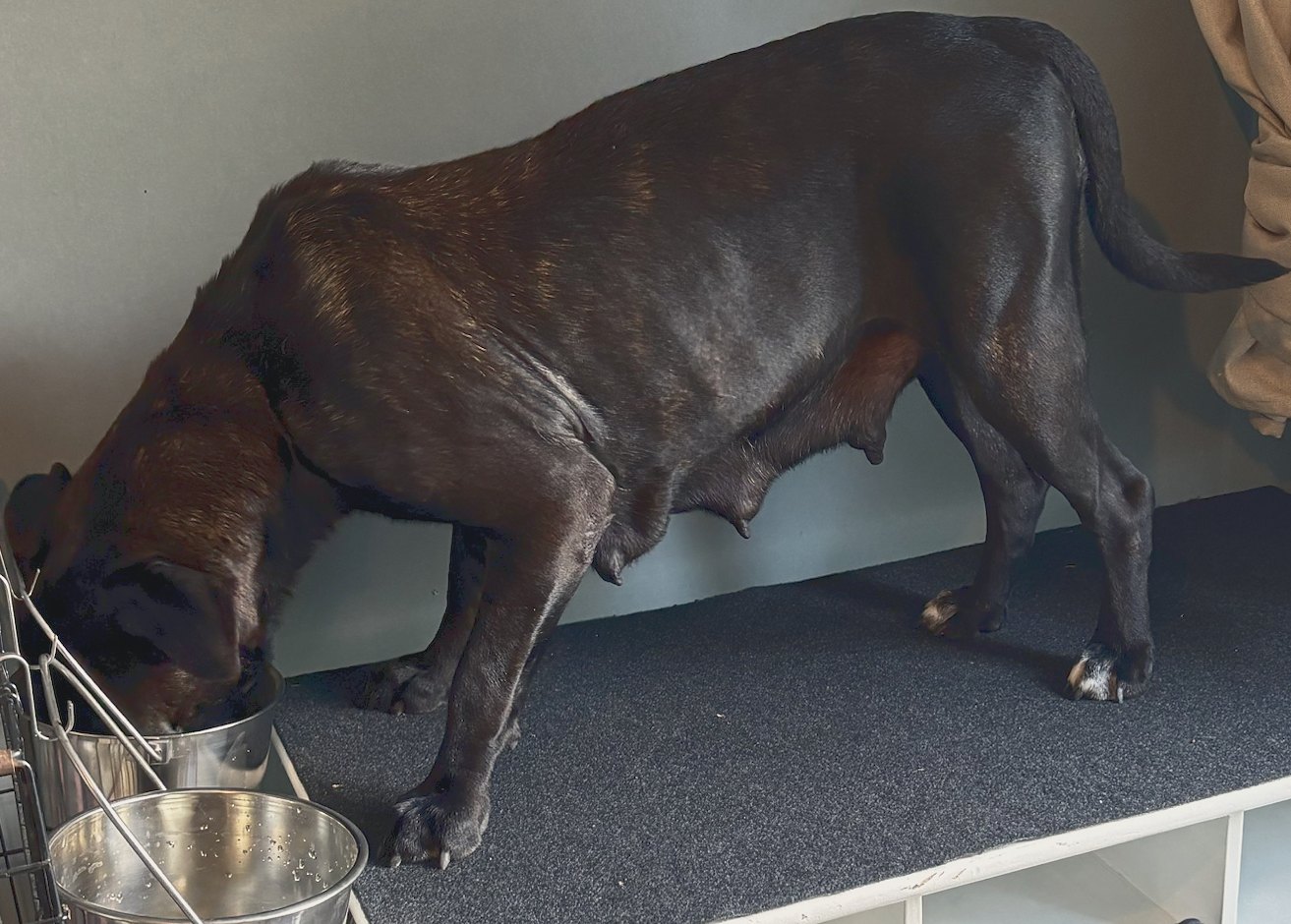
Lactation is calorically demanding, peaking around 3 to 5 weeks postpartum, when a dam may need roughly 2 to 4 times her normal adult maintenance calories, gradually returning to baseline by around 8 weeks as weaning completes. A high-energy-density food formulated for gestation and lactation, or a quality all-life-stages formula, fed free-choice so she can eat as needed throughout the day, is the standard approach — restricting her food during this period isn’t appropriate.
Milk output rises with the number of puppies, so a big litter means a much bigger appetite. Keep fresh water available at all times, because even mild dehydration reduces milk. With a large litter, especially in a small breed, ask your vet about supplementing the puppies with milk replacer and offering soft solid food from around three to four weeks. This eases the drain on the dam and lowers her risk of eclampsia, which is most likely in the first four weeks of heavy nursing. Do not give calcium supplements during pregnancy unless your vet prescribes them. They can increase rather than prevent the risk.
When supply is genuinely inadequate
True agalactia — a real absence of milk — is uncommon, and when supply is low, it usually has an identifiable cause: mastitis, metritis, eclampsia, nutritional deficits, dehydration, pain, or (less commonly) a hormonal disruption. Progesterone supplementation during pregnancy is a known but avoidable cause of reduced milk production afterward. If supply does need support, a vet may use a small dose of oxytocin alongside metoclopramide, which can improve production within roughly 12 to 24 hours — this is a vet-administered intervention, not something to attempt independently.
A quick note on milk stasis vs. mastitis
Galactostasis — milk stasis or engorgement, without infection — can occur and predisposes a gland toward mastitis if it isn’t relieved, but it isn’t itself an infection. Postpartum complications: mastitis, metritis and eclampsia covers the infected form and its warning signs in detail; the distinction matters because the two are managed differently.
Check every day that all teats are being used. A gland the puppies avoid can become full, hard and hot. Keeping the puppies’ nails trimmed and the bedding clean helps protect the glands. A gland that is hot, painful or produces discolored milk needs a vet check the same day.
When to call your vet
- A puppy has not nursed by about 12 hours old: puppies must get colostrum within the first 24 hours.
- A puppy loses weight, or does not gain, after its first 24 hours; healthy puppies reach at least 1.5 times birth weight by day 7.
- Puppies cry constantly and will not settle between feeds.
- A gland is hot, hard, painful or produces discolored or bloody milk.
- The dam has a temperature above 103 °F (39.5 °C), stops eating, or seems weak or flat.
- She trembles, pants heavily, walks stiffly or seems restless and anxious while nursing: possible eclampsia, an emergency.
- If in doubt, call — your vet would rather hear from you early.
Work on it
A few minutes here will teach you more than re-reading the article.
Ask yourself
- Am I tracking puppy weight daily, rather than judging supply by how the milk looks?
- Is the dam’s food genuinely free-choice and calorie-dense enough for peak lactation demand?
- Would I recognize the difference between simple engorgement and a genuine infection?
Find out & check
- Find out what feeding schedule and food your vet recommends specifically for a nursing dam of your breed and litter size.
- Check the dam’s mammary glands daily for heat, swelling, or discomfort.
Do one thing
- Set up daily puppy weigh-ins now, if you haven’t already, as your primary check on milk adequacy.
Was this article helpful?
Anonymous. We do not store your name, email or IP address.
Sources & further reading
- VCA Animal Hospitals — Feeding the Nursing Dog. vcahospitals.com
- Merck Veterinary Manual — Periparturient Problems in Bitches and Queens. merckvetmanual.com
- Merck Veterinary Manual — Management of the Neonate in Dogs and Cats. merckvetmanual.com
- Merck Veterinary Manual — Labor, Delivery, and Postpartum Care in Bitches and Queens. merckvetmanual.com
- Merck Veterinary Manual — Mastitis in Small Animals. merckvetmanual.com
- Calabrò S et al. (2021), Animals — Effects of Two Commercial Diets on Several Reproductive Parameters in Bitches: Note Two—Lactation and Puppies’ Performance. doi.org
- Merck Veterinary Manual — Eclampsia in Small Animals. merckvetmanual.com
Where evidence is limited, recommendations rest on established practice and expert judgment, and may be updated as knowledge develops.
Next steps
- Read next: Postpartum complications: mastitis, metritis and eclampsia.
- Related: The dam’s first 24 hours after whelping.
- Return to the area hub: Whelping: the complete guide from first contractions to recovery.