If you’re reading this because something seems wrong right now, the list below is what to check first. Any one of these is a reason to call your vet immediately — don’t wait to see if it resolves on its own.
The most important first
- Strong, persistent straining for 20–30 minutes with no puppy delivered: call now.
- Weak or intermittent labor for about 2 hours with no puppy delivered: call now — never wait more than 4 hours.
- More than about 2 hours of rest between puppies when you know or expect more remain: call now.
- Green or black discharge before the first puppy, or with no puppy following within about 15–30 minutes later on: call now — this signals placental separation.
- Maternal collapse, extreme lethargy, seizures, or profuse bright-red bleeding: this is an emergency, call now.
Call your vet now if you see any of these
- No straining within 24 hours of the temperature drop or of the start of stage 1 signs — normal stage 1 is 6–12 hours.
- Strong, persistent straining for 20–30 minutes with no puppy delivered.
- Weak or on-and-off straining for more than about 2 hours with no puppy delivered — do not wait beyond 4 hours.
- More than about 2 hours between puppies when you know or expect more puppies remain (from a prenatal x-ray or ultrasound count).
- Green or greenish-black discharge before the first puppy (an emergency), or with no puppy following within about 15–30 minutes later in the whelping — this indicates placental separation and possible fetal oxygen deprivation.
- Foul-smelling discharge, or discharge that is markedly heavier than expected, at any point.
- Profuse, bright-red bleeding.
- A visible puppy or fetal membrane stuck in the birth canal without progress for about 15 minutes.
- Maternal distress: collapse, extreme lethargy, seizures, frequent vomiting, severe pain, exhaustion, repeatedly licking the vulva with no progress, or a temperature above 103°F (39.5°C).
- A known total litter count (from a prenatal x-ray or ultrasound) that doesn’t match the number of puppies delivered.
- Pregnancy beyond about 70 days from the first mating (or about day 66 from the LH surge) with no labor.
- Waters broken 2–3 hours ago with nothing following.
- Bloody discharge before the first puppy, or fresh bleeding that lasts more than about 10 minutes.
While you wait for, or travel to, the vet
Keep the puppies that are already born warm and dry in a separate, lined box, without direct contact with a heat source. Bring your whelping log, including when strong straining started and the expected puppy count. Do not give oxytocin, calcium or any other product to speed up labor unless your vet tells you to — given at the wrong moment, some of these can harm the bitch or the puppies.
Higher-risk bitches
Difficult births are more common in brachycephalic breeds, toy breeds, older or overweight bitches, and litters of more than about eight — but also with only one or two puppies, where labor may never become strong. If your bitch is in one of these groups, agree a plan with your vet before the due date.
Why these specific markers, not a general “feeling”
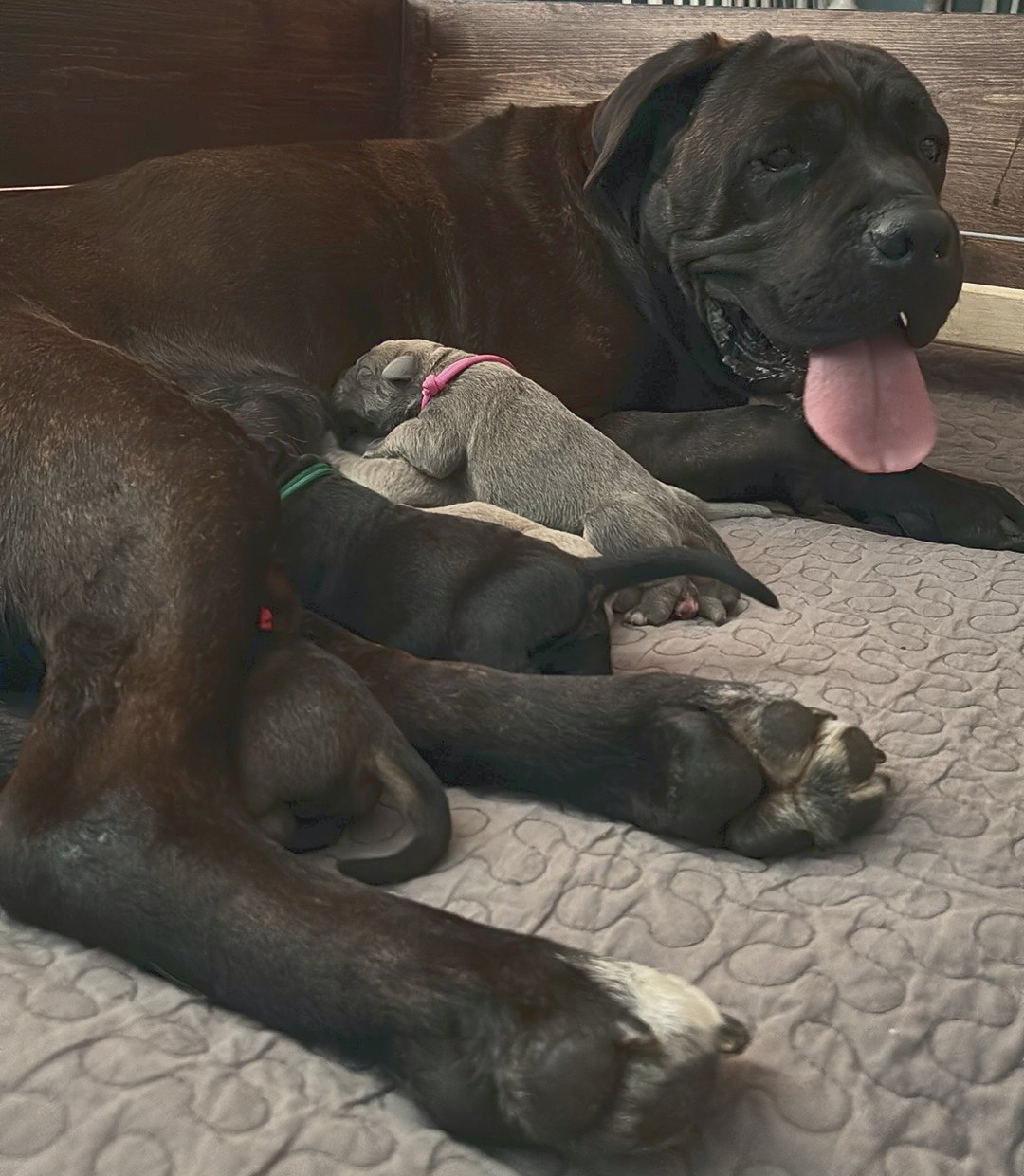
Each of these thresholds exists because it’s the point where the science shows outcomes start to worsen without intervention — for example, active labor lasting more than 4 hours without delivery, or whelping lasting more than 24 hours overall, meets the clinical criteria for dystocia. Waiting past these markers “to be sure” costs time that matters for both the dam and the remaining puppies. If you’re unsure whether what you’re seeing matches one of these, call and describe it — that’s a better use of your vet’s time than guessing.
What comes next
If your vet suspects the whelping has stalled, the next step is usually diagnosis and, depending on the cause, either medical management or surgery — covered in full in dystocia, malpresentation, and uterine inertia and cesarean section.
The danger does not end with the last puppy: trembling, restlessness, stiffness or seizures in the days and weeks after birth may be eclampsia (low blood calcium) and need urgent veterinary care.
When to call your vet
- Strong straining for 20–30 minutes without a puppy.
- Weak or on-and-off contractions for about 2 hours with no puppy — never wait more than 4 hours.
- More than about 2 hours between puppies when more are expected.
- Green or black discharge before the first puppy — call immediately.
- No labor within 24 hours of the temperature drop, or about day 70 after the first mating.
- A fever above 103°F (39.5°C), collapse, heavy bleeding, or trembling and seizures after the birth.
- If in doubt, call — your vet would rather hear from you early.
Work on it
A few minutes here will teach you more than re-reading the article.
Ask yourself
- Do I have this list somewhere I can find instantly, not just somewhere I’ve read it once?
- Do I know my puppy count from a prenatal x-ray or ultrasound, so I can check it against what’s delivered?
Find out & check
- Find out your vet’s after-hours emergency contact and confirm it works, before you need it.
Do one thing
- Bookmark or print this page now, before labor begins.
Was this article helpful?
Anonymous. We do not store your name, email or IP address.
Sources & further reading
- Cornell University Riney Canine Health Center — Dystocia in Dogs: Understanding Difficult Births. vet.cornell.edu
- Merck Veterinary Manual — Dystocia in Small Animals. merckvetmanual.com
- American Kennel Club — Best Practices for Whelping & Caring for Newborn Puppies. akc.org
- VCA Animal Hospitals — Breeding for Dog Owners: Problems at Birth. vcahospitals.com
- The Royal Kennel Club — Whelping complications and problems. royalkennelclub.com
- PDSA — Whelping: a guide to your dog giving birth. pdsa.org.uk
- Linde Forsberg C, Persson G (Acta Veterinaria Scandinavica, 2007) — A survey of dystocia in the Boxer breed. doi.org
Where evidence is limited, recommendations rest on established practice and expert judgment, and may be updated as knowledge develops. This is general information, not a substitute for immediate veterinary care during an actual whelping emergency.
Next steps
- Read next: Dystocia, malpresentation, and uterine inertia.
- Related: The stages of labor, step by step.
- Return to the area hub: Whelping: the complete guide from first contractions to recovery.