Pulling on the leash is a problem vets hear about regularly, and it is not a sign that the dog is trying to lead the pack. A dog pulls because it wants to get somewhere — to a smell, another dog, a person — and because pulling has worked before. Teaching a puppy that a loose leash is what gets it where it wants to go makes walks safer and more pleasant for both of you.
The most important first
- Pulling is learned, not a bid for rank. It is changed by making a loose leash worthwhile, not by force.
- Pulling matters for welfare: a review in the Veterinary Record notes that, apart from bites, being pulled over on a lead is the leading cause of non-fatal dog-related injuries in the UK, and that pulling can make walks shorter and less frequent.
- Pressure from a collar raised the pressure inside the eye in dogs in two studies, and no collar tested on a model neck kept pressure low enough to rule out injury when the dog pulled.
- In one study, shelter dogs pulled harder in a back-clip harness than in a collar to reach food. A harness spares the neck, but it does not teach a dog not to pull.
- Research on specific loose-leash training methods is limited; the approach below follows the reward-based methods veterinary behaviorists recommend.
Last updated: November 8, 2026
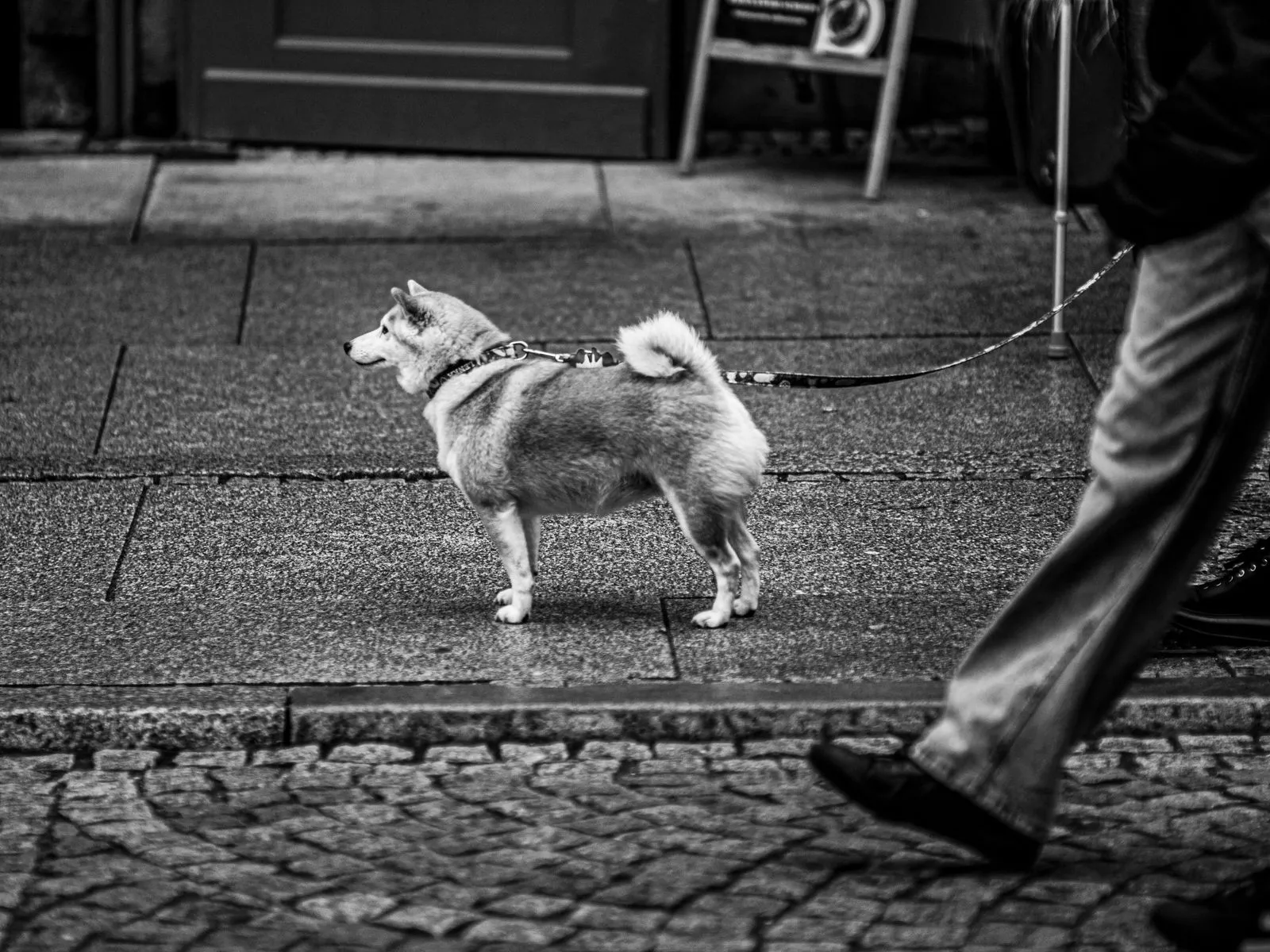
Why dogs pull
The world is full of things a dog wants to reach. If pulling gets a dog to the lamp post it wanted to sniff, the dog learns that pulling works. This has nothing to do with dominance: see dominance and the “alpha” myth for what research says about that idea. Dogs also take in the world mostly through the nose, so a walk without time to sniff is a frustrating walk; our article on how dogs sense the world explains why.
How the person on the other end behaves matters too. Shih and colleagues measured leash tension while shelter volunteers walked dogs and found that both the volunteers’ personalities and their way of handling the leash were linked with how much the dogs pulled.
Why pulling is a welfare issue
Townsend and colleagues, reviewing research on lead pulling for veterinary professionals, describe several knock-on effects. Pulling can make walks less frequent, shorter and less enjoyable, which can lead to weight gain and less mental stimulation, and it can weaken the bond between dog and owner, which is a risk factor for a dog being given up. Aversive equipment used to stop pulling can cause pain, distress and injury, and punitive training methods can cause stress, fear and anxiety and trigger aggression.
Collar or harness?
When a dog pulls against a collar, the pressure lands on the neck. Pauli and colleagues measured how hard 26 dogs pulled and then applied the same pressure through a collar or a harness: pressure inside the eye rose significantly with the collar but not with the harness. They recommend a harness for dogs with weak or thin corneas, glaucoma or other conditions where raised eye pressure could be harmful. Bailey and colleagues found that exercising in a collar raised eye pressure in both long-nosed and short-nosed (brachycephalic) dogs, and that in brachycephalic dogs just wearing a collar while standing still raised it.
Carter and colleagues tested seven collars and a slip lead on a model neck with a firm pull, a strong pull and a jerk on the lead. None of the collars kept the pressure low enough, in their view, to mitigate the risk of injury when pulling on the lead.
A harness is not a training tool on its own, though. Shih and colleagues measured 52 shelter dogs straining toward a food treat: the dogs pulled harder and for longer in a back-connection harness than in a collar, with no difference in signs of stress. With a toy as the lure, there was no difference. A harness that fits well protects the neck while your puppy learns, but the learning still has to happen. Harnesses can also affect movement: a systematic review by Blake and colleagues found one reliable study in which harnesses reduced shoulder extension at walk and trot. Ask your vet or breeder which fits your dog.
Teaching a loose leash, step by step
There is little research comparing specific methods for teaching loose-leash walking. The steps below follow the reward-based principles in the position statement of the American Veterinary Society of Animal Behavior (AVSAB), which recommends rewards, not punishment, for all dog training. Our article on early learning and first training covers how puppies learn.
- Start indoors or in the garden, where there is little to pull toward. Reward your puppy with a treat or praise each time it is beside you with a loose leash.
- Reward the position you want. Deliver the treat at your side, by your leg, so the puppy learns that this is a good place to be.
- Stop when the leash goes tight. Stand still and wait. When the leash slackens — the puppy turns back or steps toward you — mark it with a word such as “yes” and walk on. Moving forward is the reward.
- Change direction when the puppy gets ahead, and reward it for following.
- Let sniffing be a reward too. Ask for a few steps on a loose leash, then release your puppy to go and sniff.
- Keep sessions short and build up slowly: a quiet street before a busy park, and practice before the walks where you need to get somewhere.
- Never jerk the leash or use equipment designed to cause discomfort.
Consistency matters more than any single technique. If the dog sometimes gets where it wants by pulling, it learns that pulling sometimes works.
In practice
A family with a 12-week-old puppy finds that every walk turns into a tug of war toward other dogs. They switch from a collar to a well-fitting harness so the puppy’s neck is protected, and practice for five minutes in the garden each day, rewarding the puppy beside them and stopping whenever the leash tightens. On walks they keep a pocket of treats and let the puppy sniff as a reward. After a few weeks the puppy checks in with them often, though busy places are still hard.
(Illustrative, composite scenario.)
When to call your veterinarian
- Your dog coughs, gags or makes breathing noises when it pulls, or after walks.
- Your dog has eye problems such as glaucoma, or a breed or condition where collar pressure could be harmful.
- Your dog seems stiff, lame or reluctant to walk: pulling can be a sign of excitement, but reluctance can be a sign of pain.
- If in doubt, call — your vet would rather hear from you early.
Work on it
A few minutes here will teach you more than re-reading the article.
Ask yourself
- What does my puppy get when it pulls?
- Do I reward my puppy when it walks beside me, or only notice when it pulls?
- Does the collar or harness I use fit my dog’s breed and health?
Find out & check
- Ask your vet whether a collar or a harness is better for your dog, especially for short-nosed breeds or dogs with eye problems.
Do one thing
- Practice five minutes of loose-leash walking in a quiet place today, rewarding every time the leash is slack.
Was this article helpful?
Anonymous. We do not store your name, email or IP address.
Sources & further reading
- Townsend L, Dixon L, Buckley L. Lead pulling as a welfare concern in pet dogs: what can veterinary professionals learn from current research? Veterinary Record 2022. doi.org
- Shih HY, Phillips CJC, Mills DS, Yang Y, Georgiou F, Paterson MBA. Dog pulling on the leash: effects of restraint by a neck collar vs. a chest harness. Frontiers in Veterinary Science 2021. doi.org
- Shih HY, Paterson MBA, Georgiou F, Mitchell L, Pachana NA, Phillips CJC. Two ends of the leash: relations between personality of shelter volunteers and on-leash walking behavior with shelter dogs. Frontiers in Psychology 2021. doi.org
- Pauli AM, Bentley E, Diehl KA, Miller PE. Effects of the application of neck pressure by a collar or harness on intraocular pressure in dogs. Journal of the American Animal Hospital Association 2006. doi.org
- Bailey ME, Packer MJ, Wills AP. Effect of a collar and harness on intraocular pressure and respiration rate of brachycephalic and dolichocephalic dogs. Veterinary Medicine and Science 2025. doi.org
- Carter A, McNally D, Roshier A. Canine collars: an investigation of collar type and the forces applied to a simulated neck model. Veterinary Record 2020. doi.org
- Blake S, Williams R, Ferro de Godoy R. A systematic review of the biomechanical effects of harness and head-collar use in dogs. bioRxiv preprint 2019. doi.org
- American Veterinary Society of Animal Behavior — Humane dog training position statement (2021). avsab.org
Where evidence is limited, recommendations rest on established practice and expert judgment, and may be updated as knowledge develops. This is general information, not veterinary advice: talk to your veterinarian about your own dog.
Next steps
- Read next: Dominance and the “alpha” myth.
- Related: How dogs sense the world · Early learning and first training.