Natural mating is the traditional way dogs are bred, and most matings go smoothly with minimal intervention. Knowing what a normal mating looks like — and what genuinely needs help — is what separates useful supervision from unnecessary interference.
The most important first
- Timing is set by progesterone testing, not by how “ready” the bitch appears on a given day.
- A normal mating typically includes a “tie,” usually lasting around five to ten minutes, sometimes longer.
- Most matings need supervision, not intervention — the dogs generally know what they’re doing.
- Two matings, roughly 24–48 hours apart, are commonly recommended to cover the fertile window.
- Genuine complications are uncommon but worth recognizing early.
Setting up the mating
By the time a mating is attempted, timing should already be set using progesterone testing rather than the bitch’s behavior alone, since standing to be mated and being in the fertile window don’t always align. Both dogs benefit from a calm, familiar-enough environment, secure footing, and enough time together beforehand for normal courtship behavior — sniffing, playing, mutual interest — rather than being introduced and expected to mate immediately.
Before the day, make sure both dogs have a current negative Brucella canis test. This infection spreads through mating, causes infertility and pregnancy loss, and can infect people, so responsible stud owners will ask for the bitch’s result and offer the stud’s. If the bitch refuses at what testing says is the right time, ask your vet rather than restraining her — gentle holding or a muzzle may sometimes be needed for safety, but never force a bitch who is not ready.
What a normal mating looks like
Once mounting occurs, a normal mating typically involves a “tie” — the male’s bulbus glandis swells inside the bitch, locking the pair together, usually for around five to ten minutes, though it can be considerably longer. This is a completely normal part of canine mating, not a sign of distress, though the pair should be able to reposition (commonly turning to stand tail-to-tail) without being forced or separated by handlers. Ejaculation happens in stages, with the sperm-rich second fraction released early in the tie, so a tie is common but not essential — bitches can become pregnant without one.
In practice
A first-time breeder sees the dogs “tied” and, unfamiliar with the process, becomes anxious and tries to separate them, fearing something is wrong. Forcing a separation during a tie can injure both dogs. Understanding in advance that this is a normal, self-resolving part of mating — and simply supervising calmly until the dogs separate on their own — avoids an entirely preventable injury.
(Illustrative, composite scenario.)
(Illustrative, composite scenario.)
When to step back and when to get help
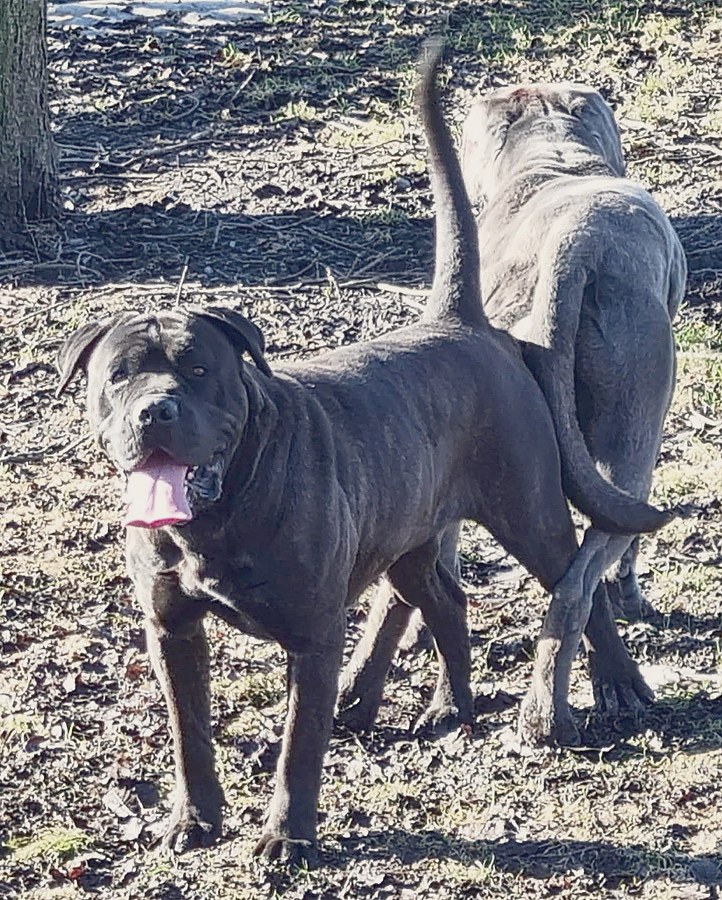
After the tie ends, check that the male’s penis returns fully into its sheath within a few minutes. If it stays out, it can quickly swell and dry — this is called paraphimosis and is a veterinary emergency, so call your vet straight away. Also contact your vet if either dog bleeds more than a trace, if the bitch shows ongoing pain after mating, or if the male’s testicles look swollen or painful.
Most natural matings need supervision rather than active intervention — inexperienced handlers who intervene too readily can do more harm than good. Genuine reasons to call a vet include a bitch showing clear pain or distress beyond normal vocalization, any sign of injury, or a male that is repeatedly unable to achieve intromission despite correct timing and a receptive bitch, which may point to an anatomical or fertility issue worth investigating. Repeating the mating roughly 24–48 hours after the first is commonly recommended, since it helps cover any uncertainty in the exact timing of ovulation.
If the male repeatedly cannot penetrate, or the bitch reacts with real pain, there may be a physical cause such as a narrowing in the vaginal canal or swollen vaginal tissue. Stop and have her examined rather than holding her still and trying again. The FCI expects healthy breeding dogs to be able to mate naturally, and a vet can advise whether that is realistic for this pair.
When to call your vet
- After the tie, the male’s penis does not return fully into its sheath within a few minutes (paraphimosis) — an emergency; call straight away.
- Either dog bleeds more than a trace, or the bitch shows ongoing pain after mating.
- The male’s testicles look swollen or painful after mating.
- The male repeatedly cannot penetrate, or the bitch reacts with real pain — stop and have her examined.
- Either dog has no current negative Brucella canis test before the mating.
- In the one to two months after mating, the bitch becomes lethargic, goes off her food, or has a pus-like or bloody discharge — call the same day.
- If in doubt, call — your vet would rather hear from you early.
Work on it
A few minutes here will teach you more than re-reading the article.
Ask yourself
- Do I know what a normal tie looks like, and would I recognize if something was actually wrong?
- Am I timing this mating by progesterone results, or by how the bitch is behaving?
- Do I have a plan for who to call if a genuine complication arises?
Find out & check
- Find out whether the location for the mating is familiar and secure for both dogs beforehand.
- Check that progesterone results support the planned mating date(s) before proceeding.
Do one thing
- Confirm the second mating date (24–48 hours after the first) with the stud owner in advance.
Was this article helpful?
Anonymous. We do not store your name, email or IP address.
Sources & further reading
- Merck Veterinary Manual — Breeding Management of Bitches. merckvetmanual.com
- UC Davis School of Veterinary Medicine — Ovulation Timing in the Dog. healthtopics.vetmed.ucdavis.edu
- UC Davis School of Veterinary Medicine — Breeding Management of the Bitch. healthtopics.vetmed.ucdavis.edu
- VCA Animal Hospitals — Estrus and Mating in Dogs. vcahospitals.com
- Merck Veterinary Manual — The Breeding Soundness Examination in Dogs and Cats. merckvetmanual.com
- Merck Veterinary Manual (Pet Owner Version) — Reproductive Disorders of Male Dogs. merckvetmanual.com
- FCI — International Breeding Strategies. fci.be
Where evidence is limited, recommendations rest on established practice and expert judgment, and may be updated as knowledge develops.
Next steps
- Read next: Semen and artificial insemination.
- Related: Timing the mating: finding the fertile window.
- Return to the area hub: Reproduction and fertility.