A neonatal puppy’s immune system offers very little protection of its own, which means infections that a slightly older puppy would shrug off can become life-threatening within hours — recognizing the early signs matters enormously.
The most important first
- Canine herpesvirus (CHV) is a leading cause of sudden death in puppies between roughly 1 and 3 weeks old, and can affect an entire litter.
- CHV thrives at the lower body temperatures typical of newborns, which is part of why keeping the whelping box warm enough is genuinely protective.
- General sepsis signs include poor nursing, weight loss, persistent crying, a low body temperature, and a distended or painful abdomen.
- Neonates have an immature immune response, so infections can progress from subtle signs to a crisis within hours — this isn’t a “wait and see” situation.
- Prompt veterinary treatment gives the best chance of a good outcome; delaying a call rarely helps.
Canine herpesvirus: a specific, serious risk
Canine herpesvirus is one of the more serious specific threats in this age window, most dangerous to puppies between about 1 and 3 weeks old, and can occasionally affect puppies up to a month or, rarely, older. It spreads through contact with infected oral, nasal, or vaginal secretions, and many adult dogs shedding the virus show no signs of illness themselves, which makes it hard to know when exposure has occurred. Mortality within an affected litter can be very high, often approaching the whole litter.
Newborn puppies often die within a day or two of the first signs. There is no CHV vaccine in the United States or Canada. A vaccine for breeding bitches is authorized in the European Union and marketed in several European countries, so breeders there can ask their vet whether it suits their situation. The encouraging news is that a dam that has been through an infection usually passes antibodies to later litters through her colostrum — which is one more reason every puppy must nurse within the first 24 hours.
Why warmth matters against CHV specifically
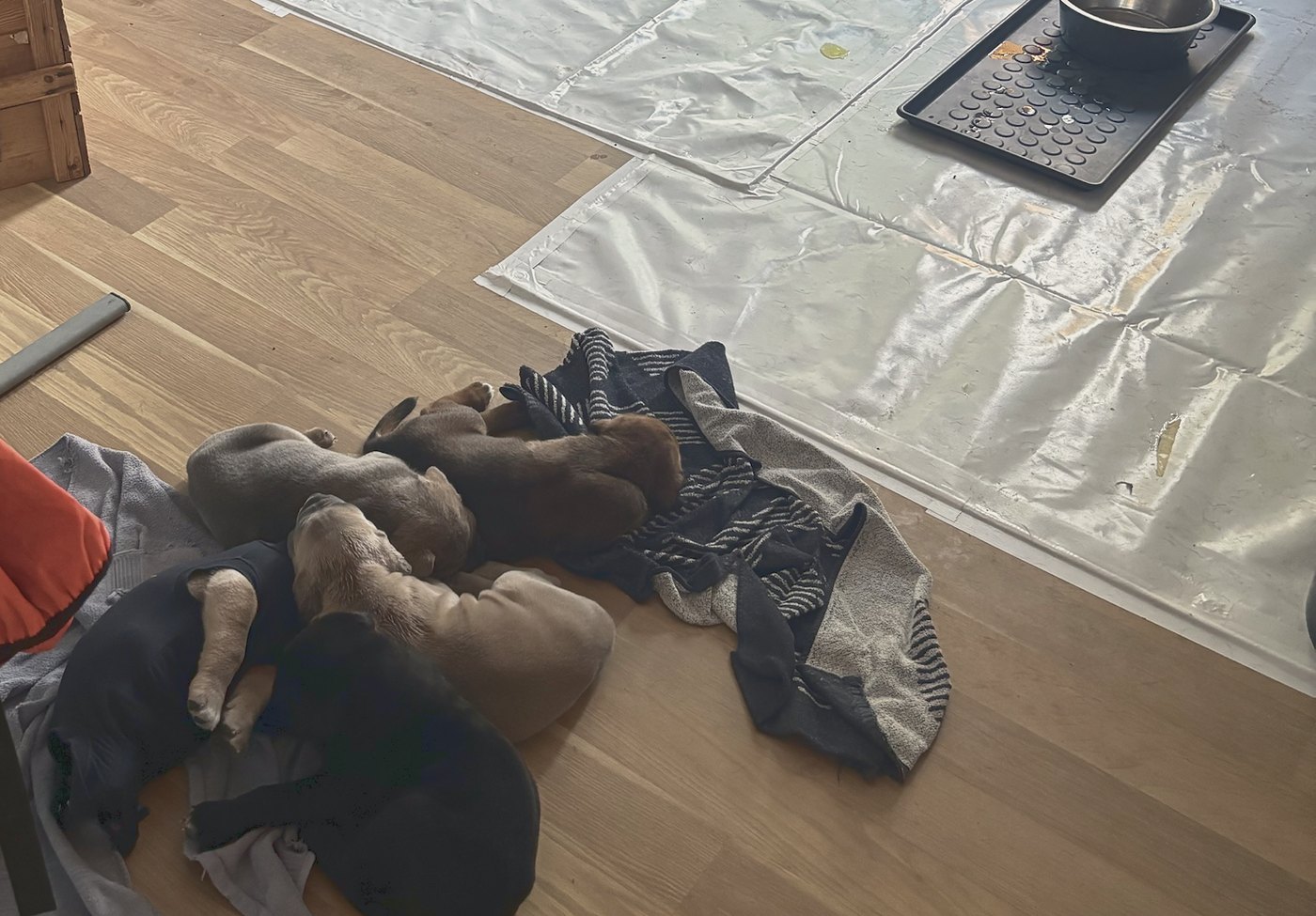
CHV replicates more efficiently at lower body temperatures — precisely the temperature range newborn puppies naturally run at before their thermoregulation matures around 4 weeks old. This gives an extra, specific reason (beyond general comfort and metabolism) for keeping the whelping box within the target ranges covered in warmth and the whelping-box microclimate — warmth isn’t just about comfort, it’s part of infection prevention too.
Recognizing CHV and general sepsis signs
CHV signs include loss of appetite, weight loss, unusual or distressed crying, a swollen or painful abdomen, breathing difficulty, and diarrhea — notably, often without a fever, which can make it easy to underestimate how serious the situation is. More generally, neonatal sepsis (a serious bacterial infection) shows through poor or absent nursing, weight loss, persistent crying, a body temperature below the normal range, and abdominal distension or pain.
Newborns rarely run a fever when they are infected. A puppy that feels cool (below the normal week-one range of about 95–99 °F / 35–37.2 °C), stops nursing or cries persistently is a more typical picture. Infection in one puppy is a warning for the whole litter: bacterial infections, such as E. coli, streptococci, staphylococci and Klebsiella, often affect more than one puppy. Ask your vet to examine the dam as well. An infection of the uterus or mammary glands is a common source.
In practice
A breeder notices one puppy has stopped nursing well and seems unusually distressed, but doesn’t see an obvious fever and initially assumes it’s a minor, self-resolving issue. Recognizing that neonatal infections often progress without a fever, and that a puppy’s condition can deteriorate within hours rather than days, is what prompts an immediate vet call rather than a wait-and-see approach.
(Illustrative, composite scenario.)
Umbilical infections and common causes
The umbilical stump is a possible entry point for infection (omphalitis) if it isn’t kept clean and dry, and common bacteria behind neonatal infections generally include E. coli, streptococci, staphylococci, and similar organisms. A stump that looks swollen, discolored, or has any discharge is worth mentioning to your vet.
Why speed matters so much here
Because a neonate’s immune system responds so poorly compared to an adult’s, infections that might stay mild in an older puppy can escalate rapidly in a newborn — sometimes within a matter of hours. This is why any of the signs above warrant a prompt call to your vet rather than a cautious wait to see if things improve on their own.
If a puppy dies
Losing a puppy is hard, but finding out why can protect its littermates and future litters. Wrap the body, keep it cool in a refrigerator (do not freeze it), and contact your veterinarian promptly about a post-mortem examination. Herpesvirus and bacterial infections are often only confirmed this way.
When to call your vet
- A puppy stops nursing, cries persistently or seems distressed — call the same day, and sooner if it is getting worse.
- A puppy feels cool, or its temperature is below about 95 °F (35 °C) in week 1 — infection in newborns usually shows as low temperature, not fever.
- A swollen or painful belly, breathing difficulty, or diarrhea in a puppy under 4 weeks.
- A red, swollen, smelly or discharging umbilical stump.
- More than one puppy becomes unwell, or a puppy dies suddenly — call promptly to protect the rest of the litter.
- The dam has a fever above 103 °F (39.5 °C), a smelly vaginal discharge, or hot, hard or painful mammary glands.
- If in doubt, call — your vet would rather hear from you early.
Work on it
A few minutes here will teach you more than re-reading the article.
Ask yourself
- Would I recognize CHV or sepsis signs even without an obvious fever present?
- Am I keeping the whelping box within target temperature both for comfort and as infection prevention?
- Do I know how quickly I’d act if a puppy suddenly stopped nursing well?
Find out & check
- Find out your vet’s out-of-hours protocol for a sudden change in a young puppy’s condition.
Do one thing
- Check the umbilical stump of each puppy in your next litter daily for the first week.
Was this article helpful?
Anonymous. We do not store your name, email or IP address.
Sources & further reading
- Merck Veterinary Manual — Canine Herpesvirus Infection. merckvetmanual.com
- VCA Animal Hospitals — Herpesvirus in Dogs. vcahospitals.com
- Merck Veterinary Manual — Management of the Neonate in Dogs and Cats. merckvetmanual.com
- Union Register of veterinary medicinal products (European Commission) — Eurican Herpes 205. medicines.health.europa.eu
- Banchi P et al. (2023), Vlaams Diergeneeskundig Tijdschrift 92 — Clinical approach to neonatal mortality in dogs. iris.unito.it
- VCA Animal Hospitals — Fading Puppy Syndrome in Dogs. vcahospitals.com
- American Kennel Club (Caroline Coile PhD, with James Evermann PhD) — Canine Herpesvirus. akc.org
Where evidence is limited, recommendations rest on established practice and expert judgment, and may be updated as knowledge develops. This is general information, not a substitute for immediate veterinary care.
Next steps
- Read next: Hygiene and biosecurity in the neonatal period.
- Related: Congenital abnormalities: what to look for.
- Return to the area hub: The neonatal period.