A pregnant bitch doesn’t need to stop being a dog — but how much activity is appropriate does change as pregnancy progresses. This guide covers how to adjust exercise and daily routine at each stage.
The most important first
- Early pregnancy generally allows normal daily activity to continue.
- High-impact and strenuous exercise should be scaled back somewhere between about week three and week five — ask your vet for your bitch.
- The final three weeks call for meaningfully reduced activity — gentle walks and free yard time, not training or strenuous exercise.
- Letting her self-regulate, alongside sensible limits you set, works better than a rigid one-size-fits-all rule.
- A calm, stable routine matters as much as the exercise itself.
- Keep her away from unfamiliar dogs, shows, classes and dog parks in the last three weeks, to protect the litter from canine herpesvirus.
A note on day counts: the weeks in this article are approximate and counted from ovulation (the LH surge comes about two days earlier). If you only know the mating dates, her true stage may be several days earlier or later, so err on the cautious side. There are no published studies yet on how much exercise is best for pregnant bitches; the guidance here reflects the experience of veterinarians and breeders, and it may change as research becomes available.
Early pregnancy: business mostly as usual
In the first few weeks, most bitches can continue their normal daily activities without special restriction, though it’s sensible to start limiting genuinely high-impact exercise from the outset rather than waiting for a visible reason to. This is a good stage to keep routine stable and low-stress — normal walks, normal play — rather than introducing new, more demanding activities.
Mid-pregnancy: scaling back intensity
From somewhere between about week three and week five (veterinarians differ, so ask yours), more strenuous activities — hard training sessions, prolonged high-intensity exercise — typically need to be reduced or stopped, even if she seems keen to continue. Lower-impact activity, like swimming or gentle walks, generally remains appropriate for longer, though jumping (off docks, over obstacles) is worth avoiding as her center of gravity and joint loading change. Clean, controlled water is preferable to lakes and other natural water for swimming.
In practice
A breeder continues their bitch’s usual agility training through mid-pregnancy because she still seems enthusiastic and capable. Scaling back the jump heights and intensity from about week four, even though she “could” still do more, better matches what’s actually appropriate for a developing pregnancy — enthusiasm isn’t the same as what’s advisable at this stage.
(Illustrative, composite scenario.)
The final three weeks: meaningfully less
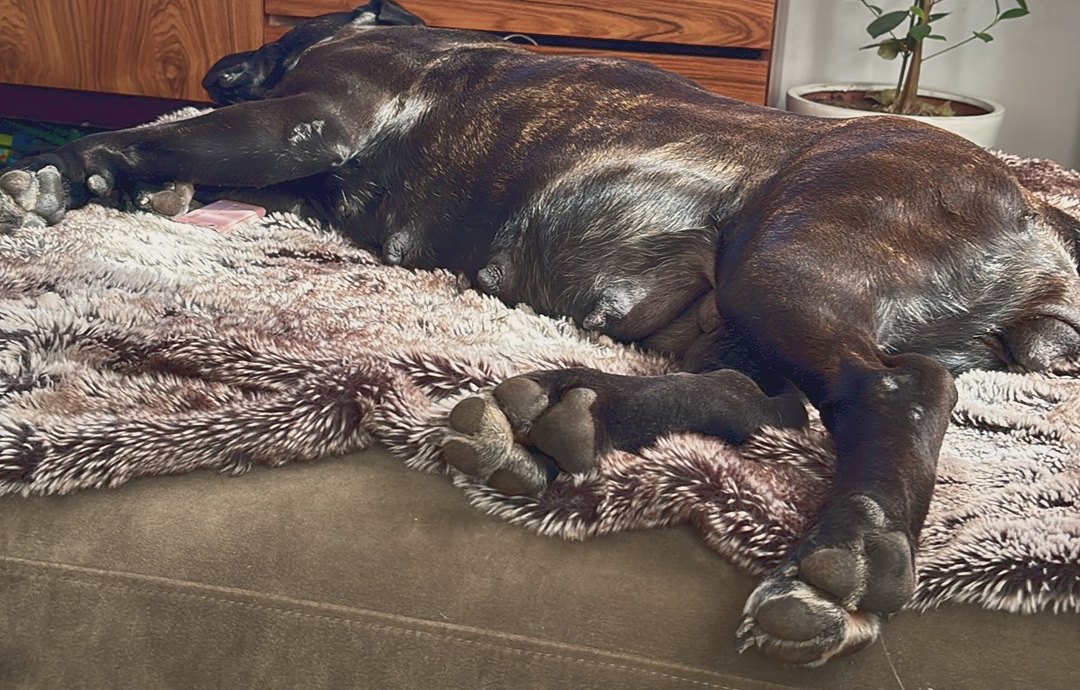
In the last three weeks before whelping, strenuous exercise should generally be avoided altogether — daily walks and free, self-directed activity in a safe yard are usually still fine, but formal training or demanding exercise is not the priority at this stage. This is also a sensible time to let her set more of the pace herself: a pregnant bitch is generally a reliable guide to her own comfort level if you’re paying attention.
Environment and daily routine
Beyond exercise itself, a calm, predictable daily routine and environment support a pregnant bitch well — minimizing unnecessary stress, avoiding introducing major changes (new pets, house moves, unfamiliar environments) where avoidable, and keeping her usual routine as stable as reasonably possible through pregnancy. This groundwork also makes the final stage of pregnancy — preparing for whelping — a smoother transition rather than a sudden shift in her environment.
Late in pregnancy she copes less well with heat. Walk her in the cooler parts of the day, give shade and water, and stop if she pants heavily or lags behind. If she seems to be in pain, collapses, or has any unusual discharge after exercise, stop and contact your veterinarian — see what’s normal and what’s not.
Keeping infection away
Canine herpesvirus is common in adult dogs and usually harmless to them, but it can cause pregnancy loss and is often fatal to puppies in their first weeks. Veterinary guidance is to keep a pregnant bitch away from other dogs outside her household for the last three weeks of pregnancy and the first three weeks after whelping. In practice, skip shows, trials, classes and dog parks in late pregnancy, and ask visitors with dogs of their own to wash their hands and change clothes before handling her.
When to call your vet
- She seems to be in pain, limps, or collapses during or after activity.
- She has any bloody, foul-smelling or pus-like discharge, or any unusual discharge after exercise.
- She overheats: heavy panting that does not settle with rest, shade and water, or weakness after being out in the heat.
- Her temperature rises above 103 °F (39.5 °C).
- She has been in contact with an unfamiliar or sick dog in the last three weeks of pregnancy — ask your vet what to watch for.
- Green or black discharge before the first puppy is an emergency — call your vet immediately.
- If in doubt, call — your vet would rather hear from you early.
Work on it
A few minutes here will teach you more than re-reading the article.
Ask yourself
- Have I planned to scale back strenuous exercise between about week three and week five, not just when it becomes obviously necessary?
- Am I watching her own comfort and energy level, rather than sticking rigidly to a pre-pregnancy exercise routine?
- Is her environment stable, or are there avoidable stressors or changes planned during this pregnancy?
Find out & check
- Find out what activity level your vet considers appropriate for her specific stage of pregnancy.
- Check whether any planned changes to her environment or routine could reasonably be postponed until after whelping.
Do one thing
- Write down your plan for scaling back her exercise around weeks three to five and again at the final three weeks, including when she will stop meeting dogs outside her household.
Was this article helpful?
Anonymous. We do not store your name, email or IP address.
Sources & further reading
- American Kennel Club — Keeping Mom in Shape: How Much Exercise Do Pregnant Bitches Need?. akc.org
- VCA Animal Hospitals — Breeding for Pet Owners: Pregnancy in Dogs. vcahospitals.com
- Colorado State University Veterinary Teaching Hospital — Pregnancy and Whelping for Dogs. csuveterinaryhealth.org
- Merck Veterinary Manual — Canine Herpesvirus Infection. merckvetmanual.com
- Dogs Victoria (ANKC member body, Australia) — Caring for Your Pregnant Bitch (fact sheet B16). dogsvictoria.org.au (PDF)
- Virginia Tech Veterinary Clinical Trials — The Role of Habitual Physical Activity on Pregnancy Health and Whelping in Dogs. research.vetmed.vt.edu
Where evidence is limited, recommendations rest on established practice and expert judgment, and may be updated as knowledge develops.
Next steps
- Read next: The pregnant bitch’s health: what’s normal and what’s not.
- Related: Feeding and body condition through pregnancy.
- Return to the area hub: Pregnancy: managing the pregnant bitch week by week.