The last two weeks before puppies leave has an administrative shape to it: a clinical examination, a microchip, a set of registrations, and a folder of paperwork that has to be right — because after handover, correcting it is someone else’s problem and your reputation.
The most important first
- Book the veterinary check with time to spare, not the day before handover — its value is that you can act on what it finds.
- The check is a clinical baseline at that moment, not a guarantee of future health, and buyers should be told so plainly.
- In England, Scotland and Wales a puppy must be microchipped by eight weeks old and registered to the breeder, and may not be transferred to a new keeper until that is done; requirements differ elsewhere.
- Scan the chip again before handover to confirm it reads and matches the paperwork.
- Every puppy leaves with the same folder: vaccination, worming, microchip, registration, parents’ health results and feeding details.
The pre-going-home veterinary check
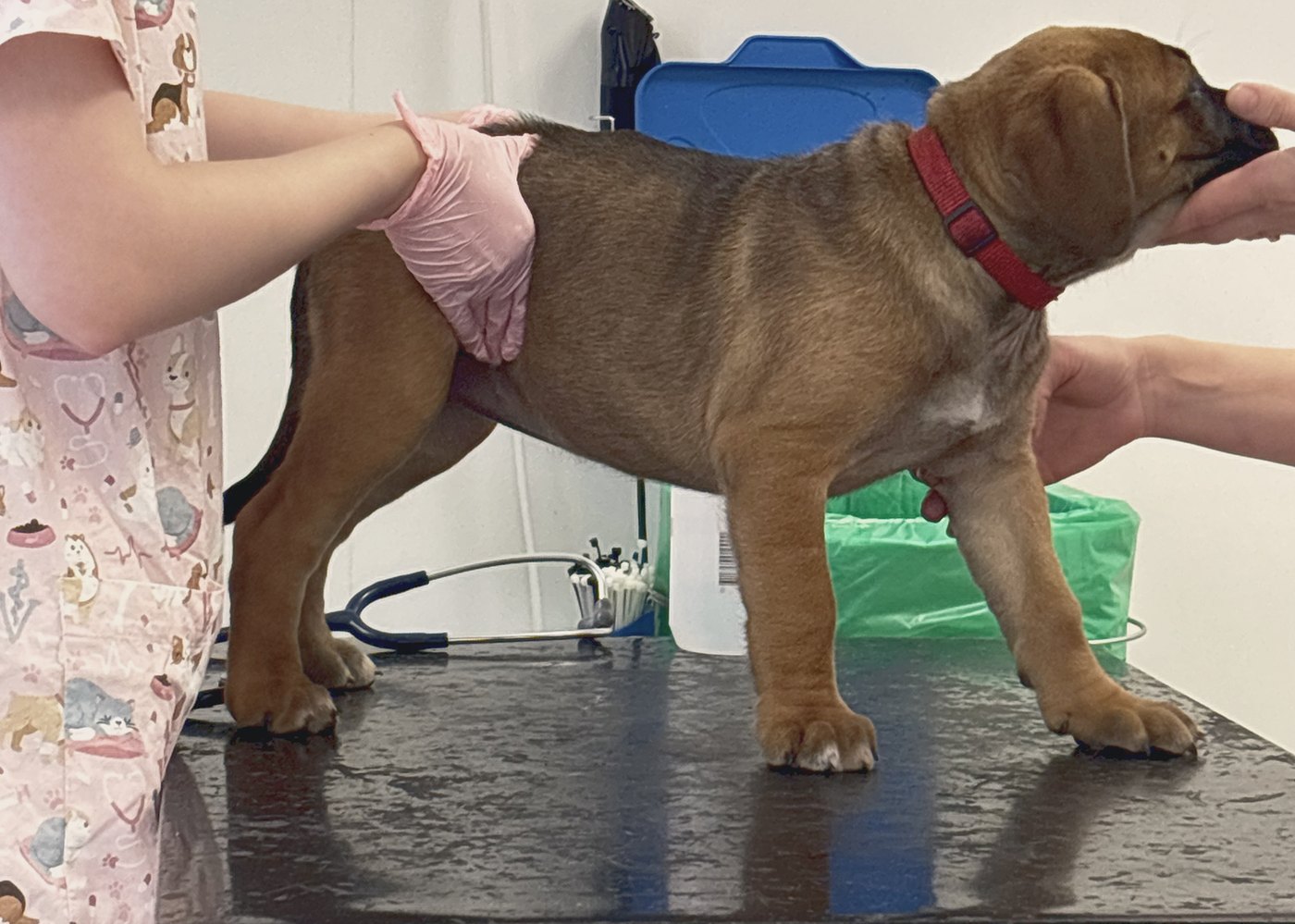
The examination is usually arranged in the week or two before puppies leave, often combined with the first vaccination and the microchip so the litter is handled once rather than three times. A thorough check covers weight, temperature, heart and lungs, eyes, ears and nose, mouth — including the palate and the developing bite — skin and coat, an abdominal palpation, lymph nodes, genitalia, and joints and gait. A fecal examination usually forms part of it, since intestinal parasites are near-universal in litters even on a good worming schedule, as covered in parasites and worming schedules.
Some findings come up often enough to be worth anticipating. Heart murmurs in young puppies are not all significant — some are flow murmurs that resolve — but they need a recheck and an honest conversation rather than silence. Ask the vet to record the murmur’s grade. Soft murmurs in young puppies often fade by four to six months. Louder ones, or any murmur still there at six months, should be investigated further, sometimes with a heart ultrasound by a cardiologist. Book the recheck before the puppy leaves, or make sure the buyer knows to. Umbilical hernias are common and usually minor, with the decision about intervention belonging to the vet. Undescended testicles at eight weeks are a note to be followed up rather than a conclusion. A bite that is developing oddly is worth recording now, so nobody is surprised later.
The reason to book early is that each of those may need a second appointment, a referral or a delayed handover. A check done the afternoon before collection can only confirm; a check done in good time can actually change what you do.
Being straight about what the check means
A veterinary examination at eight weeks says that nothing detectable was wrong on that day. It does not, and cannot, exclude conditions that appear later — hip or elbow problems, inherited eye disease, epilepsy, many cardiac conditions. Presenting the certificate as if it guaranteed a healthy life sets up a conversation you do not want to have in two years. Saying clearly what it does cover, alongside the parents’ health screening results, is both more honest and more convincing to the kind of buyer you want.
Microchipping
The microchip is the puppy’s permanent identity, and the legal detail around it is stricter than many breeders realize. In England, Scotland and Wales, a dog must be microchipped by eight weeks of age, the breeder is recorded as the first keeper, and a dog must not be transferred to a new keeper until the seller has microchipped it and registered it in their own details. The new owner then transfers the registration into their name. Database records carry the dog’s date of birth, sex, breed or description and color, and it is the keeper’s responsibility to keep contact details current — a chip registered to an old phone number reunites nobody. Northern Ireland also requires microchipping, but has no first-keeper rule and requires a council dog license instead.
Rules differ between countries: age limits, which databases are recognized, whether registration is centralized, and what is required for travel or export all vary, so confirm your own jurisdiction’s requirements rather than assuming. What does not vary is the practical advice. Record the chip number on every document, have the chip scanned at the veterinary visit to confirm it reads, and scan again on the morning of handover to confirm it reads and that the number matches the paperwork — far better that you discover a problem than the new owner’s vet.
Rules vary widely, even within one country. In Australia, most states require puppies to be microchipped before sale or by twelve weeks, though ages differ between states. New South Wales also requires the microchip number and a breeder identification number in every advert for puppies born from December 1, 2025. In the United States there is no national requirement, but many buyers and registries expect it. Whatever the law, register the chip in a database that vets and shelters search, and check that the details are correct before handover.
In practice
A breeder books the litter’s veterinary check, vaccination and microchipping for the day before the first puppies go home, to keep everything fresh. The vet finds a murmur in one puppy that needs a recheck in three weeks. The breeder now has to have an unplanned conversation with a buyer who has already arranged time off work — a conversation that, with the appointment two weeks earlier, would have been calm and well-informed instead.
(Illustrative, composite scenario.)
Registration and pedigree paperwork
Kennel club registration follows its own timetable and its own rules. The general shape is the same across registries: the litter is registered by the breeder, on the basis of a registered sire and dam of the same breed, and individual puppies are then registered or transferred into the new owners’ names. Registries differ on DNA requirements, on how frequently-used sires are handled, and on what documentation the stud dog owner must sign, so work from your own registry’s current requirements.
One tool worth understanding is restricted or limited registration, where a puppy is registered but its progeny cannot be, which several registries offer. It is a legitimate way to place a puppy as a companion without a breeding future, and it is a decision to make deliberately and explain to the buyer, not a default to apply silently.
What the kennel clubs say
In FCI countries: limited registration (“not to be used for breeding”) is set by the national kennel club. A breeder can ask for it when registering the litter, but cannot add it once the puppy has changed owner, and only the club that set it can lift it. Offspring of a dog bred anyway cannot be registered with any FCI member.
Source: FCI, Criteria for limited registration (valid from November 1, 2019). National kennel clubs may set stricter rules.
Last updated: November 8, 2026
Rules change, so always check with your own kennel club.

The folder that goes with each puppy
Assemble it while the litter is still with you, not on the doorstep: the vaccination record with product, batch number, date and the date the next dose is due; the worming record with products and dates; the microchip number and confirmation of registration; registration or pedigree paperwork; the parents’ health screening results; the contract; the current food and feeding routine; and insurance details if any is provided. The complete set, with a per-puppy checking routine, is laid out in the pre-sale health checklist.
When to call your vet
- The vet check is less than a week away and a puppy has diarrhea, vomiting, coughing or poor appetite — ask whether to bring the appointment forward
- A puppy’s chip will not scan, or the number does not match the paperwork
- Swelling, heat or discharge appears at the microchip or vaccination site
- A puppy seems lethargic or off food for more than a day after its vaccination or microchipping
- A murmur, hernia or other finding was noted and the recheck date has not been set
- If in doubt, call — your vet would rather hear from you early.
Work on it
A few minutes here will teach you more than re-reading the article.
Ask yourself
- Is my veterinary check booked early enough that a finding could actually change my plans?
- Do I explain to buyers what the check does and does not cover?
- Are my microchip and registration steps compliant with the rules where I live, not where I read about them?
Find out & check
- Find out your country’s legal requirements on microchipping age, registration and transfer, and your registry’s current litter registration requirements.
Do one thing
- Build the handover folder as a physical or digital template now, so each puppy’s copy is filled in rather than assembled.
Was this article helpful?
Anonymous. We do not store your name, email or IP address.
Sources & further reading
- Association of Microchip Database Operators — Microchipping Legislation: A Clear and Simple View. amdo.org.uk
- GOV.UK — Get your dog or cat microchipped. gov.uk
- NSW Office of Local Government — Sell or give away a pet. olg.nsw.gov.au
- RSPCA Australia Knowledgebase — Is microchipping mandatory for cats and dogs?. kb.rspca.org.au
- American Veterinary Medical Association — National Check the Chip Day. avma.org
- American Kennel Club — Frequently Used Sires Requirement FAQs. akc.org
- American Kennel Club — Dog and Litter Registration. akc.org
- University of Illinois College of Veterinary Medicine — The Tell-tale Murmur: Heart Problems in Puppies. vetmed.illinois.edu
Where evidence is limited, recommendations rest on established practice and expert judgment, and may be updated as knowledge develops. Microchipping law, registration requirements and export rules differ between countries — confirm the rules that apply where you breed.
Next steps
- Read next: Pre-sale health checklist.
- Related: Vaccination and immunity in puppies.
- Return to the area hub: Raising a healthy litter.