The reason puppies need a series of vaccinations rather than a single one has nothing to do with building up a dose — it is that nobody knows exactly when the antibodies a puppy got from its mother stop protecting it and start blocking the vaccine instead.
The most important first
- Core vaccines protect against distemper, adenovirus and parvovirus; rabies is core wherever the disease is present, and requirements vary by country.
- WSAVA guidance is to start at 6 to 8 weeks and repeat every 2 to 4 weeks until 16 weeks of age or older.
- The dose given at 16 weeks or later is the most important one, because maternal antibody has usually waned by then.
- There is a window, often somewhere around 8 to 12 weeks, when maternal antibody is too low to protect but high enough to interfere with the vaccine. Its timing cannot be predicted for an individual puppy without blood testing.
- A puppy that has had one vaccination is not a protected puppy, and the buyer must be told so explicitly.
Maternal antibody, and why it complicates everything
Puppies are born with almost no immune protection of their own and acquire it from colostrum in the first hours of life — the mechanism described in the neonatal period. That borrowed immunity is what keeps them alive for the first weeks, and it is also what makes vaccination difficult.
Maternally derived antibody interferes with a puppy’s response to vaccination, whether the vaccine is modified live or inactivated. As it wanes, it passes through a period where there is not enough left to protect the puppy against infection, but still enough to neutralize a vaccine before the puppy’s own immune system responds to it. This is the window of susceptibility, and because the amount of antibody a puppy receives varies with the dam’s own immunity and how much colostrum that individual puppy drank, its timing differs from litter to litter and from puppy to puppy. It often falls somewhere around 8 to 12 weeks, but without blood testing it cannot be predicted for an individual puppy.
A puppy’s early protection comes almost entirely from colostrum, and the gut can only absorb those antibodies for a short time after birth — absorption has largely stopped by 24 hours. A puppy that nursed poorly in its first day, or a litter whose dam was not up to date on her vaccinations, may have less protection than its littermates. Tell your veterinarian if this applies; they may suggest starting earlier or taking extra precautions.
The series exists to cover that uncertainty. Repeated doses mean that whenever the window closes for a given puppy, a dose follows soon enough to matter.
The schedule
WSAVA’s current guidance is to begin core vaccination at 6 to 8 weeks of age and repeat every 2 to 4 weeks until 16 weeks of age or older. The final dose, at 16 weeks or later, is the critical one: by that age maternal antibody has usually declined far enough that the puppy can respond. In especially high-risk situations, the guidance is to continue to 20 weeks and to vaccinate every 2 to 3 weeks.
Current guidance also favors a further dose at or shortly after 26 weeks (about 6 months) of age, rather than waiting until 12 to 16 months, in order to narrow the window in which a puppy that failed to respond remains unprotected. Alternatively, a blood sample taken at or after 20 weeks, and at least 4 weeks after the last dose, can be tested for antibodies; a puppy shown to be protected does not need the 26-week dose.
Which vaccines are core, which are recommended by lifestyle, and what the law requires all vary by country — leptospirosis, for instance, is treated as core for all dogs under current North American guidance but is handled differently elsewhere, and rabies vaccination is legally mandated in some jurisdictions and not others. Take the timing principles from the guidelines and the actual protocol from your vet.
The breeder’s part, and the handover
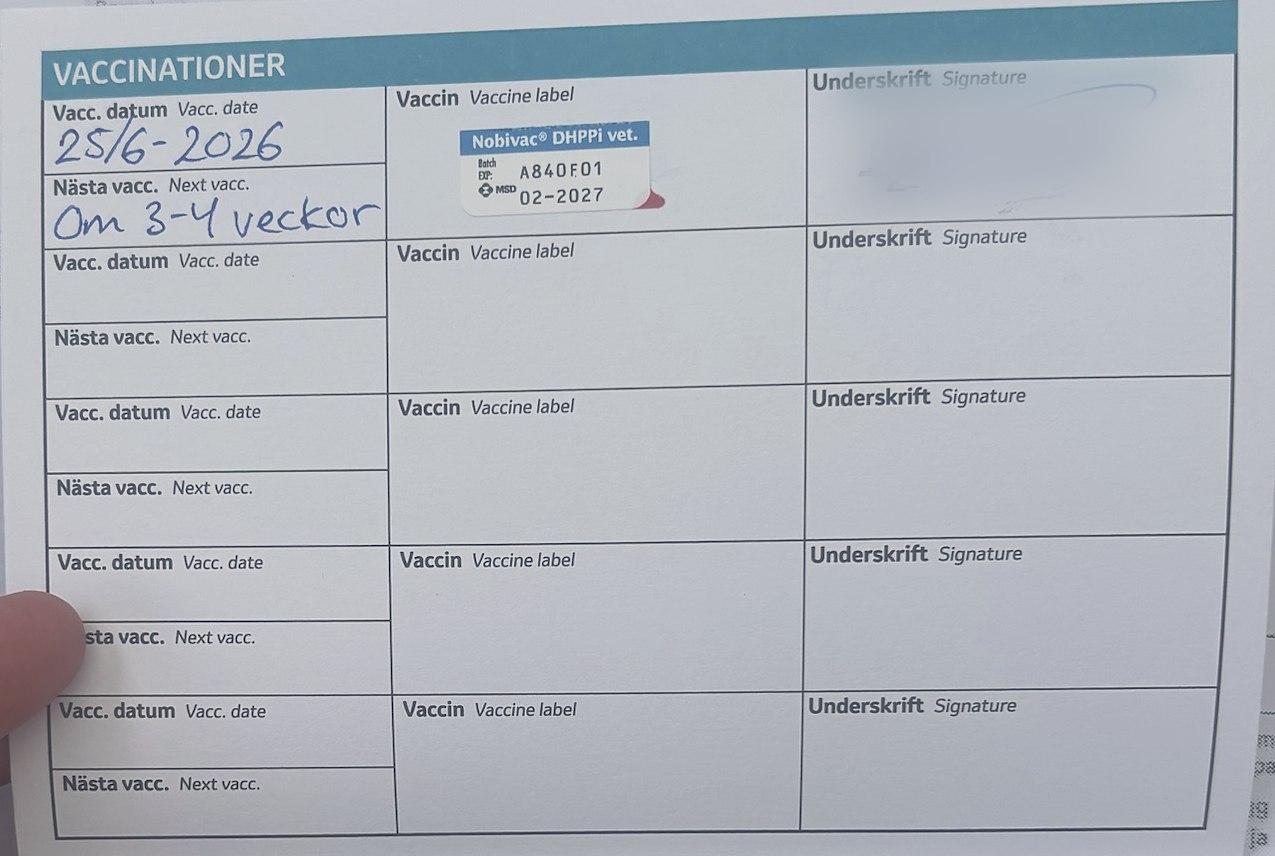
In most cases the breeder gives the first dose, at six to eight weeks, and the rest of the series belongs to the new owner. That makes documentation part of the product: date, vaccine and manufacturer, batch number and expiry date, the site and route of injection, and the veterinarian who administered it, with the dates the remaining doses are due.
It also makes the conversation part of the product. A buyer who hears “the puppy is vaccinated” and understands it as “the puppy is protected” may take an eight-week-old puppy somewhere it should not yet go. Say plainly that the series is unfinished, that protection is not complete until it is, and when the next dose is due.
In practice
A breeder hands over a puppy at eight weeks with its first vaccination done and mentions it in passing. The new owner, delighted, takes the puppy to a busy dog park that weekend. Nothing about the vaccination record was wrong — what was missing was one sentence explaining that the puppy was part-way through a series and not yet protected.
(Illustrative, composite scenario.)
Vaccination and socialization, at the same time
The window in which a puppy is not yet fully vaccinated overlaps almost exactly with the window in which socialization does the most good, which puts two real risks against each other: infectious disease on one side, and a behaviorally under-prepared dog on the other. The practical answer is rarely to choose one — it is to manage exposure so that a puppy meets people, surfaces, sounds and healthy, vaccinated dogs in controlled settings, while avoiding places where large numbers of unknown dogs eliminate. The developmental side of that balance belongs to behavior, development and enrichment; the disease side is covered in infection control and biosecurity for the litter.
The American Veterinary Society of Animal Behavior considers the risk of infection from well-run early socialization small compared with the lifelong cost of behavior problems. In practice: at least one set of vaccines a week or more before a puppy class, a first deworming, indoor surfaces that can be disinfected, and no dog parks or other heavily used, uncleaned areas.
At home, ask visitors to arrive in clean clothes, remove or cover shoes, wash hands, and not come straight from other dogs.
Things that go wrong
The three most common failures are straightforward. A series stopped too early, before the 16-week dose, leaves a puppy that may never have responded at all. Records that travel incompletely leave the next vet guessing and often restarting. And an unwell puppy vaccinated on schedule because the appointment was booked is a puppy vaccinated at the worst possible moment — vaccination is for healthy animals, and your vet will usually postpone vaccination in a puppy that is unwell — a puppy that is off-color on the day should be seen rather than simply injected.
Parvovirus: know the signs
Parvovirus most often affects puppies between about six weeks and six months — exactly the age a litter is with you. Early signs are tiredness, loss of appetite and vomiting, often followed quickly by diarrhea that may be bloody and foul-smelling. A puppy with these signs needs a veterinarian the same day; call ahead so the clinic can keep other patients safe.
The virus can survive in the environment for many months and resists most household cleaners, so remove all organic matter first, then use a disinfectant proven against parvovirus with the full contact time on the label.
After the injection
Mild soreness, tiredness or a slightly reduced appetite for up to a day are common. A small, firm lump at the injection site usually shrinks within a couple of weeks. Seek care immediately for collapse, repeated vomiting or diarrhea, difficulty breathing, hives, or swelling of the face, eyes or neck.
When to call your vet
- A puppy is lethargic, stops eating, or vomits — especially with diarrhea or blood in the stool (same day).
- A puppy collapses, has trouble breathing, or develops hives or a swollen face after a vaccination — emergency.
- Mild vaccine side effects last more than a day or two, or an injection lump persists beyond about three weeks or grows.
- A puppy may have missed colostrum in its first 24 hours, or the dam’s vaccinations were not up to date.
- A puppy is unwell on the day a vaccination is due — ask whether to postpone.
- You are unsure which vaccines, including rabies and leptospirosis, your country or state requires.
- If in doubt, call — your vet would rather hear from you early.
Work on it
A few minutes here will teach you more than re-reading the article.
Ask yourself
- Does my documentation tell the new owner exactly when the next dose is due, not just what has been given?
- Do I say out loud that a part-vaccinated puppy is not a protected puppy?
- Do I have a plan for socialization during the weeks before the series is complete?
Find out & check
- Find out from your vet which vaccines are core where you live, what the legal requirements are, and at what age they recommend the first dose for your circumstances.
Do one thing
- Prepare a one-page vaccination record template that includes the due dates for the remaining doses.
Was this article helpful?
Anonymous. We do not store your name, email or IP address.
Sources & further reading
- WSAVA Vaccination Guidelines Group — 2024 Guidelines for the Vaccination of Dogs and Cats. wsava.org
- American Animal Hospital Association — 2022 AAHA Canine Vaccination Guidelines. aaha.org
- American Veterinary Medical Association — Vaccinations. avma.org
- Cornell University College of Veterinary Medicine — Parvovirus: Transmission to treatment. vet.cornell.edu
- American Veterinary Society of Animal Behavior — Position Statement on Puppy Socialization. avsab.org
- VCA Animal Hospitals — Breeding for Dog Owners: Caring for Mother and Puppies After Weaning. vcahospitals.com
- Merck Veterinary Manual — Management of the Neonate in Dogs and Cats. merckvetmanual.com
- UK Government (Defra) — Dog breeding licensing: statutory guidance for local authorities. gov.uk
Where evidence is limited, recommendations rest on established practice and expert judgment, and may be updated as knowledge develops. Vaccination protocols, core vaccine definitions and legal requirements differ between countries — confirm yours with your own veterinarian.
Next steps
- Read next: Infection control and biosecurity for the litter.
- Related: Parasites and worming schedules · Heartworm prevention for puppies and breeding dogs · Ticks and tick-borne disease in dogs.
- Return to the area hub: Raising a healthy litter.