When medical management isn’t enough, or a whelping was never going to succeed without surgery, a cesarean section becomes the safest path forward for both dam and puppies — knowing roughly what to expect makes a stressful moment easier to navigate.
The most important first
- A C-section becomes necessary when medical management fails, there’s a confirmed obstruction, or the dam or puppies show signs of distress.
- Emergency C-sections carry higher risk than planned ones, because prolonged labor beforehand causes oxygen deprivation and other complications.
- Anesthesia crosses the placenta and affects puppies too — this is why active newborn resuscitation right after delivery matters.
- Full recovery from anesthesia takes anywhere from about 2 to 12 hours; puppies can usually nurse once both dam and puppies are stable.
- One C-section does not automatically mean every future litter needs one.
When a C-section becomes necessary
A cesarean section is indicated when medical management of dystocia (covered in dystocia, malpresentation, and uterine inertia) has failed or isn’t appropriate, when there’s a confirmed physical obstruction, when fetal distress is detected (a fetal heart rate below about 200 beats per minute suggests stress, and persistently lower rates, for example under 160, usually mean surgery is needed), or when the dam shows systemic illness or collapse. Some breeds — particularly extreme brachycephalic breeds, where pelvic and puppy-head proportions make natural delivery genuinely difficult — are often planned for an elective C-section in advance, rather than waiting to see if natural whelping is possible.
Emergency vs. planned: why timing matters
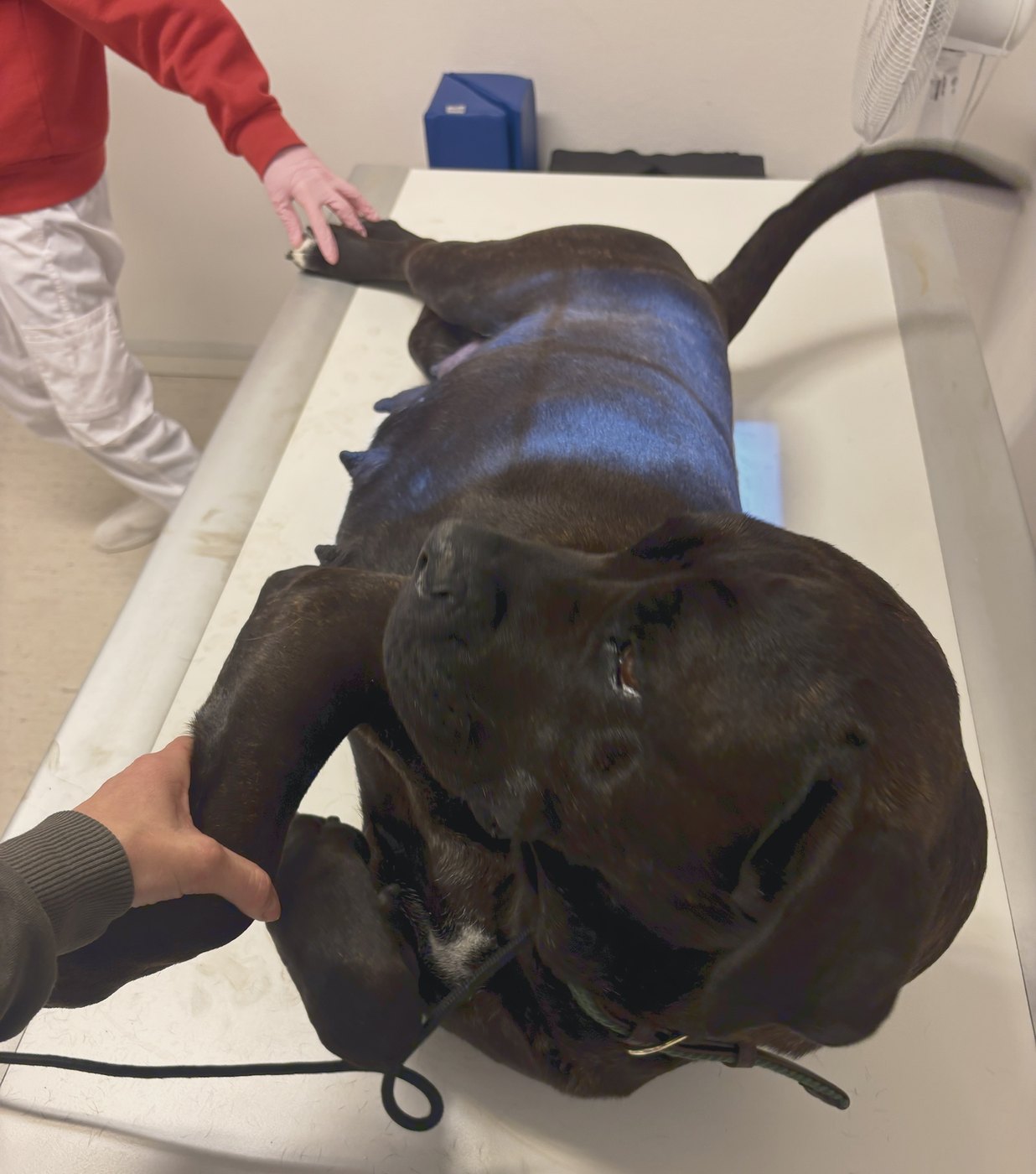
Outcomes are measurably worse for emergency C-sections than for planned ones, largely because a prolonged, unsuccessful labor beforehand causes the dam and puppies to become oxygen-deprived and physiologically stressed before surgery even begins. This is part of why the warning signs and timing thresholds covered elsewhere in this area matter — recognizing a stalled labor early, rather than waiting, is what keeps a C-section (if needed) a controlled procedure rather than a true emergency.
A planned C-section depends on knowing the due date precisely. Puppies delivered too early may not survive, so planned surgery is usually timed using progesterone testing during the season and/or late-pregnancy monitoring agreed with your vet.
Anesthesia and why puppies need help afterward
Most anesthetic drugs cross the placenta and affect puppies as well as the dam — this is why puppies born via C-section often need more active help getting started than puppies born naturally. Veterinary teams typically clear membranes immediately, vigorously towel-rub each puppy to stimulate breathing, suction the nose and mouth if needed, and keep puppies warm until they’re breathing steadily and the dam is alert enough to take over.
In practice
A breeder is surprised that puppies delivered by emergency C-section seem sluggish and slow to breathe compared to puppies from a previous natural whelping. Understanding that anesthesia affects puppies too, and that this is a normal and expected part of C-section recovery that the veterinary team is actively managing with stimulation and suction, reframes what looks alarming as a known and manageable part of the process.
(Illustrative, composite scenario.)
Recovery for the dam
Full recovery from anesthesia can take anywhere from about 2 to 12 hours, depending on what was used. Expect a mild temperature rise of 1–2 °F (about 0.5–1 °C) for the first one to three days, bloody discharge for up to about a week (heaviest in the first three days; a dam spayed during the surgery should have little or none), and a need for close supervision so a still-groggy dam doesn’t accidentally lie on or injure a puppy. Only vet-approved, nursing-safe pain relief should be used — never aspirin or ibuprofen.
Only leave puppies with her unsupervised once she can stand, is steady and is clearly interested in them. For the first day, offer small amounts of food and water often rather than a full bowl, as eating or drinking quickly after anesthesia can make her vomit. Check the incision every day. Cones are usually avoided because they can injure puppies and stop her from cleaning them; ask your vet what they prefer, and when any external stitches should come out (often at 10–14 days).
Call your vet if:
- her temperature goes above 103 °F (39.5 °C), and urgently if it reaches 104 °F (40 °C);
- bloody discharge lasts longer than a week, changes color or smells bad;
- the incision becomes red, swollen, wet or starts to open;
- the puppies cry constantly or are not nursing.
Breeding again after a C-section
Needing a C-section for one litter doesn’t automatically mean every future litter will need one — the underlying cause matters. A breed-related anatomical issue is likely to recur, but a one-off cause like malpresentation or an oversized single puppy may not. This is a conversation to have directly with your vet once the dam has recovered.
Registries may also limit this. In the UK, The Kennel Club requires C-sections to be reported and normally will not register further litters from a bitch who has already had two litters by C-section. The Irish Kennel Club has a similar two-litter limit. Rules differ by country and registry, so check yours (for example the AKC, CKC, Dogs Australia or your FCI national club) before planning another litter.
When to call your vet
- Her temperature rises above 103 °F (39.5 °C) after surgery; a small rise of 1–2 °F (about 0.5–1 °C) in the first one to three days is expected.
- The incision is red, swollen, wet, smelly or starting to open.
- Bloody discharge lasts more than a week, changes color or smells bad.
- She vomits repeatedly, will not eat or drink, or is still very drowsy many hours after going home.
- Any puppy is not breathing well, cries constantly, or has not nursed within the first 24 hours (it needs colostrum).
- Before surgery: green or black discharge before the first puppy, or strong straining for 20–30 minutes with no puppy, is an emergency.
- If in doubt, call — your vet would rather hear from you early.
Work on it
A few minutes here will teach you more than re-reading the article.
Ask yourself
- If my breed carries elevated dystocia risk, have I discussed an elective vs. emergency C-section plan with my vet?
- Do I know what to expect from puppies immediately after a C-section, so it doesn’t look alarming if it happens?
- Do I know which pain medications are safe for a nursing dam, in advance?
Find out & check
- Find out your vet’s typical recovery timeline and warning signs to watch for after a C-section, specific to your bitch.
Do one thing
- If your breed or litter is high-risk, ask your vet now whether a planned C-section is the safer route for this pregnancy.
Was this article helpful?
Anonymous. We do not store your name, email or IP address.
Sources & further reading
- VCA Animal Hospitals — Caesarean Sections in Dogs: Post-Operative Instructions. vcahospitals.com
- Merck Veterinary Manual — Dystocia in Small Animals. merckvetmanual.com
- Merck Veterinary Manual — Labor, Delivery, and Postpartum Care in Bitches and Queens. merckvetmanual.com
- Moon PF et al. (2000), Journal of the American Animal Hospital Association — Perioperative risk factors for puppies delivered by cesarean section in the United States and Canada. jaaha.kglmeridian.com
- Boller M et al. (2025), Journal of Veterinary Emergency and Critical Care — RECOVER Guidelines: Newborn Resuscitation in Dogs and Cats. onlinelibrary.wiley.com
- Cornell University Riney Canine Health Center — Dystocia in Dogs: Understanding Difficult Births. vet.cornell.edu
- The Kennel Club and British Veterinary Association — Reporting caesarean sections is key to protecting pedigree dog health and welfare. bva.co.uk
- Irish Kennel Club — Attention Breeders: New Rules from January 2018. ikc.ie
Where evidence is limited, recommendations rest on established practice and expert judgment, and may be updated as knowledge develops. This is general information, not a substitute for immediate veterinary care during an actual whelping emergency.
Next steps
- Read next: Newborn resuscitation.
- Related: Dystocia, malpresentation, and uterine inertia.
- Return to the area hub: Whelping: the complete guide from first contractions to recovery.