A puppy does not start learning when it starts classes at four months — it has been learning since its eyes opened, and the only question for a breeder is whether those first weeks were arranged on purpose or left to happen.
The most important first
- The first three months of life are the primary and most important time for a puppy’s socialization and social learning — most of which happens on your premises.
- Reward-based methods are the position of the main veterinary behavior bodies: AVSAB recommends them for all canine training and states that aversive methods, which rely on force, pain or emotional or physical discomfort, should not be used.
- Sessions at this age are short: a few minutes at most, a few times a day, ended while the puppy is still interested.
- A name and a recall cue are the two things worth teaching before eight weeks, and feeding time gives you both.
- What you build is a foundation the new owner continues: early training changes what is likely, not what is certain.
What a puppy is already learning before it leaves
AVSAB describes the first three months of life as the primary and most important time for puppy socialization. That period begins in your whelping room and is more than half over by the day the puppy leaves, which means the most consequential stretch of a dog’s social learning happens on your premises and nobody else’s. The developmental detail behind it is in critical developmental periods and windows.
The consequence is that every interaction in that pen already teaches something. A puppy picked up when it screams learns that screaming works. A litter fed while mobbing the bowl learns that mobbing works. None of this requires intention on your part, so deciding what gets rewarded is not an optional extra you might add if you have time — it is a choice you are already making.
Why reward-based methods are the standard of care
This is not a matter of taste, and it is worth stating with the source attached rather than as an opinion. The American Veterinary Society of Animal Behavior’s position statement on humane dog training recommends reward-based methods for all canine training, on the grounds that they offer the most advantages and the least harm to the learner’s welfare, and states that aversive methods — those relying on force, pain, or emotional or physical discomfort — should not be used in training or in the treatment of behavior disorders.
The evidence cited has two halves. In the short term, dogs trained with aversive methods show stress-related behavior during training: tense body, lowered posture, lip licking, tail lowering. Over the longer term, aversive training has been associated — in survey studies that cannot prove cause — with aggressive behavior towards people and other dogs and with anxiety-related behaviors, while several studies have found higher obedience in dogs trained with rewards.
For a seven-week-old the argument hardly needs the literature. Punishment at this age mostly teaches a puppy to avoid you, and avoiding you is the opposite of what the next five weeks depend on.
A name, a recall, and nothing much else
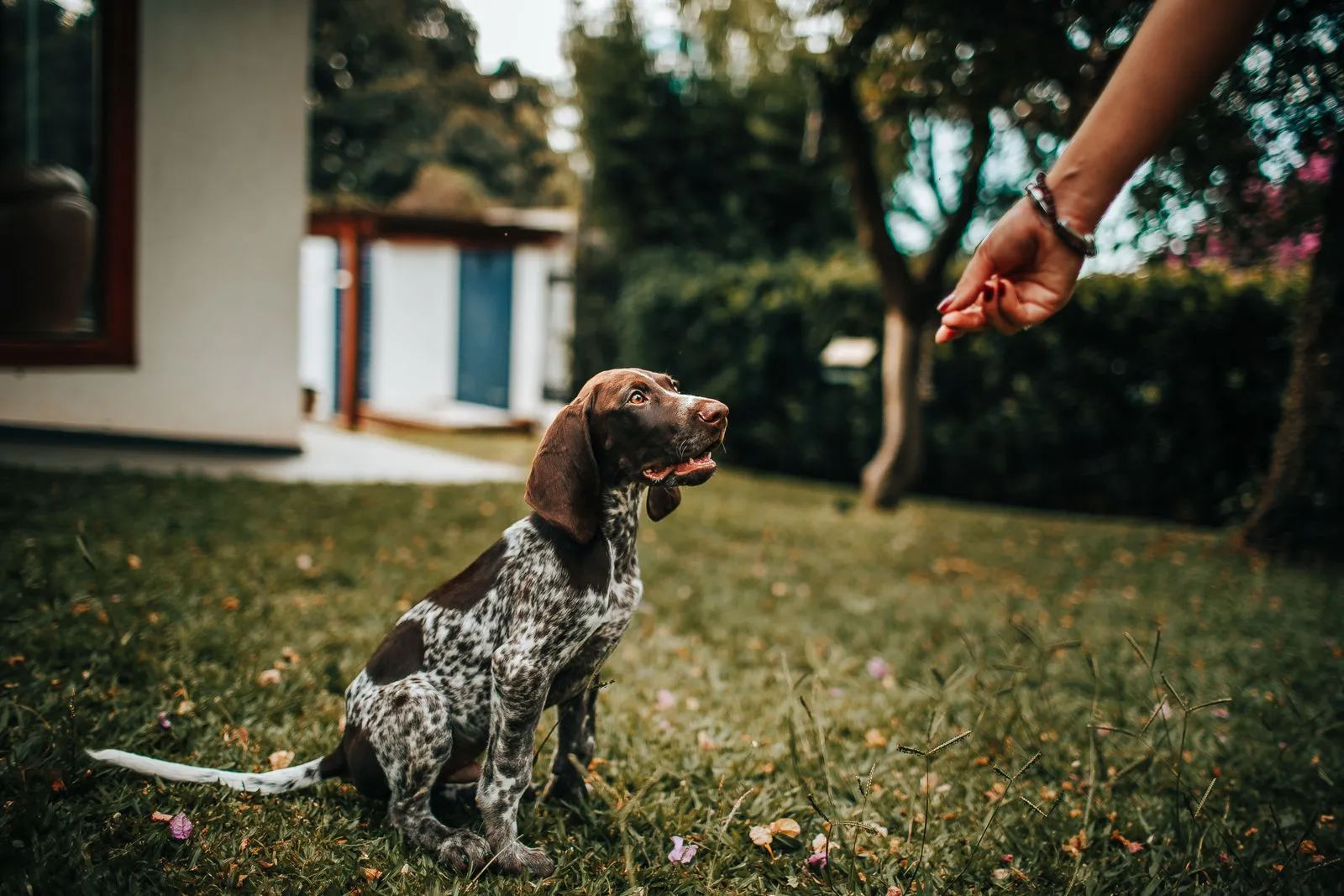
Resist teaching a repertoire. Two things are worth having before the puppy leaves, and both build into feeding rather than adding to your day.
The first is name recognition, most easily built by capturing: when the puppy happens to look at you or move towards you, mark it — a short word, the same one every time, said the instant it happens — and follow immediately with food. Marker and reward must be close together in time; a treat arriving three seconds later rewards whatever happened three seconds later. A clicker or a word such as “yes” both work, and consistency matters far more than the choice.
The second is coming when called, treated as a game rather than an obedience exercise. Feeding time is the natural place, and calling a litter to its food is long-established breeder practice: a high-pitched repetitive sound — the traditional “pup, pup, pup” carries well and resembles nothing else in the house — used before the bowls go down and always followed by something good. A litter called to food twenty times a week for three weeks has a recall cue with a real history behind it.
Keep sessions to a few minutes, a few times a day, and work with one puppy at a time where you can — in a group the confident puppies take all the food and all the learning. Ninety seconds out of the pen also doubles as practice at being alone with a person, part of crate, travel and short separations. Note the differences as you go: who offers behavior, who waits, who needs the task made easier.
If a puppy will not take food during a session, freezes or tries to get away, stop. A puppy that suddenly loses interest in food or play may be unwell and should be checked by your vet.
In practice
A breeder who has never trained a litter starts calling the puppies with the same two-syllable sound before every meal from four and a half weeks, and marks and feeds any puppy that looks at her during the day. She teaches nothing else. By eight weeks the puppies turn and run towards that sound from anywhere in the pen, and every buyer goes home with the cue written down. She taught one thing, and taught it several hundred times.
(Illustrative, composite scenario.)
Handing training over
The handover is part of the job. Tell the new owner exactly what the puppy knows: the marker word, the recall sound, which food was used, and what has not been taught. A recall cue nobody uses for two weeks stops meaning anything.
Point them at a class, and be accurate about timing. AVSAB’s position is that puppies can start classes as early as seven to eight weeks, having had at least one set of vaccines a minimum of seven days beforehand and a first worming, and that socialization before full vaccination should be the standard of care. That is managed exposure, not a choice between socialization and disease protection; the two halves of managing it are in vaccination and immunity and infection control and biosecurity.
Early classes are safe and valuable, but the puppy is not fully protected yet. Puppy vaccinations continue every few weeks until at least 16 weeks of age, with a further dose around six months, so tell the buyer to keep every vaccination appointment. Choose classes that turn away unwell puppies and keep floors clean, and avoid dog parks and places with unknown dogs until the veterinarian says the course is complete.
If problems appear, guide buyers to the right help. A reward-based trainer is right for everyday manners. Fear, panic or aggression belong with the veterinarian first, who may refer to a board-certified veterinary behaviorist. Advise buyers to avoid trainers who use pain, intimidation or “dominance” methods.
Then be honest about the limits. Early learning makes good outcomes more likely; it does not deliver them, and a well-started puppy in a home with no structure will not stay well started. What you hand over is a puppy that has found humans worth paying attention to.
Work on it
A few minutes here will teach you more than re-reading the article.
Ask yourself
- What is my litter being rewarded for that I have not chosen — mobbing the bowl, jumping at the gate, crying to be picked up?
- Do I work with puppies individually, or only as a group where the boldest take everything?
- Could I write down, in three lines, what each puppy knows by the day it leaves?
Find out & check
- Find out which local classes take puppies from seven or eight weeks and what vaccination they require, so your recommendation to buyers is specific rather than general.
Do one thing
- Choose your recall sound and marker word today, write them up where everyone in the house can see them, and start using them at the next meal.
Was this article helpful?
Anonymous. We do not store your name, email or IP address.
Sources & further reading
- American Veterinary Society of Animal Behavior — Position Statement on Humane Dog Training, 2021. avsab.org
- American Veterinary Society of Animal Behavior — Position Statement on Puppy Socialization. avsab.org
- VCA Animal Hospitals — Puppy Behavior and Training: Training Basics. vcahospitals.com
- American Animal Hospital Association — 2015 AAHA Canine and Feline Behavior Management Guidelines. aaha.org
- World Small Animal Veterinary Association — 2024 Guidelines for the Vaccination of Dogs and Cats. wsava.org
- American Kennel Club — Early Socialization and Training Tips for Puppies. akc.org
- Merck Veterinary Manual — Social Behavior of Dogs. merckvetmanual.com
- McEvoy V et al. — Canine Socialisation: A Narrative Systematic Review, Animals, 2022. mdpi.com
Where evidence is limited, recommendations rest on established practice and expert judgment, and may be updated as knowledge develops. Early training influences what is likely, not what is guaranteed: behavior in the adult dog depends heavily on what happens after the puppy leaves.
Next steps
- Read next: House-training and daily routines.
- Related: Socialization: the breeder’s most important behavioral work · How the puppy brain and behavior develop.
- Return to the area hub: Behavior and development.