House-training is usually described as something new owners do in their first two weeks, which is the wrong end of it — by eight weeks a puppy already has a habit and a surface preference, and you gave it both.
The most important first
- From around three weeks, once puppies are mobile and eliminating without the bitch’s stimulation, they instinctively move away from the sleeping area to relieve themselves — and that instinct is what you build on.
- A toilet area beside the bed from three weeks sets a location habit and a surface preference before the puppy ever sees a garden.
- Paper or pine pellets are widely recommended because they resemble nothing else in a house; clay-based cat litter is not recommended, and in breeders’ experience pads can be confused with rugs and bedding.
- Predictable feeding produces predictable elimination — one of the most useful things you can hand a buyer.
- A puppy in a new home still needs a break every one to two hours when awake, and after every meal, nap and bout of play: your work shortens that job, it does not finish it.
Why this starts with you
In the neonatal period the bitch does the work: grooming by the mother stimulates puppies to eat, to eliminate and to stay in the nest. In the transitional period, roughly thirteen to nineteen days, the eyes and ears open and puppies begin eliminating on their own. Within a week or two they can choose where — and a behavior with no location gets one.
What they choose is not random. Even very young puppies crawl away from the nesting spot to relieve themselves, so the litter is already looking for somewhere that is not the bed. If the pen offers nowhere in particular, they use whatever is furthest from it that week, and the habit that forms is “not here” rather than “there”. Offer an obvious alternative and the habit becomes specific — and specific habits travel.
Around three weeks is the point to act, because that is when puppies begin taking solid food and can eliminate independently. How the pen is arranged to allow this is covered in the puppy environment; this article is about the behavior that layout is for.
Keeping the choice simple
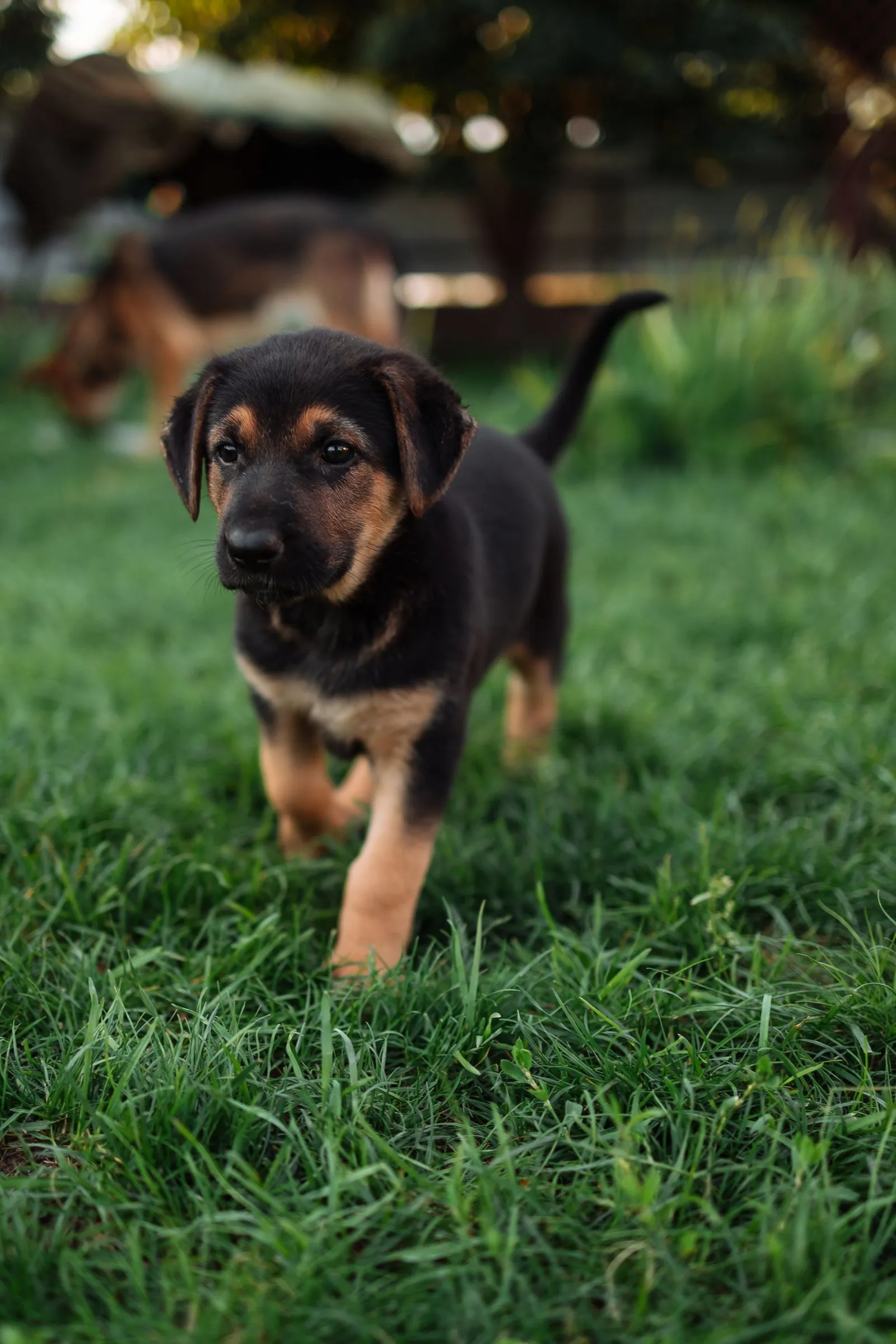
The litter should have a big target and essentially two options: bed or toilet. Ambiguity defeats young puppies. A tray hard to climb into, too small to turn around in, or placed across the feeding area will be used inconsistently. Put it beside the sleeping area, with an edge low enough for the smallest puppy to step over, and expect one tray to stop being enough once the litter moves to a bigger pen.
Surface matters as much as position, because what you are setting is a substrate preference. Recycled paper and pine pellets are commonly recommended for the specific reason that they look and feel like nothing else in a house, so a puppy that prefers them is not learning to prefer rugs and bedding. Clay-based litter is not recommended; in practice, puppies are inclined to eat it, and clumping and scented varieties are worse. Pads are convenient but, in breeders’ experience, can generalize to soft textiles — worth mentioning to buyers whose houses are full of them. Where puppies will eventually go outdoors, artificial turf or a tray of real turf in the last two weeks shortens the final step. Puppies also will not reliably use a soiled tray, and a soiled tray sends them elsewhere: see daily care and hygiene.
Cleaning up
Clean accidents with an enzymatic cleaner that breaks down the residue. Avoid ammonia-based household cleaners — to a puppy they smell like urine and can draw it back to the same spot.
Feeding routine, and why it is the lever
Once puppies are on solid food, when they eat determines when they eliminate. Young dogs characteristically need to go after eating, after sleeping and after active play, so a litter fed at unpredictable times gives unpredictable results, while one fed at the same four points every day produces something close to a timetable — which lets you be present at the useful moments, and which the new owner inherits.
So feed on a schedule, worked out with your veterinarian for the age and breed, and hold it steady rather than letting it drift; what and how often are in feeding the growing litter. Then write it down — actual clock times, actual amounts — and send it home with each puppy. A buyer who knows their puppy ate at seven, twelve, five and nine, and what usually happens fifteen minutes later, is house-training with information rather than guessing — and predictable routine does good beyond the toilet, as frustration tolerance sets out.
Most puppies need to urinate within about 15 minutes of a meal and pass a stool within about half an hour, and nearly all need to go the moment they wake. Building your toilet trips around those moments does most of the work.
In practice
A breeder who has always spread newspaper across the whole pen floor switches at three weeks to a low-sided tray of paper pellets beside the bed, leaving the rest bare. By six weeks the puppies use the tray almost exclusively. The change she did not expect came in the follow-up calls: buyers who once described three or four weeks of accidents now described a handful in the first week. The pen had given them somewhere specific to go.
(Illustrative, composite scenario.)
Where the new owner takes over
Overselling this causes more trouble than saying nothing. You can honestly say the puppy has learned to leave its bed to eliminate, has used a particular surface, and comes with a schedule that makes its needs predictable. You cannot say it is house-trained: it has never seen their floor, their garden or their weather.
Describe the first weeks in numbers rather than reassurance. A young puppy may need to go out after every meal or large drink, on waking, roughly every half hour during energetic play, every one to two hours while awake, and every four hours even when resting — and may need overnight outings until around five months old. A common benchmark for relaxing supervision is eight to twelve weeks without a mistake — that is, weeks in the new home with no accidents, not the puppy’s age.
Two pieces of advice are worth giving explicitly. Reward at the site, immediately: quiet praise and a small treat where the puppy has just performed, not once everyone is back indoors, because a reward indoors rewards coming indoors. And do not punish accidents — punishing a puppy for a natural act can teach it never to eliminate near a person, producing a dog that waits until it is alone and goes behind the sofa. That is the reasoning behind reward-based methods generally. Last, tell buyers to take some of the surface with them: a bag of the pellets your puppies have used, scattered in the new toilet area, carries the preference into the new house.
Tell buyers, too, that a few drops of urine when greeting excited people, or when the puppy crouches and lowers its head, are not house-training failures. Scolding makes both worse; keep greetings calm and low-key.
When it is not a training problem
Some toileting problems are medical. A puppy that urinates very often in small amounts, strains, cries or squats repeatedly, has blood in its urine, is always damp around the back end or seems to leak urine, has diarrhea, or suddenly goes backward after doing well should be checked by a veterinarian before you change the training. Bladder infections and some birth defects can look exactly like “not getting it”.
When to call your vet
- A puppy urinates very often in small amounts, strains, or cries when urinating.
- You see blood in the urine or stool.
- A puppy is always wet around the back end, leaks urine while resting, or dribbles constantly.
- A puppy has diarrhea, especially with vomiting, dullness or poor appetite.
- A puppy that was doing well suddenly starts having accidents again.
- If in doubt, call — your vet would rather hear from you early.
Work on it
A few minutes here will teach you more than re-reading the article.
Ask yourself
- Does my pen give the litter a clear choice between bed and toilet, or only a vague sense of away-from-the-bed?
- Is my feeding schedule steady enough to predict, within fifteen minutes, when the litter will need to go?
- Am I setting a surface preference I would want in my own house, and in theirs?
Find out & check
- Check with your veterinarian how many meals a day your litter should have at each age, so the schedule you give buyers is the right one.
Do one thing
- Write your litter’s feeding times and amounts on one sheet today, ready to copy for every puppy pack, with a line on what usually happens fifteen minutes after a meal.
Was this article helpful?
Anonymous. We do not store your name, email or IP address.
Sources & further reading
- American Kennel Club — Set Your Puppies Up for Success: Housetraining Foundation. akc.org
- VCA Animal Hospitals — House Training for Puppies and Dogs. vcahospitals.com
- Merck Veterinary Manual — Social Behavior of Dogs. merckvetmanual.com
- Merck Veterinary Manual (pet owner version) — Behavior Problems in Dogs. merckvetmanual.com
- Merck Veterinary Manual (pet owner version) — Infectious Diseases of the Urinary System in Dogs. merckvetmanual.com
- The Royal Kennel Club — How do I toilet train my dog?. royalkennelclub.com
- Dogs Queensland — Toilet training. dogsqueensland.org.au
Where evidence is limited, recommendations rest on established practice and expert judgment, and may be updated as knowledge develops. Early toilet habits make house-training in the new home quicker and easier — they do not complete it.
Next steps
- Read next: Crate, travel and short separations.
- Related: The puppy environment: space, surfaces and setup.
- Return to the area hub: Behavior and development.