Most of what keeps a litter healthy is not dramatic — it is a short, repeatable routine done every day, which is also what makes problems visible early enough to be small ones.
The most important first
- A hands-on check of every puppy, every day, catches more than any amount of watching the litter as a group.
- Bedding that is damp or soiled should be changed when it happens, not at the end of the day — wet bedding causes skin and paw problems.
- Daily handling is both a health check and habituation: the puppy learns that feet, ears and mouth being touched is ordinary.
- Keep written records of weights, worming, vaccination and anything unusual — they become the buyer’s documentation later.
- The dam needs the same daily attention as the puppies, particularly her appetite, her mammary glands and her body condition.
The daily check
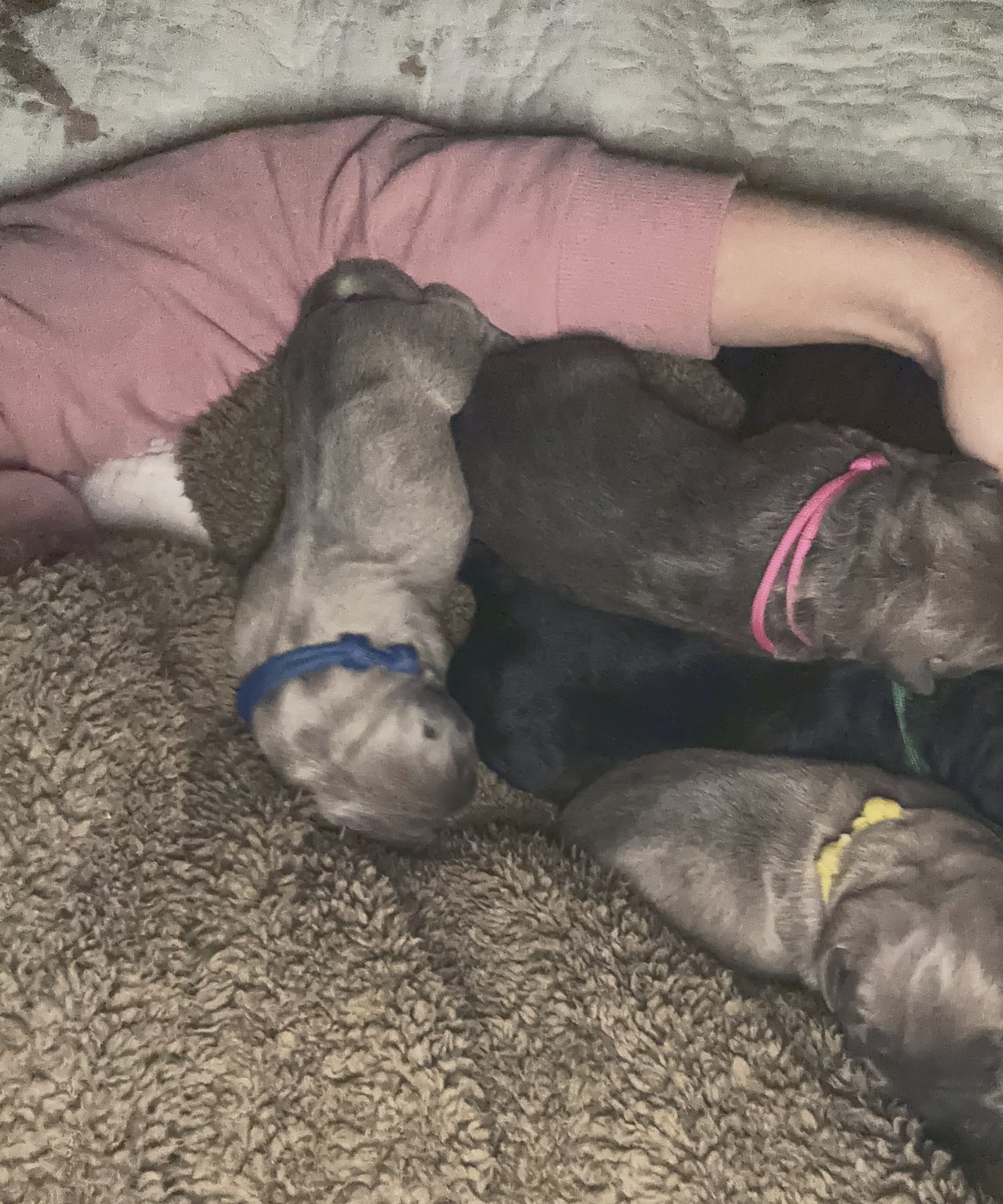
Go through the litter one puppy at a time rather than assessing them as a group. Pick each one up and look for the same things every day: is it alert and responsive when handled, warm to the touch, well-rounded rather than thin, nursing or eating with appetite, with clean eyes and nose, healthy skin, and normal, formed stools. Note anything different from yesterday.
The value of doing this in the same order every day is that it makes deviation obvious. A puppy that is quieter than usual, or that feels slightly cooler, or that hangs back at the food bowl, is telling you something before any obvious symptom appears — and early is where the difference is made. Restlessness, persistent crying, failure to gain weight, unusual discharge and lethargy are all reasons to look closer and, if they persist, to call your vet.
Weighing is the backbone of this — daily for at least the first two weeks, then weekly, as covered in growth and body condition in puppies — the number is a check on the impression, not a replacement for it.
What the numbers should do
A healthy puppy should reach at least one and a half times its birth weight by day 7 and roughly double it by about day 10–14. In the first week, a newborn’s body temperature is normally about 95–99 °F (35–37.2 °C) — lower than an adult’s — so a puppy that feels cool, cries persistently, or will not suckle needs attention now. If a puppy’s weight has not started rising again within 24–48 hours of you noticing a problem, see your vet.
Cleaning: what, and how often
Soiled and damp bedding should be removed as it occurs. Puppies that lie on wet material develop skin and paw inflammation, and a damp environment is also harder to keep warm. Have enough bedding in rotation that changing it is never a decision about whether it can wait.
The elimination area needs emptying and topping up frequently — a tray that is unpleasant to use is a tray puppies stop using, which undoes the habit the setup in the puppy environment was designed to build. Food and water dishes get washed daily; weaning is messy, and leftover gruel sours quickly.
Cleaning products matter as much as the cleaning. Surfaces should be washable and non-porous so that they can actually be disinfected, and any product used around puppies needs to be safe for the species and thoroughly rinsed. The wider question of quarantine, visitors and disease prevention is covered separately in infection control and biosecurity for the litter.

Clean first, then disinfect
Disinfectants work poorly on dirty surfaces. Remove feces, food and bedding first, wash with detergent, then apply a disinfectant that is effective against parvovirus, leave it wet for the full contact time on the label, rinse, and let the area dry before puppies return. Many household cleaners do not kill parvovirus. Clean while the dam is out and keep the puppies in a clean, warm box during the process.
Handling as part of the routine
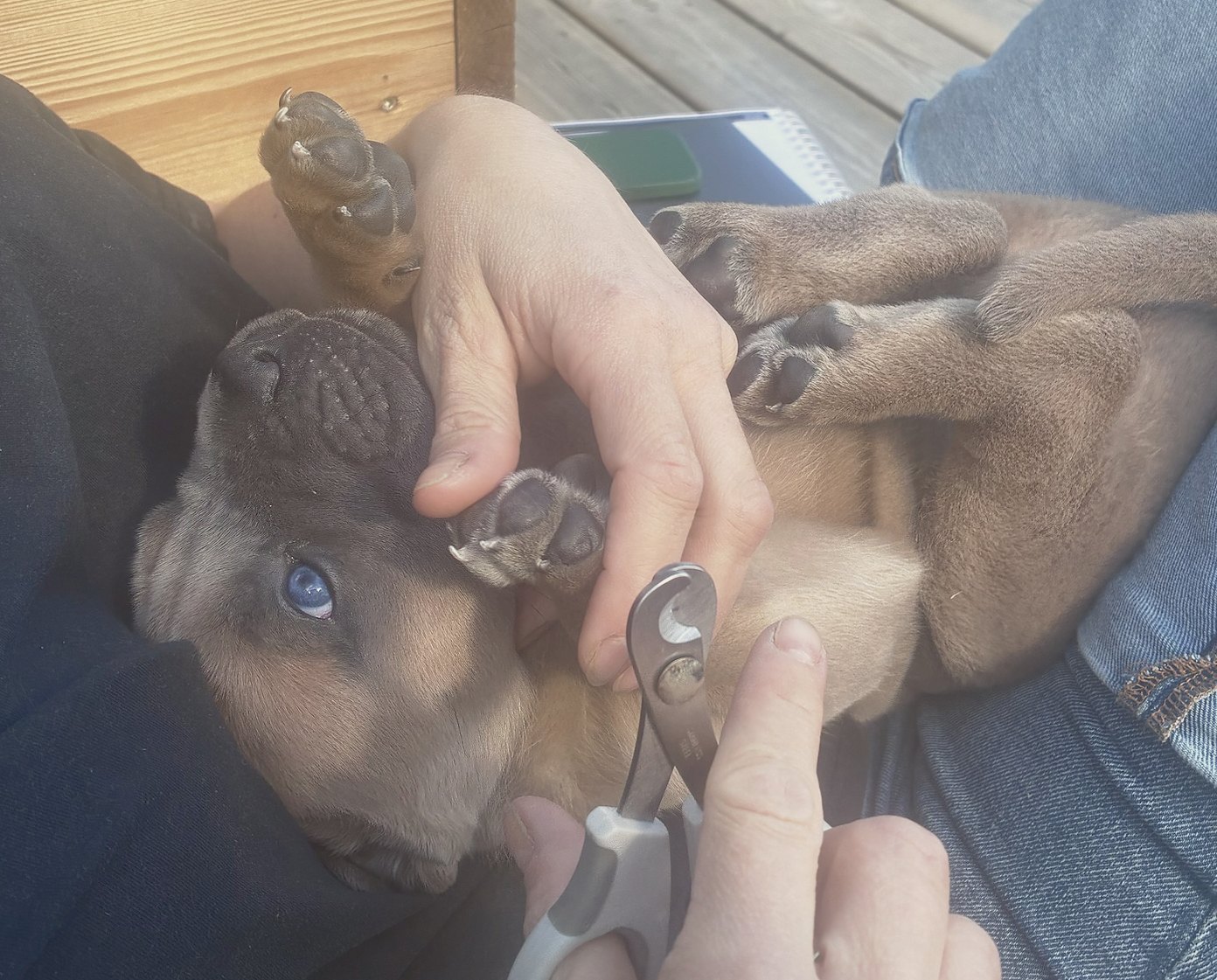
Daily handling does double duty. It is how you perform the health check, and it is how a puppy learns that human hands are unremarkable. Short, calm sessions — a few minutes of gentle massage, several times a day — work better than long ones, and slow, firm strokes are more settling than brisk ones. Touch the feet, look in the ears, lift the lips and touch the gums, as ordinary parts of being handled rather than as procedures. Everyone who handles the puppies should wash their hands first; visitors should wear clean clothes and leave outdoor shoes at the door.
Nails need attention from an early age: they grow quickly, they are sharp, and they scratch the dam’s mammary skin while puppies nurse. Trim only the sharp tip, about once a week from the first week, using small scissors or puppy clippers — long nails scratch the dam’s teats and can contribute to mastitis. Trimming small amounts frequently, so the puppy experiences it as routine rather than as a fight, is what makes the new owner’s life easier for the next decade.
Brushing, the sound of clippers, and gentle drying can all be introduced in the same low-key way — put the equipment on the floor to be investigated before it is ever used. Bathing is rarely needed for a litter, and when it is, warm water, a damp cloth for the face, and a short session are enough.
In practice
A breeder handles the litter constantly but always in the same way — cuddling, holding them against the chest. At eight weeks, the puppies are relaxed about people and tense about having their paws touched. Adding thirty seconds of deliberate foot, ear and mouth handling to each daily check costs almost nothing and produces puppies whose first vet visit and first nail trim are uneventful.
(Illustrative, composite scenario.)
Records, and the dam
Write things down as they happen: weekly weights, worming dates and products, vaccination dates and batch numbers, any illness and what was done about it. This is partly for you — patterns across litters are only visible if they are recorded — and partly because much of it goes to the buyer as documentation, as covered in the pre-sale health checklist.
The dam is easy to under-monitor once the puppies get interesting. Check her appetite, her body condition, and her mammary glands daily. The glands should be soft and the milk whitish; glands that are hot, hard, painful or red, milk that is bloody or yellowish, a fever above 103 °F (39.5 °C), or a dam who suddenly avoids her puppies point to mastitis, which needs prompt veterinary treatment — as does a bitch who is off her food. Her needs change fast through weaning, and they are covered further in from nursing to weaning.
Be especially alert two to three weeks after whelping, at peak milk production, and particularly in small breeds with large litters: panting, restlessness, trembling, a stiff gait or wobbliness can be the start of eclampsia (low blood calcium). This is an emergency — take the puppies off her and call your vet immediately.
When to call your vet
- A puppy loses weight, or its weight has not started rising within 24–48 hours of you spotting a problem.
- A puppy is cold, weak, won’t suckle, cries constantly, or has diarrhea.
- The dam’s mammary glands are hot, hard, red or painful, or her milk is bloody or yellowish.
- The dam pants, trembles, walks stiffly, or seems disoriented — possible eclampsia; take the puppies off her and call immediately.
- The dam goes off her food, has a fever above 103 °F (39.5 °C), or her vaginal discharge is heavy or foul-smelling.
- If in doubt, call — your vet would rather hear from you early.
Work on it
A few minutes here will teach you more than re-reading the article.
Ask yourself
- Do I check each puppy individually every day, or mainly observe the litter as a group?
- Is my bedding supply big enough that changing it is never postponed?
- Does my handling include feet, ears and mouth — or only cuddling?
Find out & check
- Check that the cleaning and disinfection products you use are safe for puppies at this age, and how thoroughly they need rinsing.
Do one thing
- Write out your daily check as a short fixed list and keep it where you do the check.
Was this article helpful?
Anonymous. We do not store your name, email or IP address.
Sources & further reading
- VCA Animal Hospitals — Breeding for Dog Owners: Caring for Newborn Puppies. vcahospitals.com
- VCA Animal Hospitals — Preparing Your Puppy for a Lifetime of Good Hygiene. vcahospitals.com
- Purdue University Center for Animal Welfare Science (Croney Research Group) — Environmental Sources of Stress for Kenneled Dogs: Space and Flooring Needs. caninewelfare.centers.purdue.edu
- Dogs NSW — Care of Puppies, Birth to 10 Days. dogsnsw.org.au
- Merck Veterinary Manual — Mastitis in Small Animals. merckvetmanual.com
- Merck Veterinary Manual — Eclampsia in Small Animals. merckvetmanual.com
- Cornell University College of Veterinary Medicine — Parvovirus: Transmission to treatment. vet.cornell.edu
- UK Government (Defra) — Dog breeding licensing: statutory guidance for local authorities. gov.uk
Where evidence is limited, recommendations rest on established practice and expert judgment, and may be updated as knowledge develops.

Next steps
- Read next: Parasites and worming schedules.
- Related: The puppy environment: space, surfaces and setup.
- Return to the area hub: Raising a healthy litter.