Once the litter is weaned, feeding stops being about survival and becomes about trajectory — the aim is optimal growth, not maximal growth, and the difference between the two matters most in the breeds that grow largest.
The most important first
- Feed a complete, balanced diet formulated for growth, with a large-breed growth formulation for large and giant breeds.
- From weaning to around six months, at least three meals a day is the general recommendation; newly weaned puppies and small breeds often need more.
- Feed measured portions rather than leaving food down all day — free-choice feeding raises the risk of excess body fat and, in large breeds, skeletal problems.
- Do not add calcium or other supplements to a complete puppy food; excess calcium is a recognized risk, not a safety margin.
- Fresh water should be freely available from weaning onward, and treats kept to no more than around a tenth of daily calories.
Choosing the food

The food should be complete and balanced for growth — meeting AAFCO or FEDIAF nutritional levels for growth rather than for adult maintenance — and it should stay the same food from weaning through going home and, ideally, into the new home. Protein requirement is at its highest immediately after weaning and declines gradually from there, which a growth diet already accounts for; there is no need to adjust it yourself.
Large and giant breeds need a diet formulated specifically for large-breed growth. These formulations control energy density and the calcium-to-phosphorus balance in a way that supports a slower, steadier skeletal development, and the risk they exist to manage — developmental orthopedic disease — is real enough that a general-purpose puppy food is not an adequate substitute for a breed that will weigh about 70 lb (32 kg) or more as an adult — the threshold used on AAFCO growth labels.
How much, how often

From weaning to around six months, the general recommendation is at least three meals a day — newly weaned puppies often get four or more at first — from six to twelve months, twice daily is usually sufficient. Small and toy breeds often need more than three meals during the earliest weeks, because their capacity is small relative to their energy needs and they are more prone to blood sugar dips.
Toy and very small puppies have little energy in reserve, and a long gap between meals, a chill, stress or a parasite burden can drop their blood sugar quickly. Weakness, trembling, wobbliness, unusual sleepiness or a seizure are signs of low blood sugar and an emergency: your vet can advise you in advance what to keep on hand while you get the puppy to the clinic. Prevent it with small, frequent meals at even intervals, including late evening and early morning, and make sure buyers of toy breeds understand this before the puppy leaves.
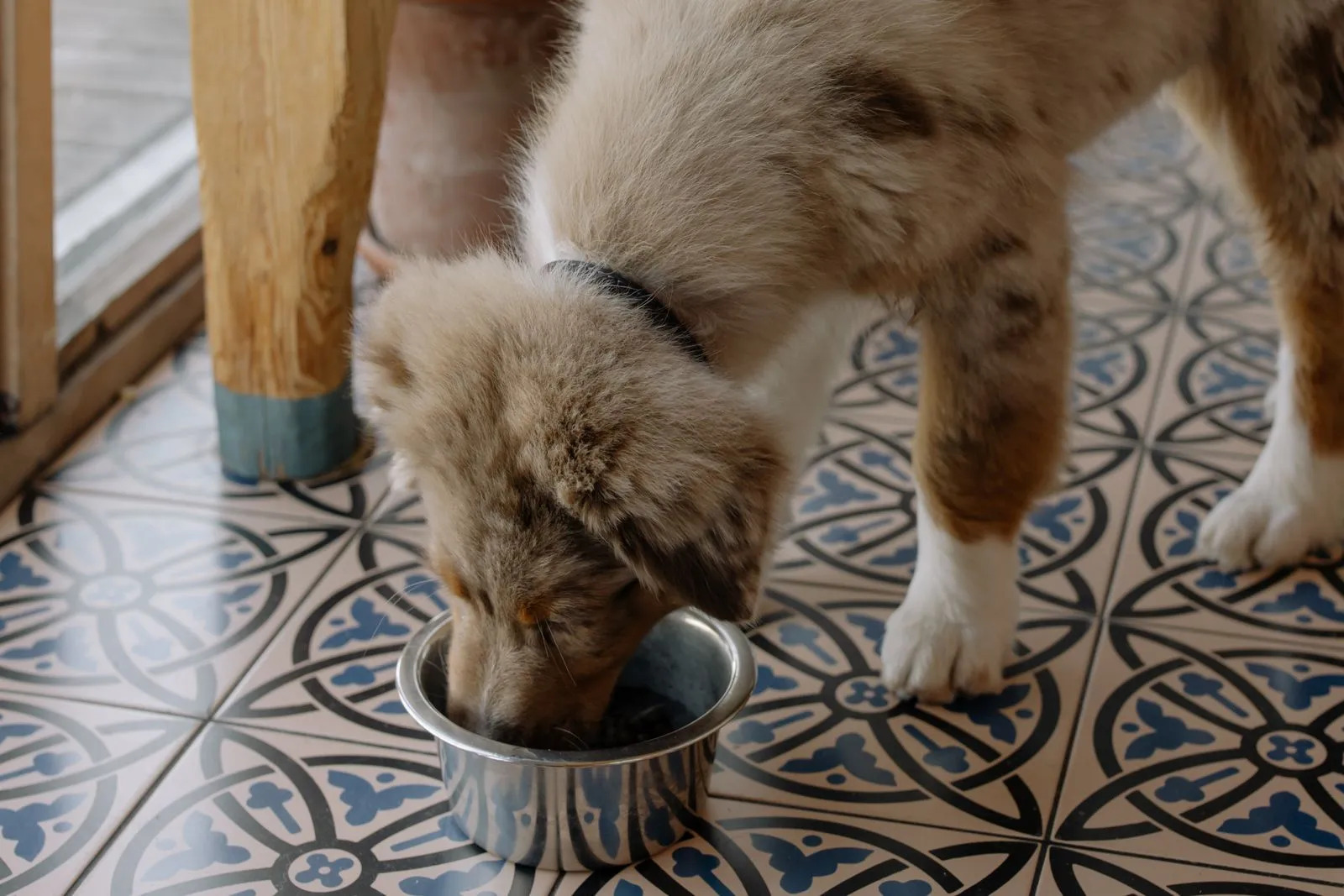
Measured portions at set meal times are preferable to leaving food available continuously. Free-choice feeding tends to produce more body fat, contributes to overweight later in life, and in large-breed puppies is associated with skeletal abnormalities. Meal feeding also gives you something free-choice feeding cannot: a daily look at who eats with enthusiasm and who does not.
Fresh water should be available at all times from weaning onward, in a shallow, stable dish that a small puppy cannot tip or drown in.
Supplements: why less is more
Puppies do need more calcium than adult dogs, which is precisely why a growth diet contains more of it — and precisely why adding more on top is a problem rather than an insurance policy. Supplemental calcium, phosphorus and vitamin D beyond what a complete diet provides is rarely necessary and can be actively contraindicated, particularly during large-breed growth. The same applies to most vitamin and mineral supplements: if the diet is complete and balanced for growth, the supplement is at best redundant. Anything beyond the diet should be a decision made with your vet, for a specific reason.
In practice
A breeder of a giant breed is told by an experienced acquaintance to add a calcium supplement “to build good bone.” Checking the label instead shows the puppy food is already formulated for large-breed growth with a controlled calcium level — and that adding to it would push intake into the range associated with the very skeletal problems the supplement was meant to prevent.
(Illustrative, composite scenario.)
Watching the result rather than the bag
Feeding guidelines printed on a bag are a starting point, not a prescription — litters, breeds and individuals vary. What tells you whether the amount is right is the puppy: weekly weights and a hands-on body condition check, as described in growth and body condition in puppies. Ribs that are easily felt under a thin layer of fat, with a visible waist, is the target throughout growth. Steady, unremarkable gain is the goal; a puppy that is visibly rounder than its littermates is being overfed relative to its needs, not thriving more than they are.
A standard body condition chart, such as the WSAVA nine-point scale, makes the hands-on check consistent: at the ideal score the ribs are easy to feel under a thin layer of fat, the waist is visible from above, and the belly tucks up from the side. Record weights weekly; a puppy that eats well but stays thin or potbellied may have worms or another health problem, not a food problem — see worming puppies. A puppy that refuses food for more than one meal, vomits repeatedly or has ongoing diarrhea needs your vet, not a change of food.

Preparing for the handover
The last feeding job before puppies leave is making the next transition uneventful. Send each buyer home knowing exactly which food the puppy is on, how much, and how many meals a day — and, where practical, with enough of that food to bridge the first days. A puppy adjusting to a new home, new people and a new routine should not also be adjusting to a new diet in the same week. If the new owner intends to change food, the advice to give is to wait until the puppy has settled and then transition gradually over several days to a week. Give buyers the weight record along with the food, portion and meal schedule, and a written day-by-day plan if they intend to change food later.
When to call your vet
- A toy or small-breed puppy is weak, trembling, wobbly, unusually sleepy, or has a seizure — emergency.
- A puppy refuses food for more than one meal, or vomits repeatedly.
- Diarrhea lasts more than a day or comes with a flat, unwilling puppy.
- A puppy stops gaining weight, or stays thin or potbellied despite eating well.
- You are considering any supplement, or a large-breed puppy is growing noticeably faster than expected.
- If in doubt, call — your vet would rather hear from you early.
Work on it
A few minutes here will teach you more than re-reading the article.
Ask yourself
- Is the food I am using formulated for growth — and for large-breed growth if that applies to my breed?
- Am I feeding measured portions at set times, or leaving food down and hoping it evens out?
- Have I checked whether anything I add to the bowl duplicates what the diet already contains?
Find out & check
- Check the label for an AAFCO or FEDIAF statement covering growth, and for large-breed growth if relevant.
Do one thing
- Write down the current food, portion size and number of meals per day in a form you can hand to every buyer.
Was this article helpful?
Anonymous. We do not store your name, email or IP address.
Sources & further reading
- Merck Veterinary Manual — Feeding Practices in Small Animals. merckvetmanual.com
- Merck Veterinary Manual — Nutritional Requirements of Small Animals. merckvetmanual.com
- VCA Animal Hospitals — Feeding Growing Puppies. vcahospitals.com
- WSAVA Global Nutrition Committee — Body Condition Score – Dog. wsava.org
- American Kennel Club — Hypoglycemia in Dogs. akc.org
- UK Government (Defra) — Dog breeding licensing: statutory guidance for local authorities. gov.uk
- Companion Animal Parasite Council — Ascarid (Roundworm). capcvet.org
Where evidence is limited, recommendations rest on established practice and expert judgment, and may be updated as knowledge develops.
Next steps
- Read next: The puppy environment: space, surfaces and setup.
- Related: From nursing to weaning.
- Return to the area hub: Raising a healthy litter.