Twenty homes will happily tell you how the dog is doing for about a year — keeping that conversation alive for the next nineteen is a different skill, and it is the one that decides what you ever learn.
The most important first
- Long-term contact is agreed at handover, not improvised later; a buyer who was told at eight weeks that you would be in touch each year is not surprised when you are.
- A low, predictable cadence works better over a decade than enthusiastic contact that fades after eighteen months.
- How you ask determines what you hear: specific, neutral questions produce usable answers, while general ones produce politeness.
- The homes that stop answering often have the most to tell you, so silence is information rather than a closed door.
- Contact details are only useful if they are kept somewhere findable and updated, which makes this an extension of your record-keeping rather than a separate task. Expectations set during the sales conversation carry most of the weight.
What you agree before the puppy leaves
The most effective thing you can do for twenty years of contact takes two minutes at handover. Say, out loud and in writing, that you will be in touch once or twice a year for the dog’s whole life, that you would like to know about any diagnosis or screening result, and that you want to hear when things go wrong as well as when they go right. A buyer who has heard this framed as normal breeder practice treats your later messages as expected. One who hears nothing will read the same message two years on as a social call or an intrusion, and answer accordingly.
Breeder schemes have made some version of this an expectation rather than a courtesy. The UK Kennel Club’s Assured Breeders scheme, until it closed on 31 December 2024, required members to provide reasonable after-sales advice and to help rehome any dog they bred, for whatever reason, throughout that dog’s lifetime, and to give each buyer a scheme feedback form. The Royal Kennel Club has said it will carry the scheme’s principles into its registration model instead, including a puppy buyer feedback system. The American Kennel Club’s Bred with H.E.A.R.T. program builds its requirements around health, education, accountability, responsibility and tradition, with annual continuing education for the breeder. Neither scheme prescribed a follow-up cadence, which is the gap this article sits in: the obligation to remain available is widely recognized, the method for staying in useful contact is left to the individual.
This belongs in the same conversation as the rest of the handover material. If you already cover feeding, vaccination and the first weeks in the puppy pack, add a short written paragraph on follow-up, naming your preferred channel and the fact that you will send a reminder. It costs a paragraph and changes the next twenty years.
Ask the buyer to transfer the microchip registration into their name before they leave, or within the days after, and to update it whenever they move or change phone number. In the UK this is a legal duty of the keeper, and similar rules apply in many other countries. A current registry record helps the dog come home if lost, and helps you find the dog later if a contact goes quiet. A short feedback form of your own at handover is also a good first follow-up.
A cadence that survives ten years
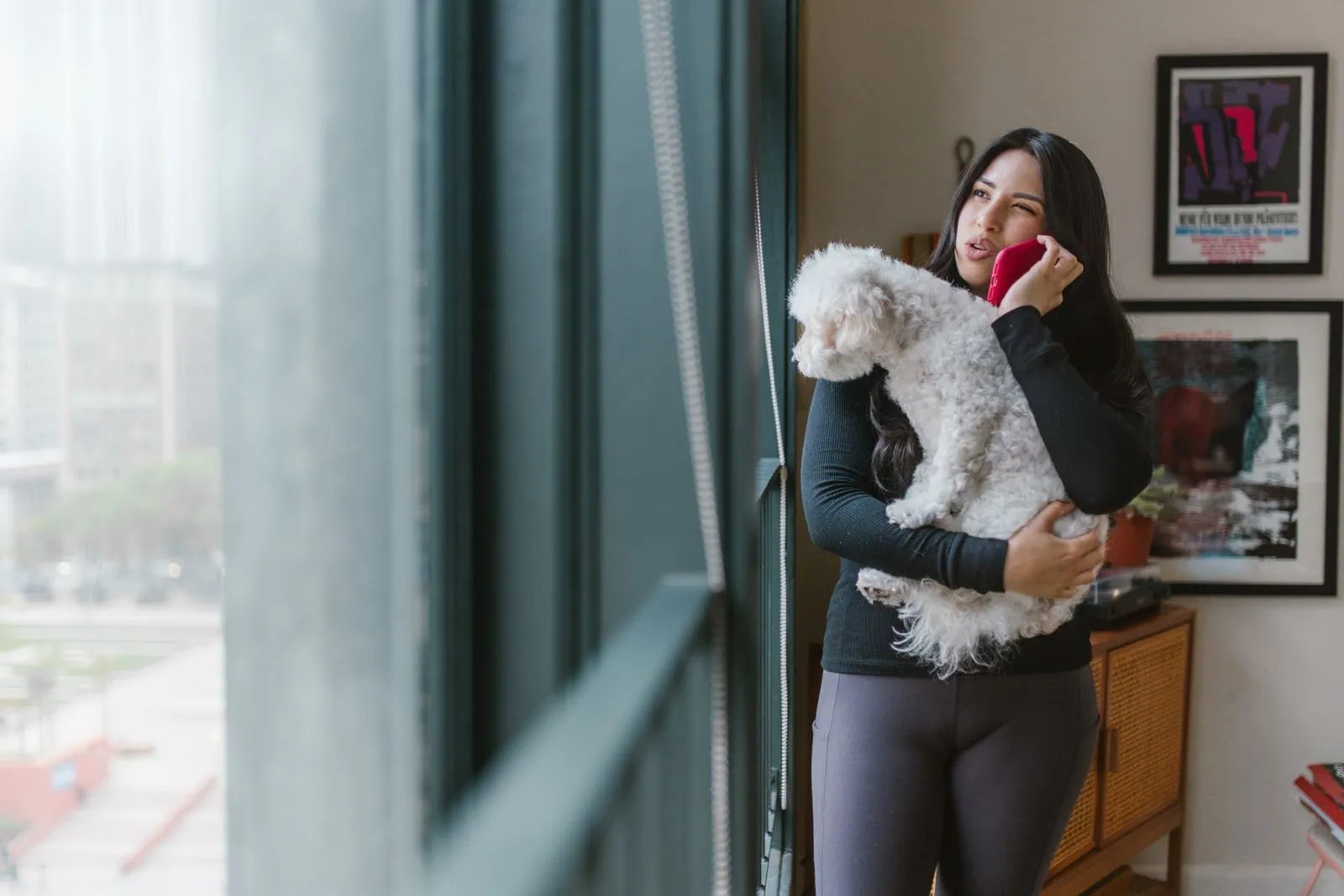
The pattern that holds up is undemanding and regular. Something short at a week and at a month, while the home is still finding its feet and settling the puppy in. Something slightly longer at six months and at a year, when adolescence has arrived and the owner has opinions. After that, once a year is enough, with one or two deliberate checkpoints at the ages where real information appears: around two, when adult screening results exist, and around seven or eight, when late-onset problems start to show.
Annual contact sounds thin, and breeders who have just placed a litter often want more. The problem is that high-intensity contact does not survive several litters at once. A breeder with four litters placed over six years is already carrying thirty homes, and a quarterly message to thirty households is a part-time job. The usual outcome is a year of enthusiasm followed by nothing — which is worse than annual contact, because it teaches the homes that your interest was temporary.
Tie the cadence to a date you cannot forget. The litter’s birthday works well: one message to the whole cohort, sent on the same day each year, asking the same questions. It takes an afternoon, it produces comparable answers across the litter, and it means nobody has to remember anything.
Asking questions that get honest answers
A general question gets a general answer. Ask how the dog is doing and you will be told that she is wonderful, which is both true and useless. Ask whether the dog has seen a vet in the past year, what for, and what the outcome was, and you get something you can record. Ask whether any screening or test has been done and with what result, and at what age any problem first appeared. Specific, dated, closed questions are easier for the owner to answer and far more useful to you.
Neutral wording matters as much as specificity. A question that signals the answer you want will get it, particularly from owners who like you and do not want to deliver bad news about a dog you bred. “Has she had any skin problems?” invites a no. “What, if anything, has she been treated for?” does not. The same applies to behavior and to anything an owner might read as a judgment of their own handling.
The limits are real. Owner-reported data are the backbone of breed health knowledge, but they are reported data. The 2004 United Kingdom purebred dog health survey, which gathered 15,881 deaths through breed clubs, achieved an overall response rate of 24 percent, with breed-specific rates ranging from under 5 percent to around 65 percent. If a large, organized survey reaches a quarter of the people it asks, a single breeder should expect gaps too, and should not treat the answers received as representative of the whole litter.
If you want answers you can compare across homes and litters, a standardized questionnaire helps. Some breeders already ask buyers to complete the University of Pennsylvania’s C-BARQ behavior questionnaire one to two years after the puppy goes home. And if an owner describes a health problem, encourage them to contact their own veterinarian first, then record what the vet found.
In practice
A breeder with three litters placed over five years sends one message on each litter’s birthday. The text is the same every year: four questions about veterinary visits, screening results, weight and any behavior that the owner finds difficult, plus an open line at the end inviting anything else. Of eighteen homes, thirteen reply within two weeks, three reply after a reminder, and two do not reply at all. One of the late replies mentions that the dog was treated for recurrent ear infections at three and again at four — something the owner had not thought worth reporting because it had been resolved both times. It is the third offspring from the same sire with recorded ear disease, which is the first signal the breeder has that there may be a pattern rather than a coincidence.
(Illustrative, composite scenario.)
Channels, reminders and the records behind them
Use the channel the home already uses: email for some, a messaging app for others, a phone call for a few. Moving everyone onto one platform reduces your response rate for no gain. What should be uniform is not the channel but the question set and the place the answers end up.
That place should be the same one holding the rest of the dog’s history, so that a screening result sent by message in March is filed where you will look for it in five years. A shared document, a simple database or a per-dog card all work; what fails is a follow-up archive that lives in your phone. Set reminders in a calendar rather than your memory, and record the date of every contact attempt alongside the answer, including those that produced nothing.
Keep handover and transition and follow-up in the same file as well. A dog whose placement was difficult is a dog whose follow-up is more likely to need judgment, and you will want the context.
The homes that stop answering
Silence is uncomfortable and easy to misread. Some non-response is ordinary: addresses change, people move countries, an email filter eats you. But a proportion of silence is meaningful. A home dealing with a serious diagnosis, a behavior problem they feel responsible for, a dog that has died young, or a decision to rehome, is a home that often goes quiet rather than writing to the breeder. The result is a systematic bias in one direction, because the answers you lose are disproportionately the bad ones.
Two things help. First, make it explicit from the start that bad news is welcome and will not be met with blame, and repeat it in each annual message. Second, follow silence once, gently, through a different channel, and then leave it. A single friendly message a few months later recovers a surprising number of homes; in our experience, three in two weeks tends to lose them for good.
It also helps to separate contact from obligation. Research on relinquishment finds that owner circumstances, rather than the animal, drive most of it: in a long-running Danish shelter study, owner-related reasons, such as the owner’s health, housing and lack of time, accounted for around three-quarters of dog relinquishments, with behavior problems named in roughly a quarter. An owner whose life has changed is not an owner who failed, and a breeder who makes that clear — including how return and rehoming works — hears about the change earlier.
What you keep, and the rules that govern it
Holding names, addresses and contact details for thirty households over twenty years means you are maintaining a personal data record, and the rules for that differ substantially between countries and sometimes between regions within them. Requirements around consent, retention periods, what you must tell people about what you hold, and their right to see it or have it erased are not the same in the European Union, the United Kingdom, the United States, Canada or Australia.
This article gives no legal interpretation. Find out what applies where you live, from your national data protection authority or a comparable body, before building a long-term buyer register, and write the answer down. The rules really do differ: EU data protection law says personal data must be adequate, relevant and limited to what is necessary for the purpose, while Australia’s Privacy Act does not apply to most small businesses below a turnover threshold, although there are exceptions. Elsewhere the rules depend on your country, state or province, so note the date you checked. Some habits travel well regardless: collect only what you need, tell buyers at handover what you keep and why, store it somewhere access-controlled rather than in a shared spreadsheet, and honor a request to be removed without argument. Information about another person’s dog is also information about that person, which matters when you later consider what to share with a breed club or register.
Work on it
A few minutes here will teach you more than re-reading the article.
Ask yourself
- Of the homes from your most recent litter, how many could you contact today without asking someone else for a number?
- When you last asked how a dog was doing, did you ask something a worried owner could have answered honestly?
- Which litter has gone longest without any contact from you, and what would you learn if that changed this month?
Find out & check
- Look up what your national data protection authority says about holding contact details of private individuals, and what it requires you to tell them.
Do one thing
- Write the four questions you will send every home, every year, and put the next send date in your calendar.
Was this article helpful?
Anonymous. We do not store your name, email or IP address.
Sources & further reading
- The Royal Kennel Club — Kennel Club announces registrations model update and the future closure of the Assured Breeders scheme (2024). royalkennelclub.com
- American Kennel Club — AKC Bred with H.E.A.R.T. requirements. akc.org
- Adams, Evans, Sampson & Wood — Methods and mortality results of a health survey of purebred dogs in the UK. pubmed.ncbi.nlm.nih.gov
- Jensen, Sandøe & Nielsen — Owner-related reasons matter more than behavioural problems: a study of why owners relinquished dogs and cats to a Danish animal shelter. mdpi.com
- University of Pennsylvania School of Veterinary Medicine — About the C-BARQ. vetapps.vet.upenn.edu
- GOV.UK — Get your dog or cat microchipped. gov.uk
- European Commission — How much data can be collected?. commission.europa.eu
- Office of the Australian Information Commissioner — Small business. oaic.gov.au
Where evidence is limited, recommendations rest on established practice and expert judgment, and may be updated as knowledge develops. No research establishes an optimal follow-up cadence, question wording or channel for breeders, so the specific intervals suggested here are convention and experience rather than findings; the response-rate and relinquishment figures quoted describe other populations and are included to show the direction and scale of the bias you should expect, not to predict your own.
Next steps
- Read next: Collecting health and longevity data.
- Related: Communication and setting expectations with buyers.
- Return to the area hub: Closing the loop: follow-up and the next generation.