Puppies learn about the world with their mouths. Most of what they pick up is harmless, but a sock, a corn cob or a length of string can block the gut, a battery can burn it, and a chip bag can suffocate a dog in minutes. This article covers the risks from the weaning pen to adolescence, for you and for the families who take your puppies home.
The most important first
- Dogs under a year old are the group most often treated for swallowed foreign objects. Puppy-proofing is part of raising a litter, not an optional extra.
- Never pull on a string, thread or ribbon you can see in a puppy’s mouth or under the tongue, or coming from the rear end. It can cut through the intestine. Go to the vet.
- Swallowed batteries and more than one magnet (or a magnet plus any metal object) are emergencies even if the puppy seems fine.
- Do not try to make a puppy vomit unless a veterinarian or poison service tells you to.
- Repeated vomiting, retching with nothing coming up, a painful belly or a puppy that stops eating needs a vet the same day.
Why puppies and young dogs swallow things
Chewing and mouthing are how puppies investigate. Teething adds an urge to chew, and adolescent dogs are often bigger, bolder and less supervised than young puppies. The result shows up in clinic data. In 2014 records from more than 890 Banfield hospitals, analyzed by a board-certified surgeon, dogs under one year old had the highest prevalence of gastrointestinal foreign bodies of any age group. The same data showed that larger breeds were affected more often than toy breeds, possibly because they can swallow socks and toys whole.
Many dogs that swallow something once do it again. The Merck Veterinary Manual notes that dogs that have eaten inappropriate objects often keep doing so. A puppy that has needed one trip to the vet for a swallowed object is a puppy whose new family needs a clear warning.
What they swallow, and why string is different
In a 2022 study of 72 dogs treated at four Italian veterinary hospitals, the most common objects were children’s toys, coins and metal objects, cloth, socks, balls, plastic, and fruit stones, followed by fishhooks, needles and hair ties. Corn cobs, bones, stones and chew pieces are other familiar culprits. Most solid objects cause trouble by getting stuck in the stomach or small intestine.
Linear foreign bodies are string-like objects: thread, string, ribbon, tinsel, fabric strips, dental floss, the cord from a toy. They made up 28% of the objects in the Italian study. They are more dangerous than a solid object of the same size. One end gets caught, often at the outflow of the stomach or under the tongue. The gut keeps trying to move the rest along, the intestine bunches up along the string like a curtain on a rod, and the string can cut through the bowel wall. Dogs with linear foreign bodies are more prone to perforation than cats. This is why you must never pull on a visible string: pulling tightens it against the bunched intestine.
Two objects need emergency care even when the puppy looks well:
- Magnets. Two magnets, or a magnet and a piece of metal, can attract each other through loops of bowel and pinch the tissue between them until it dies. In two reported dogs this caused damage to the stomach outlet and colon in one and a perforated small intestine in the other. The authors advise surgery for any dog suspected of swallowing more than one magnet or a magnet plus metal.
- Batteries. Disk (button) batteries can generate an electric current in contact with tissue and cause severe burns and perforation. In one reported dog, two disk batteries perforated the gut, and the dog died despite surgery. The author points out that earlier X-rays might have changed the outcome. Treat any suspected battery ingestion as an emergency.

Choking and airway obstruction
Choking means something is blocking the airway, not the gut. Signs include struggling to breathe, pawing at the mouth, choking or gagging sounds, and blue-tinged gums or tongue. If the puppy can still breathe, keep it calm and go to a vet immediately. If you can clearly see the object, the AVMA describes opening the mouth with both hands and grasping it, taking care not to push it further down. Keep your face away from the mouth: a frightened dog may bite. Any choking episode, even one you resolve yourself, should be followed by a vet check. Consider a pet first-aid course before your first litter so you know what to do before you need it.
Snack-bag suffocation: what the evidence is, and is not
A dog that puts its head into a chip, snack, cereal or treat bag can find the bag tightening around its neck as it breathes in. This risk is real, but the evidence is weaker than for foreign bodies, and it is worth being honest about that.
The best-known figures come from an owner survey run by Preventive Vet, a pet-care publisher, and reported in JAVMA News in 2018. Of 1,354 respondents, 72% said a chip or snack bag was involved, 11% a pet food or treat bag and 6% a cereal box liner. About a quarter of the bags came from the trash, and 39% of owners were home when it happened. More than half of the dogs weighed over 30 pounds, so this is not only a small-dog problem. The statement that a pet can suffocate in under five minutes is an expert estimate, not a measured figure.
What this evidence is: a self-selected, unverified survey of people who had already lost or nearly lost a pet, plus case reports from emergency veterinarians. What it is not: a measure of how common bag suffocation is. Advocacy groups such as the nonprofit Prevent Pet Suffocation have raised awareness through owner stories and petitions, but we found no peer-reviewed study of the problem. The precautions cost almost nothing, so the uncertainty is not a reason to skip them: put snacks in a bowl, store food in hard containers, cut empty bags open along the side and bottom before throwing them away, and use a lidded trash can behind a closed door.

Poisons that matter most for puppies
Puppies swallow poisons for the same reason they swallow socks. They chew what they find. Human medications, xylitol-sweetened products, rodent bait, garden and household chemicals and the dam’s own medicines are covered in detail in our article on poisoning risks in the kennel and home. Batteries belong on both lists: they cause chemical and electrical burns as well as blockage. If you suspect poisoning, call your vet or the ASPCA Animal Poison Control Center at (888) 426-4435 (a fee may apply), and bring the packaging.
Puppy-proofing by age
- The weaning pen. Once puppies are on their feet and mouthing everything, check the pen daily for frayed bedding, loose threads, chewed toy parts, hair ties and anything small enough to swallow. Choose toys that cannot be chewed into pieces, and remove any toy that is starting to come apart. Pull up loose fabric strips from vet bedding as soon as they appear.
- Visitors and family areas. Bags, socks, children’s toys, coins and medicines come into the house with visitors. Keep puppies out of rooms where these are within reach.
- The new home. Give buyers a short, written checklist: socks and laundry put away, trash bins lidded and behind doors, snack bags cut open before disposal, no corn cobs or cooked bones in reach, cords and string toys picked up after play, and batteries and magnets (including children’s magnetic toys) stored away.
- Teething and adolescence. Provide plenty of safe chew items, supervise when chews are new, and confine the puppy to a puppy-proofed area or crate when nobody can watch.
Free printable: Keep it out of reach
A one-page A4 sheet for the fridge or the puppy pack, made to hand to new owners: what puppies swallow, and what to do.
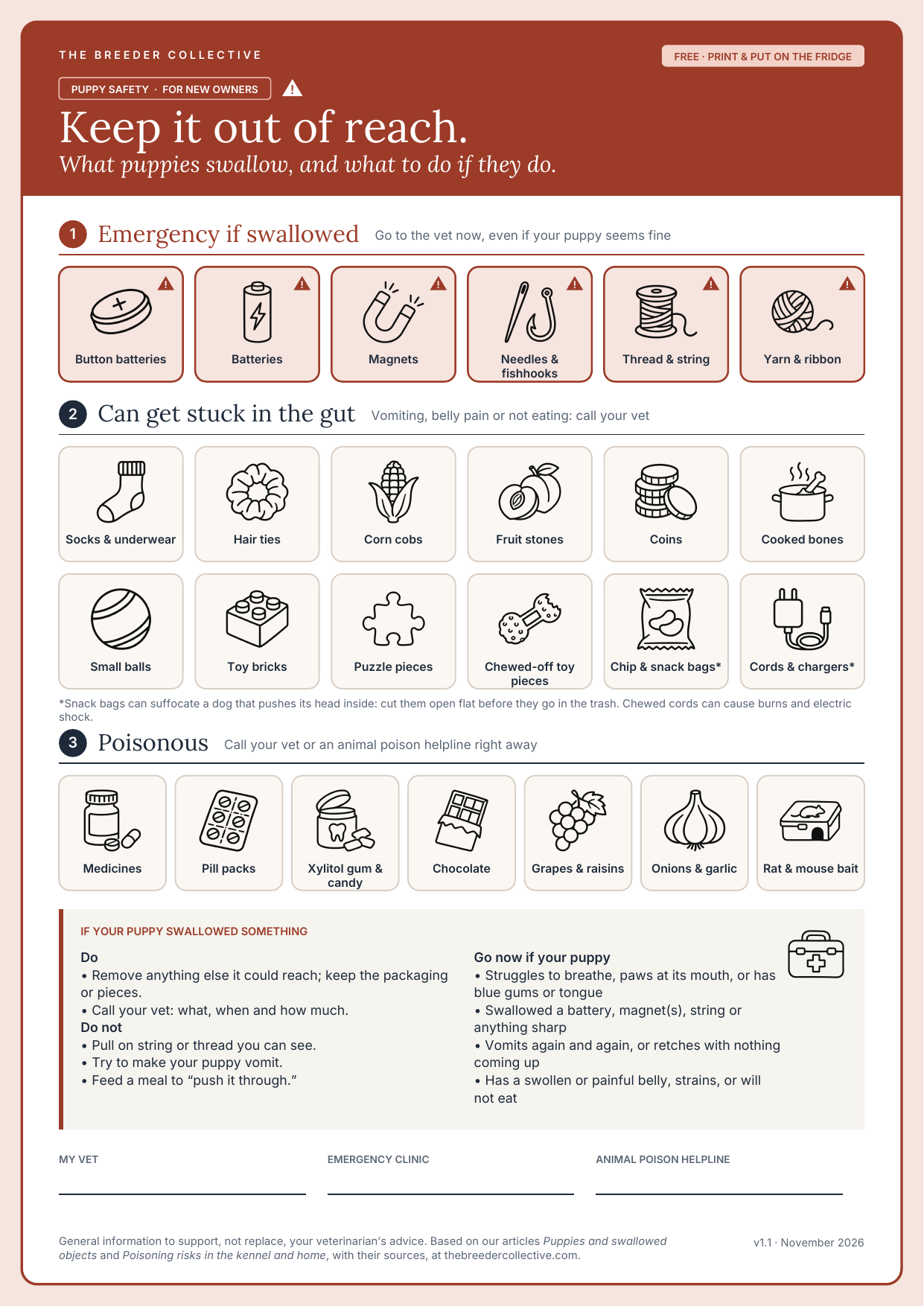
Printing on A4 paper? Download the A4 version.
Warning signs and first steps
Signs of a gut blockage include vomiting, lethargy and loss of appetite, and sometimes diarrhea, a painful or swollen belly and collapse. Watch also for retching with nothing coming up, drooling, straining, and a puppy that hides or will not settle. Obstruction near the stomach tends to cause frequent, severe vomiting, while blockages further down can look milder at first, so a puppy that “only” vomits once or twice and stops eating still needs a vet.
Time matters. In the Italian study, vomiting for more than 24 hours before treatment was linked to death. Dogs with an obstruction caused by a swallowed object tend to do well if diagnosed and treated quickly.
If you saw or suspect a swallowed object:
- Remove anything else the puppy could reach, and keep any pieces or packaging.
- Do not pull on string or thread, and do not try to make the puppy vomit.
- Do not feed a meal “to push it through.”
- Call your vet, say what was swallowed, when, and how much, and follow their advice.
When to call your vet
- Your puppy has trouble breathing, is pawing at its mouth, or its gums or tongue look blue: go now.
- You know or suspect your puppy swallowed a battery, more than one magnet, a magnet plus metal, string, or anything sharp: go now, even if it seems well.
- You can see string or thread under the tongue or coming from the rear end: go now, and do not pull.
- Your puppy vomits repeatedly, or retches without bringing anything up.
- Your puppy has a painful or swollen belly, strains without passing stool, or is unusually quiet.
- Your puppy refuses food or water, or vomits and then stops eating, even if it vomited only once or twice.
- If in doubt, call — your vet would rather hear from you early.
Work on it
A few minutes here will teach you more than re-reading the article.
Ask yourself
- If I walked into the puppy pen right now, what is in there that a puppy could swallow?
Find out & check
- Find out whether your vet takes X-rays for suspected foreign bodies out of hours, or where the nearest emergency hospital is.
- Check what your puppy pack tells buyers about socks, string toys, corn cobs and snack bags.
Do one thing
- Add a one-page “swallowed objects and snack bags” checklist to your puppy pack this week.
- Print the free fridge sheet and add it to every puppy pack.
Was this article helpful?
Anonymous. We do not store your name, email or IP address.
Sources & further reading
- Merck Veterinary Manual, Pet Owner Version — Disorders of the Stomach and Intestines in Dogs (Gastrointestinal Obstruction). merckvetmanual.com
- Holt DE (University of Pennsylvania), Today’s Veterinary Practice — Pet Health by the Numbers: Prevalence of Gastrointestinal Foreign Bodies. todaysveterinarypractice.com
- Di Palma C, et al., Animals 2022 — Endoscopic and Surgical Removal of Gastrointestinal Foreign Bodies in Dogs: An Analysis of 72 Cases. mdpi.com
- Hunt GB (UC Davis), WSAVA World Congress Proceedings 2011 via VIN — Linear Foreign Bodies. vin.com
- Journal of the American Animal Hospital Association — Magnet Ingestion in Dogs: Two Cases. jaaha.kglmeridian.com
- Journal of the American Animal Hospital Association, 2018 — Ileocolic Perforation Secondary to Disk Battery Ingestion in a Dog. jaaha.kglmeridian.com
- American Veterinary Medical Association — First aid tips for pet owners. avma.org
- AVMA, JAVMA News — Snack bags pose suffocation risk to pets. avma.org
Where evidence is limited, recommendations rest on established practice and expert judgment, and may be updated as knowledge develops. This article is general information and does not replace an examination by your veterinarian. If you suspect an emergency, contact a veterinarian immediately.