Dogs say a great deal with their bodies, but no single signal has one fixed meaning. A wagging tail, a yawn or a lick of the lips can mean different things in different situations, so the skill is to read the whole dog — tail, ears, face, posture and movement — together with what is happening around it.
The most important first
- Read signals together and in context. Researchers who studied common “stress signals” such as lip licking and shaking found that their meaning depended on the dog and the situation, not on the signal alone.
- A wagging tail is not always friendly. The side and the style of the wag change with the dog’s emotional state, and other dogs notice the difference.
- The “guilty look” is not guilt. In an experiment, dogs showed it when their owners scolded them, whether or not they had done anything wrong.
- A growl is a warning, and it is useful. Punishing growling can suppress the warning without removing the fear behind it, so the dog may later bite with little or no warning.
- Training with rewards, not force, is the approach veterinary behaviorists recommend.
Last updated: November 8, 2026
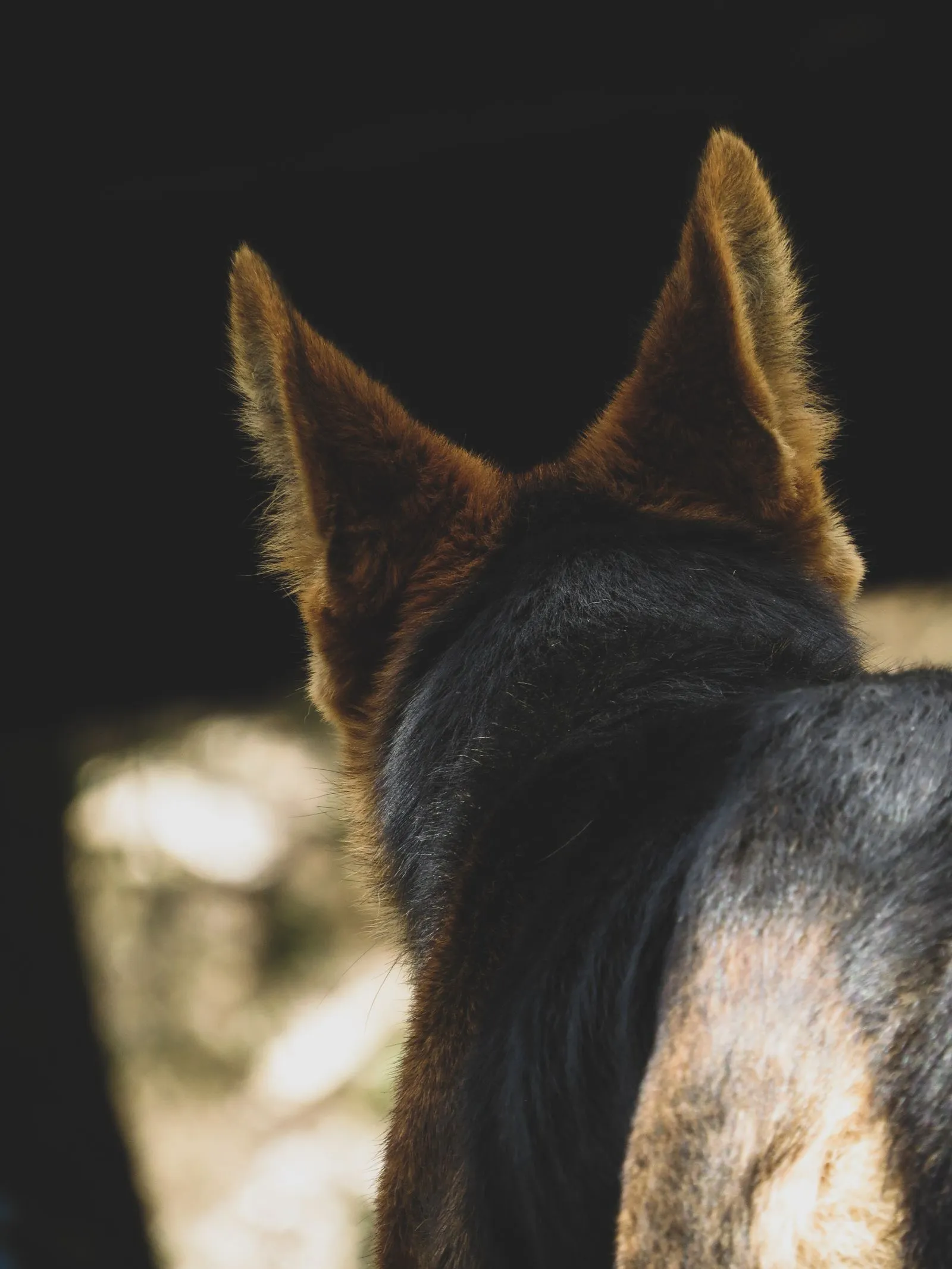
Read the whole dog, not one signal
Dogs communicate with their bodies, faces, voices and scents, and they use many of the same signals with people that they use with other dogs. Siniscalchi and colleagues, reviewing research on dog communication, note that some of these signals take on different meanings when they are directed at people. That is one reason single-signal charts can mislead.
Signals such as lip licking, yawning and shaking are often listed as signs of stress. When Riggio and colleagues filmed 64 dogs in a test that briefly separated them from their owners and introduced a stranger, these behaviors did not rise and fall neatly with the expected level of stress, and their links with stress hormones differed between dogs. The researchers conclude that the meaning of such behaviors depends on the dog’s internal state and the situation. In practice: notice the signal, then look at the rest of the body and at what has just happened.
What you are looking at, roughly from tail to nose:
- Tail: its height, how stiff it is, how it moves.
- Body and posture: loose and wiggly, or stiff and still; leaning forward, or lowered and leaning away.
- Ears: relaxed, pricked forward, or pressed back.
- Face and eyes: soft, or tense; mouth relaxed and open, or closed tightly; the whites of the eyes showing as the dog looks away.
- Movement: approaching, freezing, or turning away.
What the tail tells you, and what it doesn’t
Tail wagging is one of the most familiar dog behaviors and, as Leonetti and colleagues point out in their 2024 review, one of the least studied. What research there is shows that wagging is not simply a sign of happiness: dogs wag asymmetrically, more to one side or the other, in response to different emotional situations. Siniscalchi and colleagues showed dogs videos of other dogs wagging: the viewers’ heart rates rose and they showed more anxious behavior when the wag was biased to the left. A wag tells you the dog is engaged with something; the rest of the body tells you how it feels about it.
The “guilty look”
Many owners are sure their dog looks guilty when it has done something wrong. Horowitz tested this with 14 dogs, who were told not to eat a treat while their owners were out of the room. Sometimes the dogs ate it and sometimes they did not, and sometimes the owners were told the wrong thing. The “guilty look” — head down, ears back, eyes averted — did not depend on whether the dog had eaten the treat. It appeared more often when the owners scolded the dog. In other words, the look is a response to the owner’s behavior in the moment, not a sign that the dog knows it broke a rule.
Growls and other warnings
A growl, a stiffening body, a hard stare, a curled lip or a snap are a dog’s ways of saying “back off” before it bites. They are valuable: they give you time to remove the dog, or the person, from the situation.
The American Veterinary Society of Animal Behavior (AVSAB) warns that punishment can mask the outward signs of fear, such as growling, without changing the fear itself. An animal that can no longer suppress its fear, it says, may suddenly act with heightened aggression and fewer warning signs. So if your dog growls, stop what is happening, give the dog space, and work out what triggered it. Our article on preventing dog bites covers what families, and especially children, need to know.
AVSAB’s 2021 position statement recommends using only reward-based methods for all dog training, including for behavior problems. It links aversive methods, such as physical corrections and pain-based collars, with signs of stress during training and, in survey studies, with later aggression, anxiety and avoidance, and says there is no evidence that aversive methods are more effective than reward-based methods in any context.
Puppies and other dogs
Puppies learn to read and use these signals through play with their littermates and other dogs, which is one reason early social experience matters. See puppy play and social communication for how that develops, and puppy socialization for how breeders build on it.
In practice
A family’s eight-month-old dog growls when the youngest child reaches for him while he is chewing a toy on his bed. Instead of telling him off, the parents call the child away, let the dog finish, and from then on keep his bed as a no-go zone for the children. They also notice what came before the growl — the dog had frozen and looked away twice — and start watching for those earlier signals.
(Illustrative, composite scenario.)
When to call your veterinarian
- Your dog growls, snaps or bites more than before, or in new situations.
- Your dog seems to react when touched in a particular place, or its posture, movement or activity changes: pain can show up as irritability.
- You are unsure whether a behavior is fear, pain or something else. Your vet can check for medical causes and refer you to a veterinary behaviorist.
- If in doubt, call — your vet would rather hear from you early.
Work on it
A few minutes here will teach you more than re-reading the article.
Ask yourself
- Do I know what my dog’s body looks like when it is completely relaxed?
- What happened just before the last time my dog growled or turned away?
- Am I reading one signal, or the whole dog?
Find out & check
- Watch your dog for a week in three everyday situations — greeting visitors, at the vet, during handling — and note tail, ears, face and posture each time.
Do one thing
- Agree as a family that nobody punishes a growl; instead, give the dog space and talk about what caused it.
Was this article helpful?
Anonymous. We do not store your name, email or IP address.
Sources & further reading
- Siniscalchi M, d’Ingeo S, Minunno M, Quaranta A. Communication in dogs. Animals 2018. doi.org
- Riggio G, Borrelli C, Atilgan D, Russo G, Diverio S, Mariti C. Rethinking dog stress behaviours: contextual and physiological insights from the attachment framework. Veterinary Quarterly 2026. doi.org
- Leonetti S, Cimarelli G, Hersh TA, Ravignani A. Why do dogs wag their tails? Biology Letters 2024. doi.org
- Siniscalchi M, Lusito R, Vallortigara G, Quaranta A. Seeing left- or right-asymmetric tail wagging produces different emotional responses in dogs. Current Biology 2013. doi.org
- Horowitz A. Disambiguating the “guilty look”: salient prompts to a familiar dog behaviour. Behavioural Processes 2009. doi.org
- American Veterinary Society of Animal Behavior — Position statement on the use of punishment for behavior modification in animals (2007). indoorpet.osu.edu
- American Veterinary Society of Animal Behavior — Humane dog training position statement (2021). avsab.org
Where evidence is limited, recommendations rest on established practice and expert judgment, and may be updated as knowledge develops. This is general information, not veterinary advice: talk to your veterinarian about your own dog.