Play between littermates looks like the part of the day you are not needed for, and it is in fact the richest piece of behavioral education in the litter — the place where a puppy learns how hard it can bite, how to ask for a game, how to calm down and how to start again after a squabble.
The most important first
- Littermates, not people, teach bite inhibition: when one puppy bites too hard the bitten puppy yelps, stops playing and often leaves, and that consequence is more informative than anything you can say.
- Play is where arousal regulation is practiced — puppies wind each other up, reach a limit, break off and resume. The breaks matter as much as the chasing.
- Puppies taken from the litter early appear to pay for it: dogs separated at 30 to 40 days had significantly higher odds of destructiveness, excessive barking, fearfulness on walks, noise reactivity, toy and food possessiveness and attention-seeking than dogs separated at two months (owner-reported).
- Your job is mostly arranging opportunity — space, surfaces, objects, escape routes, partners of different sizes — and interrupting only when play has stopped being mutual.
- Play with people is a separate skill from play with dogs; the touch side is in handling and body-handling exercises.
What puppies are learning while they play
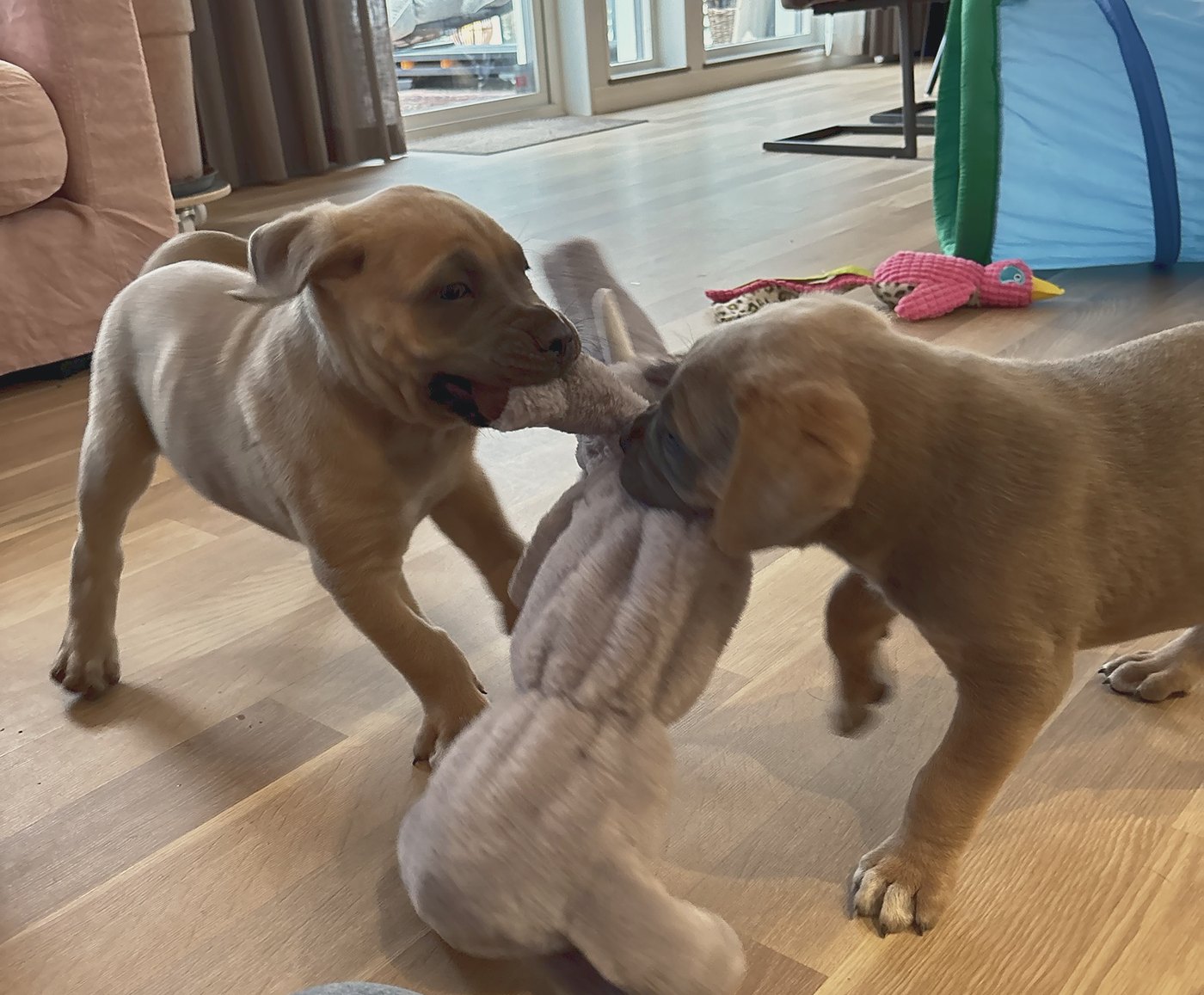
Social play is not rehearsal for one specific adult behavior. It is practice at negotiating with another dog in real time: reading a posture, producing one, getting it wrong and finding out what happens. Dogs signal with body posture, facial expression, tail and ear position, piloerection, vocalization, scent and touch, and a puppy at eight weeks runs hundreds of small experiments a day in that vocabulary, with partners who answer immediately.
Bite inhibition is the clearest example, because the feedback loop is so short. Play biting is social play rather than a teething behavior, and in a litter it is self-correcting: the puppy that bites too hard loses its playmate. Weeks of that lesson produce an adult dog able to take a treat or grab a toy without doing damage — one of the few things a breeder cannot substitute for.
Arousal regulation is less visible and just as valuable. Watch two six-week-old puppies and you will see intensity climb, then a break — a shake, a scratch, a sniff at something irrelevant — then the game restart. A puppy that only goes up, and has to be lifted out to stop, is showing you a gap — the skills covered in frustration tolerance and problem-solving.
Signals, fairness and the myth of the even match
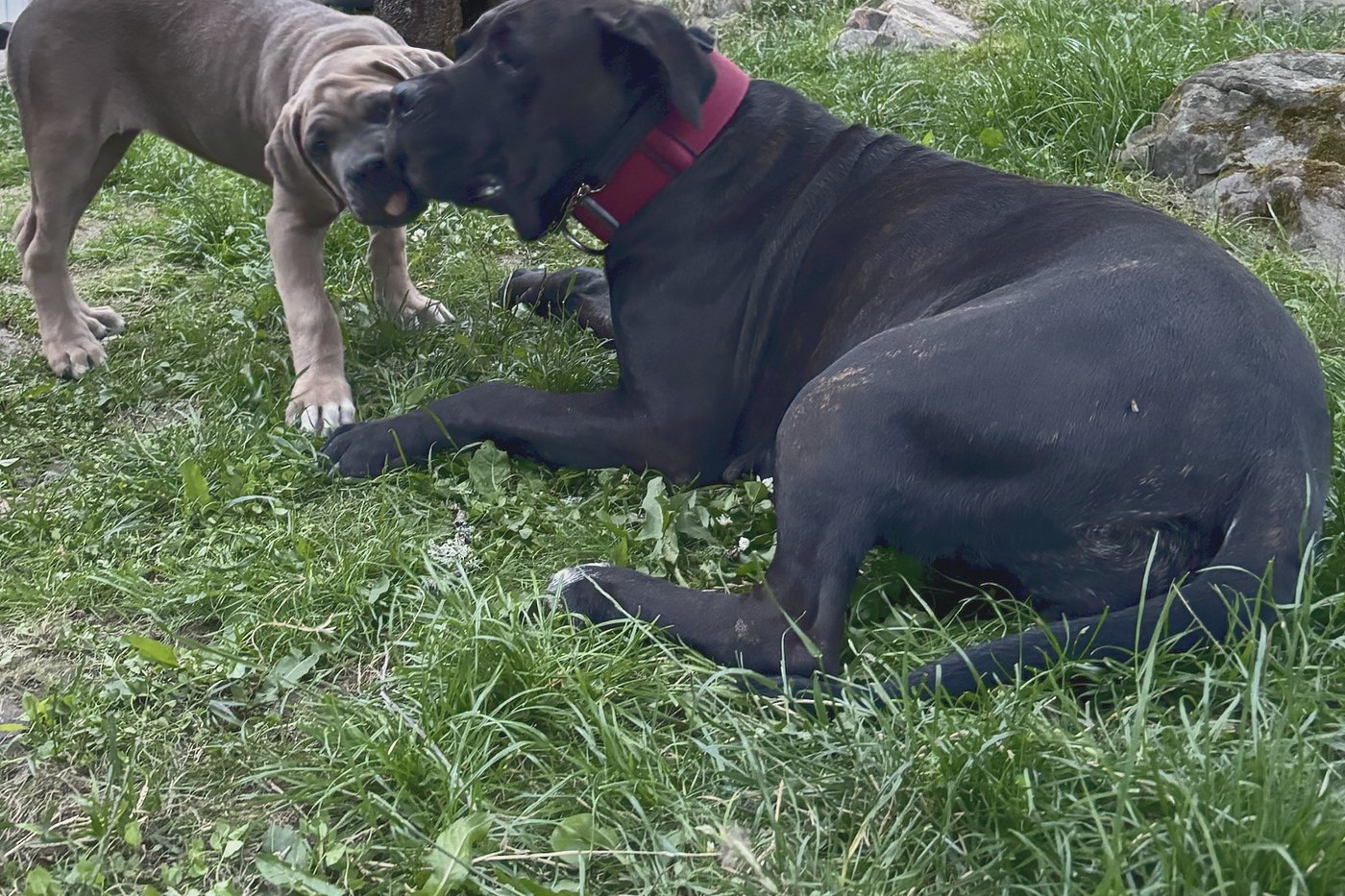
Popular writing often claims that a game must be roughly fifty-fifty to continue, and that the stronger dog must handicap itself. The research is less tidy. In one study of dyadic play in dogs, symmetry varied considerably between pairs, and higher-ranking and older dogs showed lower proportions of self-handicapping than their younger or lower-ranking partners. Role reversals occurred during chases and tackles but never during mounting, muzzle bites or muzzle licks, which appeared to mark position rather than being traded back and forth.
For a breeder the useful conclusion is that unevenness is not automatically a problem. A bold puppy that pins a quieter one repeatedly, with the quieter one returning for more, is a normal game. You are watching not for equality but for mutuality: does the quieter puppy come back, and can it get out?
Studies of actual litters point the same way as studies of adult pairs. Play between littermates is never perfectly even, and it becomes more lopsided as puppies grow. Preferences also narrow: by a few months of age, many puppies have one favorite partner, and the preference is often not mutual. In practice, the same puppy can end up as everyone’s target. Splitting the litter into smaller, better-matched play groups is often enough to fix it.
When to interrupt, and when not to
Most breeders interrupt too much, usually because puppy play sounds appalling. Growling, screaming, neck biting, pinning, rolling and mouthing are all normal, and a litter stopped every time it gets loud is being denied its curriculum.
Interrupt when the game stops being mutual, and the signs are specific: one puppy cannot disengage, keeps trying to leave and is followed, hides, or stops offering play and only defends; one does all the chasing and none of the yielding; or the intensity has climbed and nobody is taking breaks. Two or three puppies ganging up on one is worth breaking up every time, because it teaches the target nothing except that other dogs are a problem. How you interrupt matters: removing the object or calling a puppy away is a pause, not a punishment. Physical correction has no place here, being associated with increased fear, anxiety and aggression in dogs.
Watch for play that ends in an injury. A puppy that limps, bleeds, keeps an eye shut or cries when you touch it after a play session should be checked by your veterinarian. Treat a sudden change the same way. A puppy that usually plays and then stops joining in, sleeps more or stops eating may be unwell, not just shy.
In practice
A breeder with a litter of seven notices that the smallest puppy has stopped joining in and sits by the wall. The obvious reading is timidity. Watching for ten minutes, the breeder sees something more specific: two littermates chase it as a pair, and there is nowhere in the pen for it to break off. Adding a low platform and a box with two openings changes the picture within days, and nobody has to be removed.
(Illustrative, composite scenario.)
Arranging the opportunity
Play needs somewhere to happen, which is where this overlaps enrichment and environmental design and the puppy environment: space, surfaces and setup. The features that make play better are cheap: enough floor area that a chase has somewhere to go, different surfaces and levels, objects that can be carried and argued over, and cover and escape routes. A litter also needs time when play is unavailable, since puppies that play to collapse and are then woken to play again become chronically over-aroused.
Partners matter too. A calm, fully vaccinated adult dog is more informative than any littermate, because an adult will tell a puppy clearly and safely that it has gone too far. That has to be managed against infection risk while the vaccination series is incomplete, as set out in vaccination and immunity in puppies and infection control and biosecurity for the litter: known, healthy, vaccinated dogs on ground your own dogs use, rather than unknown dogs in public places. And do not let dog-to-dog play crowd out play with people, which is the beginning of early learning and a puppy’s first training.
What goes with the puppy, and what does not
Eight weeks of good litter play does not produce a permanently sociable dog. It produces a foundation, which the new owner then either maintains or does not. Say so plainly at handover: the mouth is soft now, and it stays soft if the puppy keeps having appropriate playmates and is not punished for mouthing. Describe what each puppy was like in play — the one that never yielded, the one that needed an escape route — because the buyer will use it, and it feeds the matching conversation too.
A puppy that shows no interest in play with friendly littermates or adult dogs, or reacts to play invitations with real aggression, is worth mentioning to your veterinarian. Veterinary behavior guidelines list this as a sign that development may not be on track. It is easier to address at eight weeks than at eight months.
Work on it
A few minutes here will teach you more than re-reading the article.
Ask yourself
- When I break up play, am I responding to how it sounds or to whether it is still mutual?
- Does every puppy in the pen have somewhere to break off a game without being cornered?
- Could I describe each puppy’s play style to a buyer in one sentence?
Find out & check
- Check your own records: at what age did the puppies in your last litter leave, and did any go before eight weeks?
Do one thing
- Watch the litter play for ten uninterrupted minutes today and write down, for each puppy, who it chose and whether it could get away.
Was this article helpful?
Anonymous. We do not store your name, email or IP address.
Sources & further reading
- VCA Animal Hospitals — Play Biting in Puppies. vcahospitals.com
- Bauer, E. B. & Smuts, B. B., Animal Behaviour 2007;73(3):489–499 — Cooperation and competition during dyadic play in domestic dogs, Canis familiaris. sciencedirect.com
- Ward, C., Bauer, E. B. & Smuts, B. B., Animal Behaviour 2008;76(4):1187–1199 — Partner preferences and asymmetries in social play among domestic dog, Canis lupus familiaris, littermates. repository.si.edu
- Pierantoni, L., Albertini, M. & Pirrone, F., Veterinary Record 2011 — Prevalence of owner-reported behaviours in dogs separated from the litter at two different ages. pubmed.ncbi.nlm.nih.gov
- Merck Veterinary Manual — Social Behavior of Dogs. merckvetmanual.com
- EU Platform on Animal Welfare — Supplementary guidance for dog breeders on the socialisation of puppies. food.ec.europa.eu
- American Veterinary Society of Animal Behavior (AVSAB) — Humane Dog Training Position Statement (2021). avsab.org
- American Animal Hospital Association (AAHA) — 2015 AAHA Canine and Feline Behavior Management Guidelines. aaha.org
Where evidence is limited, recommendations rest on established practice and expert judgment, and may be updated as knowledge develops. Owner-reported studies show associations rather than proving cause, and veterinary and welfare guidance recommends that puppies stay with the litter until at least eight weeks.
Next steps
- Read next: Fear, recovery and building resilience.
- Related: Socialization: the breeder’s most important behavioral work.
- Return to the area hub: Behavior and development.