Swimming can be one of the best parts of a dog’s summer, but water can turn dangerous quickly — a pool with no easy way out, a current that’s stronger than it looks, or a game of fetch that goes on too long — so the rules are simple: supervise like you would a small child, give your dog a way out, and bring fresh water.
The most important first
- Never leave a dog unsupervised near water, even a strong swimmer.
- Teach your dog how to get out of the pool, and fence it when it’s not in use.
- Use a well-fitted life jacket for boats, rough water and dogs that aren’t strong swimmers.
- Take breaks during water retrieves. Swallowing too much water can cause water intoxication.
- Bring fresh water to the beach and don’t let your dog drink salt water.
Last updated: November 8, 2026
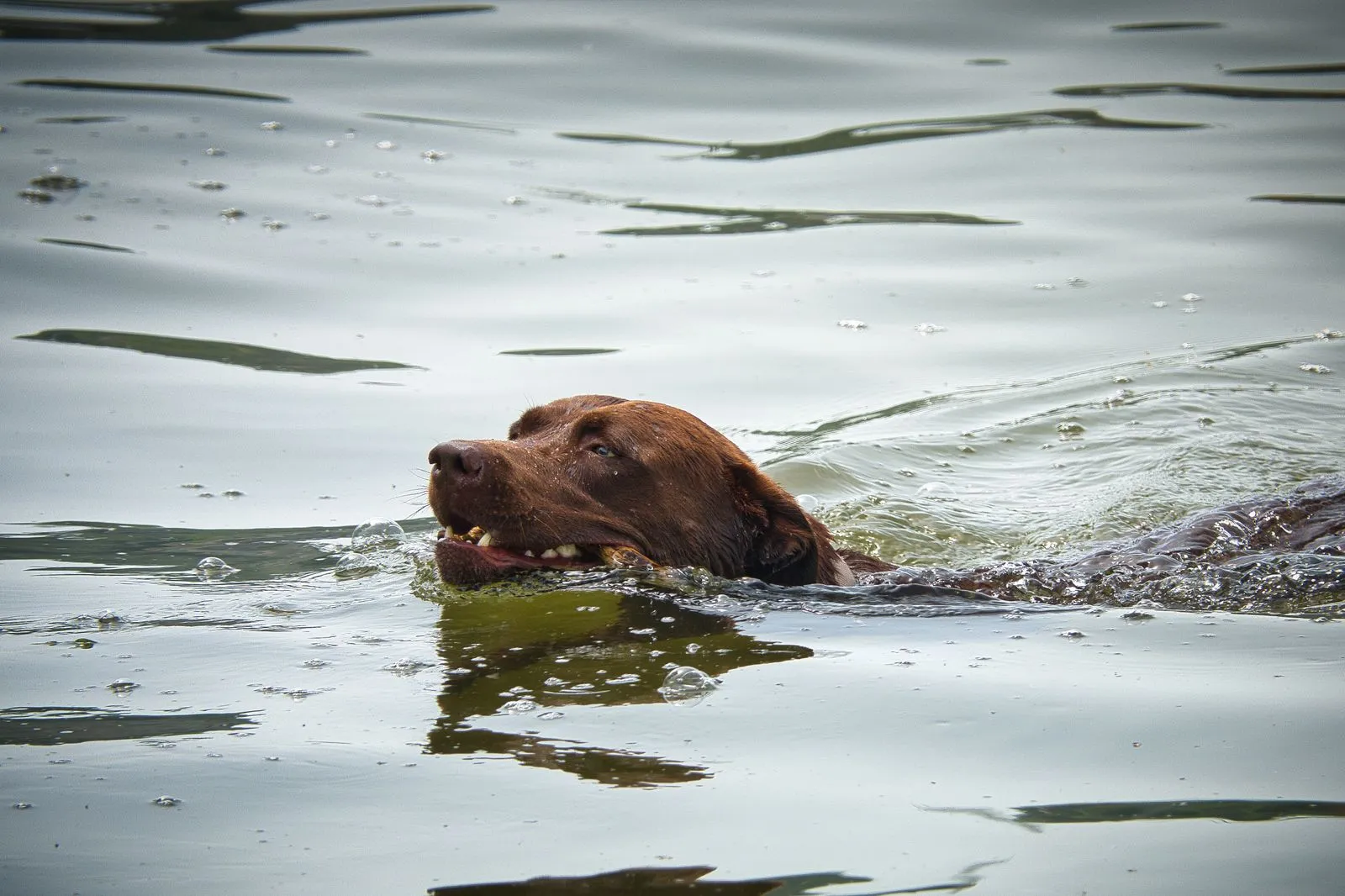
Not every dog is a natural swimmer
The American Animal Hospital Association (AAHA) stresses watching dogs closely whenever they are in or near water, since even strong swimmers can tire or get into trouble. It recommends a properly fitted life jacket for dogs that aren’t strong swimmers — ideally a bright or reflective one with a handle on the back so you can see and lift your dog. The Pet Poison Helpline notes that there are no standards or buoyancy ratings for dog life jackets, so read reviews and check the fit carefully.
Introduce water gradually, in shallow, calm water, and never force a reluctant dog to swim.
Pools
- Fence the pool so your dog can’t get to it unsupervised. The Pet Poison Helpline points out that pools are especially dangerous for older and visually impaired pets.
- Teach the exit. AAHA advises teaching your dog how to get out of the pool using the steps or a pet ramp, and practicing regularly.
- Watch out for soft covers. Dr. Jandrey, an emergency and critical care veterinarian at UC Davis, has described dogs walking onto soft pool covers, getting trapped as the cover collapses, and inhaling water; a solid safety cover is safer.
Lakes, rivers and the sea
AAHA advises watching for currents, tides and poor water quality, including blue-green algae, and avoiding water that looks discolored, foamy or scummy.
Salt water. The Merck Veterinary Manual notes that dogs have developed dangerously high blood sodium after swimming or playing in the ocean without access to fresh water. Signs often start with vomiting within hours and can progress to weakness, diarrhea, tremors and seizures. Treatment has to correct sodium slowly, over days, so this needs a vet. UC Davis advice is that a few gulps won’t harm a dog, but you should carry fresh water and offer it often.
Boats. AAHA recommends a life jacket, shade, fresh water and a first aid kit, and keeping dogs away from hooks, bait and fuel.
Water intoxication
Dogs can also swallow too much fresh water. Writing in Whole Dog Journal, Denise Flaim describes water intoxication as taking in more water than the body can handle, which lowers blood sodium and makes cells — including brain cells — swell. Risk situations include repeated retrieves in pools or lakes, swimming with the mouth open, and biting at hoses or sprinklers. Highly driven retrievers and small dogs seem especially at risk.
Warning signs include lethargy, a bloated belly, vomiting, stumbling, restlessness, drooling, pale gums and glazed eyes, progressing to breathing difficulty, seizures and collapse. It can progress quickly and needs emergency care.
Prevention: frequent breaks to rest and pee, a limit on throws, flat toys rather than balls so your dog’s mouth stays more closed, and no games with hose or sprinkler jets.
In practice
A family’s young Border Collie loves retrieving a ball from the lake and would go on all afternoon. After reading their breeder’s advice, they switch to a flat floating toy, stop every ten throws for a rest and a pee break, and bring fresh water. When she once comes out wobbly and bloated, they stop immediately and call the emergency vet on the way.
(Illustrative, composite scenario.)

If your dog gets into trouble
Get your dog out of the water safely without putting yourself at risk. The Pet Poison Helpline recommends learning canine CPR, and warns that complications can develop after a near-drowning even if your dog seems to recover — so contact a vet straight away. The 2026 RECOVER first aid guidelines, by Mandell and colleagues, were written so that veterinary teams can give owners clear, practical first aid instructions; ask your vet or a first aid course how to apply them.
When to call your veterinarian
- After any near-drowning, even if your dog seems fine.
- Coughing, fast or difficult breathing after swimming.
- Vomiting, bloating, stumbling, drooling or glazed eyes after water play.
- Vomiting, weakness or tremors after a day at the beach.
- If in doubt, call — your vet would rather hear from you early.
Work on it
A few minutes here will teach you more than re-reading the article.
Ask yourself
- Can my dog get out of our pool (or a friend’s) on its own?
- Does my dog swallow water when retrieving?
- Do I carry fresh water to the beach?
Find out & check
- Look for a pet first aid course that covers CPR.
Do one thing
- Practice the pool exit with your dog this week, or buy a life jacket that fits.
Was this article helpful?
Anonymous. We do not store your name, email or IP address.
Sources & further reading
- American Animal Hospital Association — Water Safety Tips for Dogs: Pools, Lakes, Beaches and Boats. aaha.org
- Pet Poison Helpline (2022, updated 2026) — Pet Water Safety. petpoisonhelpline.com
- UC Davis Veterinary Medical Teaching Hospital, via Newswire (2011) — Vet Recommends These Water Safety Tips For Your Pooch. newswire.com
- Thompson LJ, Merck Veterinary Manual (2024) — Salt Toxicosis in Animals. merckvetmanual.com
- Flaim D, Whole Dog Journal (2014, updated 2024) — Water Intoxication in Dogs. whole-dog-journal.com
- Mandell DC, Thawley VJ, Burkitt-Creedon JM, Fletcher DJ, Boller M, Fausak E (2026) — RECOVER Guidelines: First aid for dogs and cats. Clinical guidelines. Journal of Veterinary Emergency and Critical Care 36(S1):S36–S62. doi.org
Where evidence is limited, recommendations rest on established practice and expert judgment, and may be updated as knowledge develops. This is general information and does not replace advice from your veterinarian.
Next steps
- Read next: Road trips and camping with your dog.
- Related: Summer heat and dogs · A first aid kit and first aid basics for dog owners.
- Return to the guide: For your puppy buyers.