For many dogs, the Fourth of July and Canada Day are the most frightening nights of the year — and a frightened dog may bolt through a gap in the fence or an open door — so the plan has two parts: keep your dog safely inside with secure ID, and help it cope with the noise using management, training and, where needed, medication from your vet.
The most important first
- Keep your dog indoors during fireworks, with doors, windows and gates secured.
- Check ID before the holiday: tag with your mobile number and current microchip details.
- Make a den in a quiet, interior room with the curtains closed and background sound.
- Talk to your vet well before the holiday if your dog is fearful; good medications exist.
- Start training early — for puppies, pair distant fireworks sounds with good things.
Last updated: November 8, 2026
How common is fireworks fear?
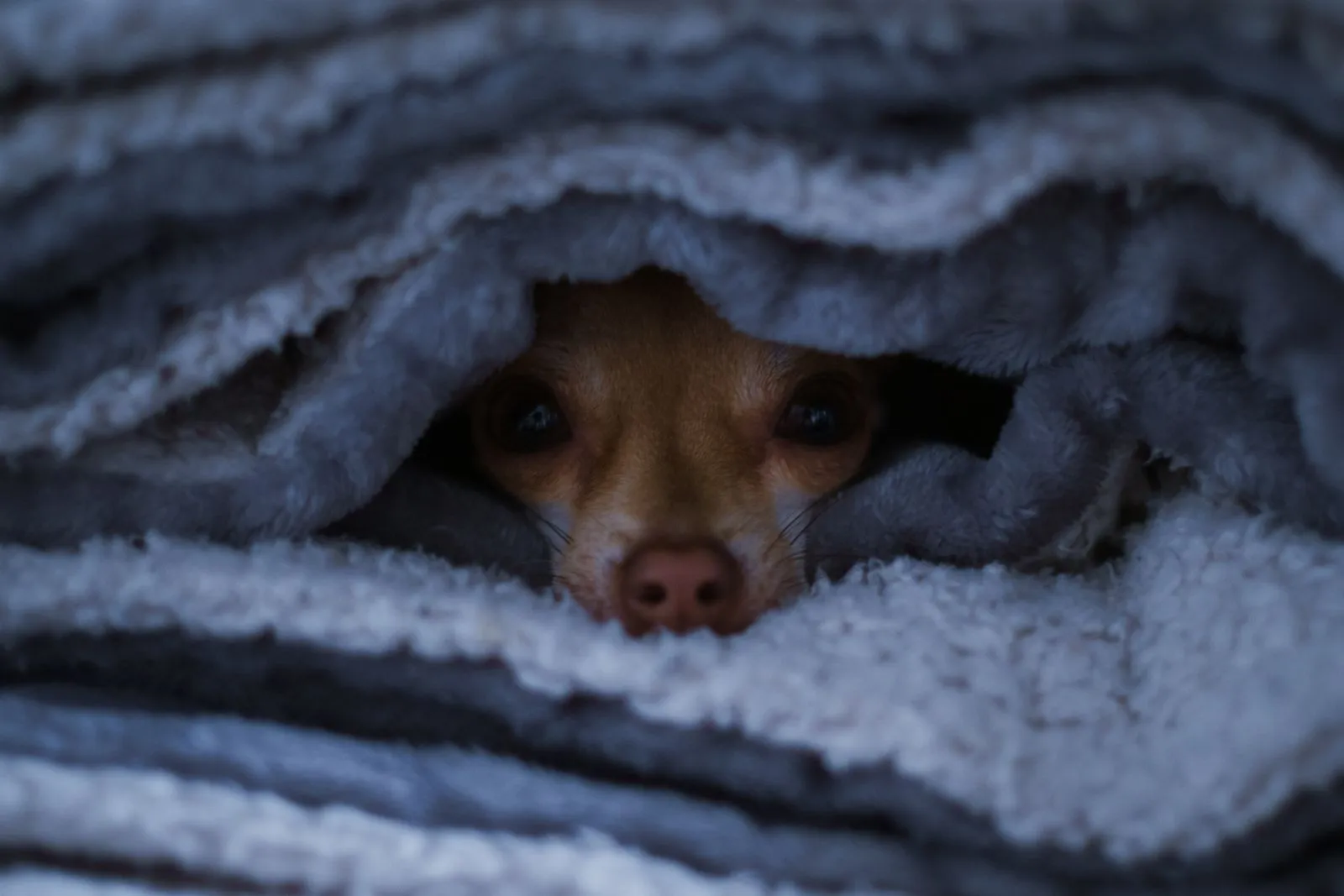
In a survey of 1,225 dogs, Riemer (2019) found that 52% were at least partly affected by fear of fireworks, and most developed the fear in their first year of life. Fear of fireworks was closely linked to fear of thunder and gunshots. While nearly three-quarters of fearful dogs recovered by the next morning, about 10% took up to a day, 12% up to a week, and more than 3% several weeks or even months. Both improvement and worsening over time were common.
In a much larger survey of 13,700 Finnish dogs, Salonen and colleagues (2020) found that noise sensitivity was the most common anxiety-related trait, affecting 32% of dogs.
Keeping your dog from bolting
A panicking dog can escape through a gap you never knew was there. Weiss, Slater and Lord (2012) found that 14% of US dogs had been lost at least once in five years, and most were found by searching the neighborhood or came home on their own. Microchips help only when the details are right: Lord and colleagues (2009) found that an incorrect or disconnected phone number was the most common reason microchipped strays couldn’t be returned.
- Walk your dog well before dark, on a leash, even in your own yard.
- Keep doors, windows and gates closed, and use a baby gate inside the front door.
- Warn visitors not to let the dog out.
- Make sure your dog wears a tag with your mobile number.
On the night
In a review of the evidence, Riemer (2023) concludes that managing the environment, offering food or play during noise events and, when indicated, anxiety medication can protect a dog’s welfare on the day.
- Den: an interior room or covered crate with familiar bedding; leave the door open.
- Sound: music, white noise or the TV to mask the bangs.
- Distraction: long-lasting chews, food puzzles or a game, if your dog will take them.
- Calm company: stay home with a fearful dog if you can, and stay close if your dog seeks you out.
- Never punish fear.
In practice
A family’s young dog panicked during last year’s Canada Day fireworks. This year they see their vet in early June, who prescribes a medication to give before the fireworks start. They practice with recordings at low volume during meals, set up a covered crate in the basement, and walk her on a leash before dusk. On the night she chews a stuffed toy in her den, and the family checks the gate twice.
(Illustrative, composite scenario.)
Supplements, wraps and medication
- Medication. Riemer’s 2023 review found good evidence for several anxiety medications, while most alternative products — nutraceuticals, herbal remedies, pheromones, homeopathy, flower remedies, essential oils — are unlikely to be enough on their own.
- Supplements. One randomized, placebo-controlled study by Ramos and colleagues (2024) found that dogs given a supplement of tryptophan, valerian and passiflora for several weeks before Christmas and New Year’s Eve showed a greater reduction in fear, and smaller stress hormone increases, than dogs given a placebo. It’s one study, so discuss it with your vet.
- Pressure wraps. A 2024 systematic review by Mathis and colleagues found the evidence for wraps weak and limited.
Training for next year
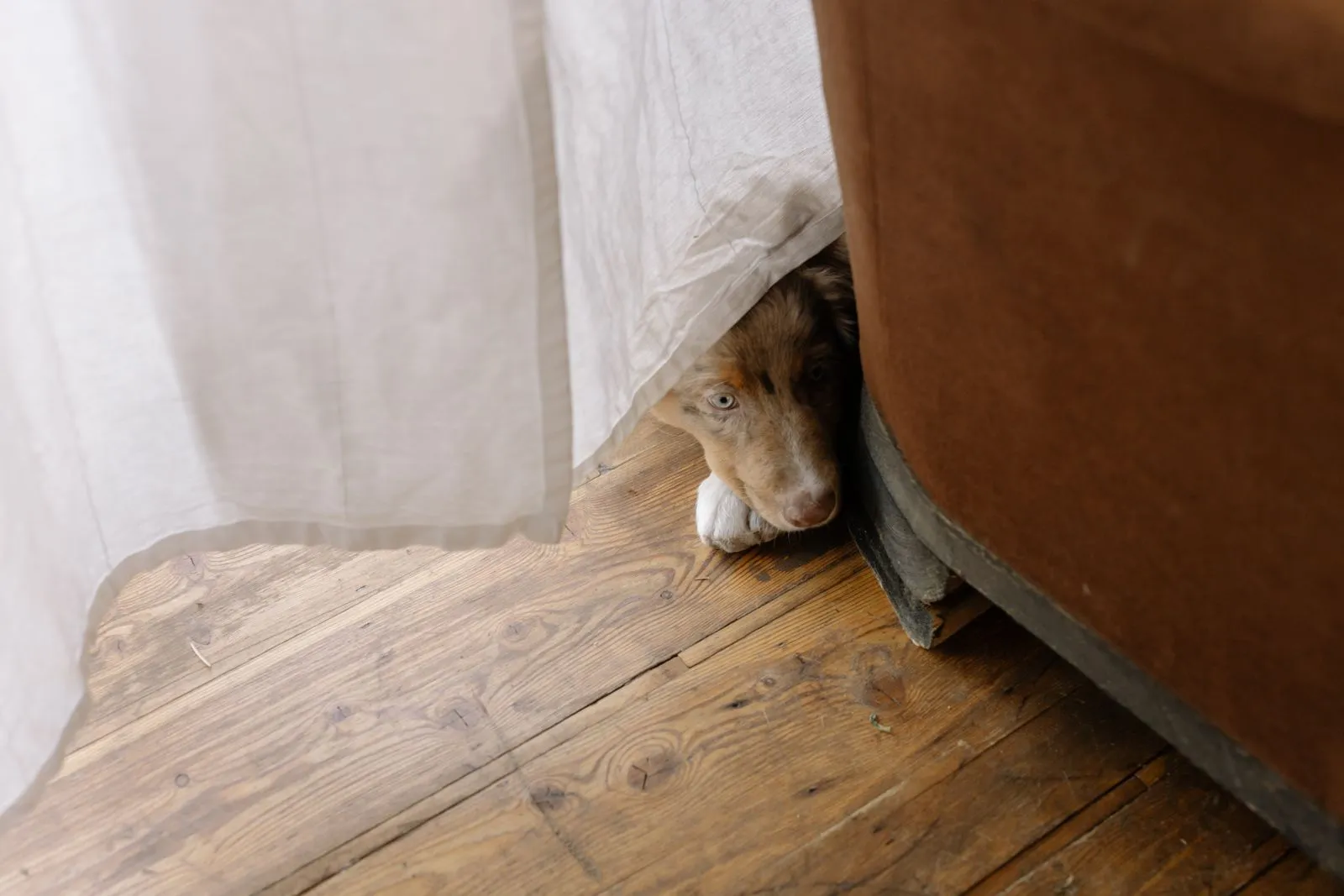
Riemer’s review found that desensitisation and counterconditioning with recordings, and counterconditioning to real noises, improve noise fears, and that preventive training appears highly effective in puppies and dogs that aren’t yet afraid. Start months before the next holiday: play recordings very quietly during meals and play, and raise the volume only while your dog stays relaxed.
When to call your veterinarian
- Weeks before the holiday if your dog has been frightened by fireworks or storms before.
- Your dog panics, injures itself or tries to escape during fireworks.
- Fear lasts days after the event or is getting worse each year.
- Your dog is lost — call your vet, local shelters and your microchip registry straight away.
- If in doubt, call — your vet would rather hear from you early.
Work on it
A few minutes here will teach you more than re-reading the article.
Ask yourself
- How did my dog react to fireworks last year?
- Could my dog get out of the yard if it panicked?
- Is my contact information on my dog’s tag and microchip current?
Find out & check
- Book a vet appointment now if your dog was frightened last year.
Do one thing
- Walk the fence line this week and fix any gaps.
Was this article helpful?
Anonymous. We do not store your name, email or IP address.
Sources & further reading
- Riemer S (2019) — Not a one-way road — Severity, progression and prevention of firework fears in dogs. PLoS ONE 14:e0218150. doi.org
- Riemer S (2023) — Therapy and Prevention of Noise Fears in Dogs — A Review of the Current Evidence for Practitioners. Animals 13:3664. doi.org
- Salonen M, Sulkama S, Mikkola S, et al. (2020) — Prevalence, comorbidity, and breed differences in canine anxiety in 13,700 Finnish pet dogs. Scientific Reports 10:2962. doi.org
- Ramos D, Yazbek KVB, Brito AC, et al. (2024) — Is It Possible to Mitigate Fear of Fireworks in Dogs? A Study on the Behavioural and Physiological Effects of a Psychoactive Supplement. Animals 14:1025. doi.org
- Mathis S, Schoolfield S, Gross P, Gruen M, Dorman DC (2024) — A Systematic Review of the Efficacy of Compression Wraps as an Anxiolytic in Domesticated Dogs. Animals 14:3445. doi.org
- Weiss E, Slater M, Lord L (2012) — Frequency of Lost Dogs and Cats in the United States and the Methods Used to Locate Them. Animals 2:301–315. doi.org
- Lord LK, Ingwersen W, Gray JL, Wintz DJ (2009) — Characterization of animals with microchips entering animal shelters. Journal of the American Veterinary Medical Association 235:160–167. doi.org
Where evidence is limited, recommendations rest on established practice and expert judgment, and may be updated as knowledge develops. This is general information and does not replace advice from your veterinarian or a qualified behaviour professional.
Next steps
- Read next: Thunderstorm fear in dogs.
- Related: Moving house with a dog.
- Return to the guide: For your puppy buyers.