Confirming a pregnancy properly — and monitoring it at the right points — relies on understanding what each method can and can’t tell you. Ultrasound, X-ray and hormone testing each have a role, but not the same one.
The most important first
- Ultrasound may pick up a pregnancy from about day 21, but it is most reliable from about day 25–35 after ovulation, when fetal heartbeats are visible. Repeat a negative early scan about a week later.
- Ultrasound is good for confirming viability but unreliable for exact puppy counts.
- X-rays give the most accurate puppy count from about day 55, ideally in the final week; skeletons only start to show at about days 42–45.
- Relaxin blood tests are a hormone-based option for confirming pregnancy, most reliable from about day 30.
- Combining methods at the right times gives the clearest overall picture.
A note on day counts: day numbers in this article are approximate and counted from ovulation, the date progesterone testing pins down. The LH surge comes about two days before ovulation, so a count “from the LH surge” runs about two days higher. If you only know the mating dates, her true day of pregnancy may be several days earlier or later, so allow a margin either way. Some vets and test makers count “days after breeding” instead, which can differ by several days from the ovulation count used here.
Early confirmation: ultrasound
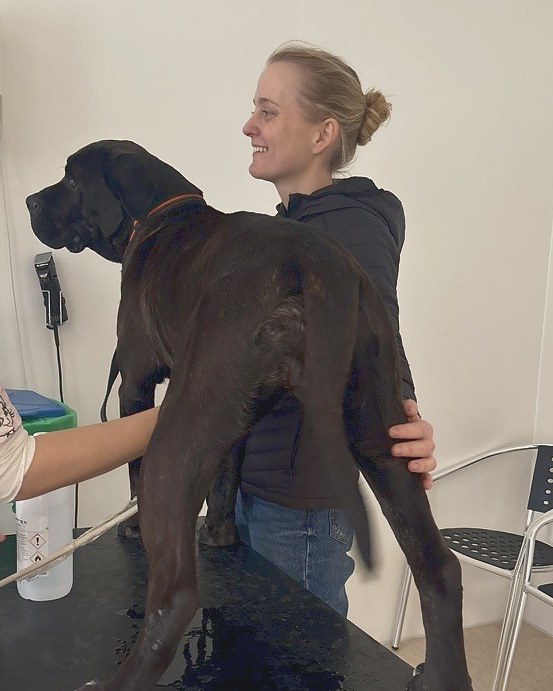
Ultrasound is generally the earliest reliable way to confirm a pregnancy, able to detect fetal sacs from about day 21 and heartbeats from about day 23–25 after ovulation. This makes it well suited to answering the first, most urgent question — is she actually pregnant, and are the fetuses viable — well before any physical signs are obvious. What ultrasound is not well suited to is giving an exact puppy count: fetuses can move, overlap or be hidden behind each other during a scan, making it easy to undercount or double-count.
A scan very early can miss a pregnancy. Ultrasound is most reliable from roughly day 25 to 35, and many vets prefer about day 28–30. If an early scan is negative or unclear, ask your veterinarian about repeating it about a week later rather than assuming she is empty. A positive scan shows a pregnancy at that moment but cannot guarantee it will continue: some embryos may still be lost and reabsorbed, often around days 28–36, so the final litter can be smaller than the early picture suggested.
Getting an accurate count: X-ray
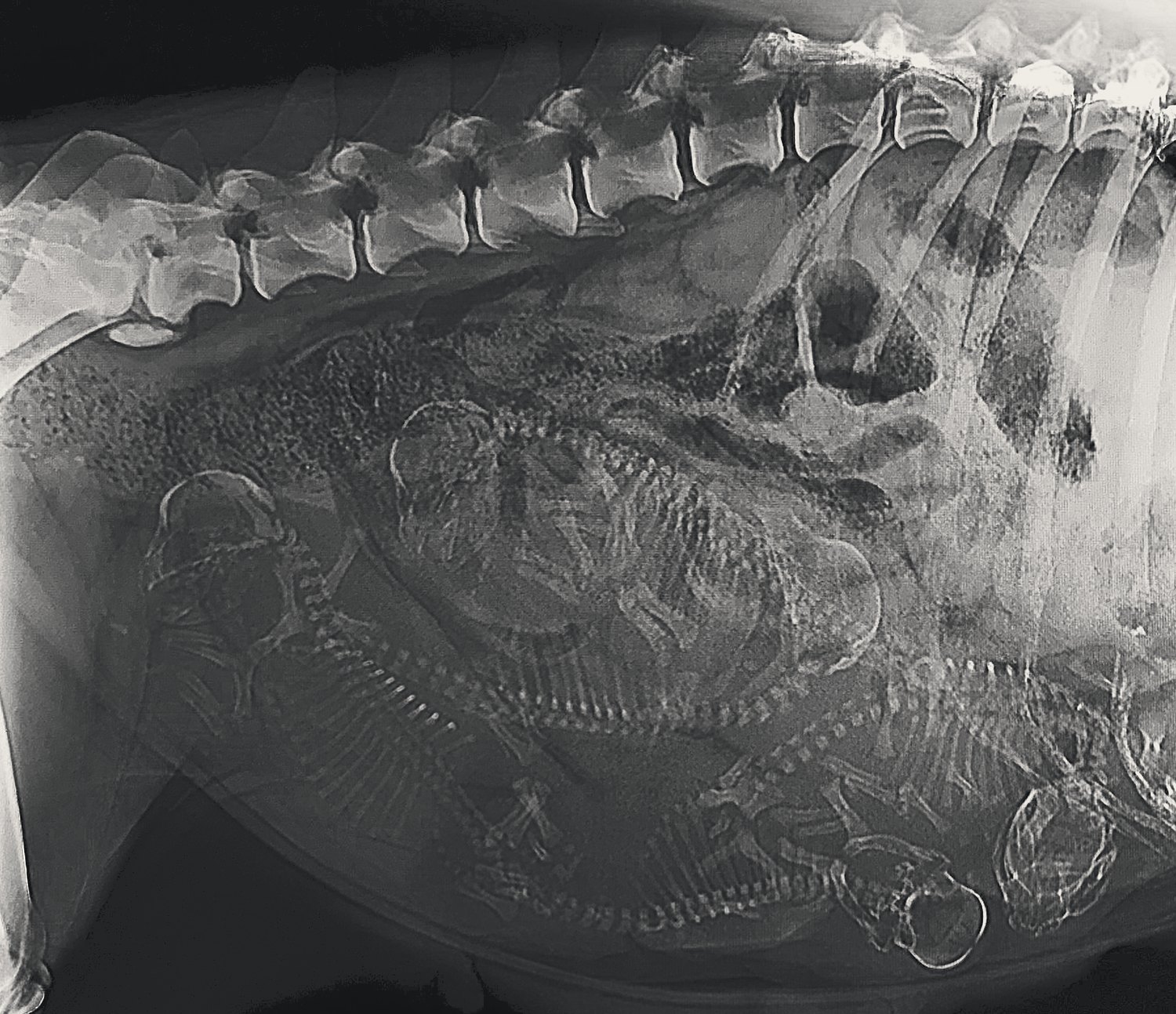
For an accurate litter size, X-rays (radiographs) are the standard method, but only once fetal skeletons have calcified enough to be visible — puppy skeletons begin to show at around day 42–45, but the most dependable count comes later, from about day 55 and ideally in the final week. Before that point, much of the skeleton is still cartilage and shows poorly or not at all, which is why counting too early can miss puppies. At the counting stage the X-ray is considered safe for the developing puppies. Counting visible skulls and spines then gives a strong guide to the number to expect at whelping (occasionally a puppy hidden behind others is still missed) — valuable for knowing when all puppies have been delivered, and for spotting a retained puppy if labor seems to finish early.
In practice
A breeder is confident their bitch is carrying four puppies based on an early ultrasound estimate, and prepares accordingly. An X-ray at about day 56 reveals six — a meaningful difference for feeding, whelping-space planning, and knowing when labor is actually complete. Timing the accurate count to the right method, at the right stage, avoids planning around a number that was never meant to be precise in the first place.
(Illustrative, composite scenario.)
Hormone-based confirmation: relaxin testing
Relaxin, a hormone produced by the placenta and therefore only in a true pregnancy (not a false one), can be measured with a blood test to confirm pregnancy — a useful option alongside or instead of imaging, particularly where ultrasound access is limited. Like ultrasound, a relaxin test confirms pregnancy is present but doesn’t provide a puppy count, so it’s typically used for confirmation rather than as a substitute for the later X-ray. It becomes detectable from about day 22–27 and is more reliable after about day 30. A test taken too early can give a false negative, so a negative early result should be repeated, and a positive one cannot guarantee that the pregnancy will continue.
Putting it together
A sensible monitoring plan generally uses ultrasound around day 25–35 after ovulation (about four weeks) to confirm viability, and an X-ray from about day 55, ideally in the final week, for an accurate count ahead of whelping — with your vet’s specific recommendations adjusted for your bitch’s history and any concerns along the way.
When to call your vet
- An early scan or relaxin test is negative or unclear but she still seems pregnant — ask about repeating it about a week later.
- She has a bloody, foul-smelling or pus-like discharge after a positive scan — a possible sign of pregnancy loss.
- Green or black discharge before the first puppy is an emergency — call your vet immediately.
- Her temperature rises above 103 °F (39.5 °C).
- She is overdue: about 70 days after the first mating, or about day 66 from the LH surge.
- During whelping, the X-ray count says more puppies are due and more than about 2 hours pass with no puppy.
- If in doubt, call — your vet would rather hear from you early.
Work on it
A few minutes here will teach you more than re-reading the article.
Ask yourself
- Do I understand why an early ultrasound and a late X-ray answer different questions?
- Have I scheduled monitoring appointments at the right stages for this pregnancy?
- Would I know what to do if an X-ray count and my expectations don’t match?
Find out & check
- Find out what monitoring schedule your vet recommends for this specific pregnancy.
- Check whether relaxin testing is available and useful in your situation.
Do one thing
- Book the ultrasound and, later, the X-ray appointment for this pregnancy now, rather than waiting.
Was this article helpful?
Anonymous. We do not store your name, email or IP address.
Sources & further reading
- Merck Veterinary Manual — Pregnancy Determination in Bitches and Queens. merckvetmanual.com
- Concannon PW (Cornell University), WSAVA World Congress Proceedings 2005 — Understanding and Monitoring Canine Pregnancy. vin.com
- American Kennel Club — The Reproductive Cycle in Dogs: From Breeding to Birthing. akc.org
- VCA Animal Hospitals — Breeding for Pet Owners: Pregnancy in Dogs. vcahospitals.com
- Colorado State University Veterinary Teaching Hospital — Pregnancy and Whelping for Dogs. csuveterinaryhealth.org
- Dogs Victoria (ANKC member body, Australia) — Caring for Your Pregnant Bitch (fact sheet B16). dogsvictoria.org.au (PDF)
Where evidence is limited, recommendations rest on established practice and expert judgment, and may be updated as knowledge develops.
Next steps
- Read next: Feeding and body condition through pregnancy.
- Related: From fertilization to fetal development: the pregnancy timeline.
- Return to the area hub: Pregnancy: managing the pregnant bitch week by week.