The whelping box and its immediate surroundings are where the next few weeks of your bitch’s life, and the puppies’ first weeks entirely, will happen. Getting the physical setup right matters as much as anything else in preparation.
The most important first
- The whelping box needs to be large enough for the bitch to lie fully stretched out, with room to spare.
- A “pig rail” — a low internal barrier — helps prevent puppies being crushed against the box sides.
- Reliable, controllable heating is essential; newborn puppies can’t regulate their own temperature.
- Sides need to be low enough for the bitch to enter and exit easily, but high enough to contain puppies.
- Location matters as much as the box itself — quiet, private, and away from household traffic.
Sizing and choosing the box
The whelping box should be large enough for the bitch to lie down fully stretched out with room to spare, since she’ll spend much of labor and the following days in it. As a guide, that means about one and a half to two times her length from nose to base of tail — but not much bigger, or puppies can crawl away from her and get cold. Sides need to be low enough that she can step in and out without difficulty, especially as she gets larger late in pregnancy, but high enough to keep mobile puppies contained once they start moving in the following weeks — many whelping boxes use adjustable-height sides for exactly this reason, low at first and raised as the puppies grow.
Choose a material you can clean and disinfect properly, such as plastic or sealed board, and check that all edges are smooth, because rough edges can injure her teats. Wire crates are not suitable, since puppies can get their heads caught between the bars. A rigid plastic paddling pool is a cheap, easy-to-clean option for small and medium breeds.
The pig rail: a specific safety feature worth understanding
A “pig rail,” sometimes called an anti-crush rail, is a low barrier fitted just above the floor around the inside of the box, creating a narrow gap between the rail and the wall. If the bitch lies against the side of the box, this gap gives a puppy caught underneath or against her somewhere to be rather than being trapped and potentially crushed or suffocated — a real risk given how little newborn puppies can move themselves out of danger. It’s a small piece of equipment that addresses a genuine, well-documented risk, and worth including even in a simple, home-built box. Pig rails are usually set about 3–4 in (8–10 cm) above the floor and stand a few inches out from the wall, leaving a puppy room to slip underneath if the dam leans back against the side.
Heating: essential, not optional
Newborn puppies cannot regulate their own body temperature for the first two to three weeks of life, which makes reliable heating in the whelping area essential rather than a nice-to-have. A heat lamp or heated pad, ideally covering only part of the box floor so the bitch and puppies can move to a cooler area if they get too warm, is the standard approach — heating the entire box uniformly risks overheating the bitch, who can regulate her own temperature and doesn’t need the same warmth the puppies do.
As a starting point, aim for about 85–90 °F (29–32 °C) in the warm part of the box during the first week and about 75–80 °F (24–27 °C) in the room. Lower it gradually to about 80 °F (27 °C) by the second week and to the low 70s °F (low 20s °C) by four weeks. Large litters need less added heat because the puppies huddle. Measure with a thermometer at puppy height, and watch the puppies too: pups spread out and panting are too warm, while pups piled up and crying are too cold. Newborns can’t move away from heat easily, so overheating and burns are real risks as well as chilling.
Ideally place the heat zone away from the walls, so puppies are drawn away from the spots where the dam is most likely to lie on them, and always keep a cooler area. Treat heat lamps as a fire risk, use heat pads on a low setting or with auto shut-off, and keep every cable out of reach.
In practice
A breeder builds a simple, well-sized whelping box but skips the pig rail, reasoning that a large box gives puppies enough room to avoid their mother anyway. During whelping, a newborn ends up pinned against the box wall as the bitch settles her weight, and only prompt attention prevents an injury. Adding the rail — a straightforward, low-cost addition — closes exactly this kind of gap that box size alone doesn’t address.
(Illustrative, composite scenario.)
Bedding and the immediate environment
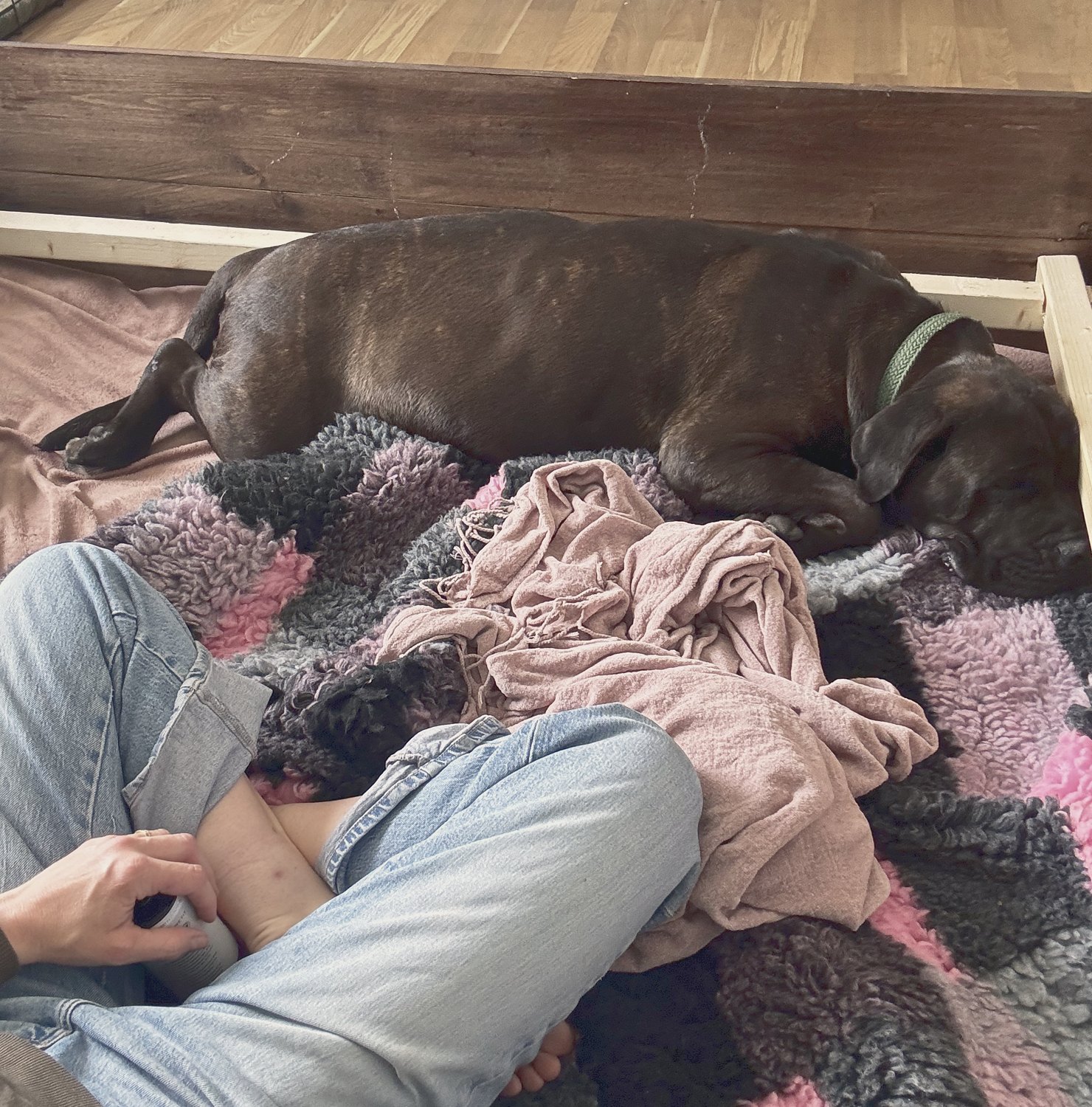
Bedding should be absorbent at the base layer, with a soft, washable top layer that doesn’t unravel or pose a tangling risk to newborns — some breeders layer newspaper or puppy pads under fabric bedding for easy, frequent changing in the days around whelping. The safest top layer is one large piece of non-slip vet bedding. Avoid loose towels, blankets, rags and carpet: puppies can crawl under them and be lain on, and frayed threads can wrap around legs. Avoid hay, straw and loose shavings for newborns as well. The room itself should stay quiet and private, away from household foot traffic and other pets, echoing the setup principles covered in preparing for whelping: the final two weeks.
Choose a warm, draft-free room with ordinary daylight and darkness rather than constant light. Leave space outside the box where the dam can stretch out away from the puppies, make sure she can get out to toilet, and clean the box daily while she is out.
When to call your vet
- Puppies feel cool, cry constantly or pile up even with heat in place — chilling is an emergency in newborns (normal body temperature is about 95–99 °F / 35–37.2 °C in week 1).
- A puppy has been lain on or trapped and is weak, struggling to breathe or not nursing.
- A puppy has a burn or red skin from the heat source.
- The dam has a fever above 103 °F (39.5 °C), or her teats look red, hot or injured.
- Puppies have not nursed within the first 24 hours.
- If in doubt, call — your vet would rather hear from you early.
Work on it
A few minutes here will teach you more than re-reading the article.
Ask yourself
- Is the whelping box actually large enough for her to lie fully stretched out?
- Does the box have a pig rail, or another way of preventing puppies being trapped against the sides?
- Do I have a reliable, controllable heat source that won’t overheat the whole box uniformly?
Find out & check
- Find out what box size is recommended for your bitch’s breed and expected litter size.
- Check that your heating setup allows both a warm zone for puppies and a cooler retreat area.
Do one thing
- Confirm the whelping box is fully assembled, in place, and heated correctly before the final two weeks begin.
Was this article helpful?
Anonymous. We do not store your name, email or IP address.
Sources & further reading
- Purdue University, Croney Research Group (Canine Welfare Science) — Setting Up a Welfare-Friendly Whelping Area. caninewelfare.centers.purdue.edu
- American Kennel Club — Best Practices for Whelping & Caring for Newborn Puppies. akc.org
- The Royal Kennel Club — Whelping Your First Litter. royalkennelclub.com
- VCA Animal Hospitals — Raising Puppies. vcahospitals.com
- VCA Animal Hospitals — Breeding for Pet Owners: Whelping in Dogs. vcahospitals.com
- Purdue University College of Veterinary Medicine and Extension (J. H. Koziol) — What to Expect When… Your Dog is Expecting. extension.purdue.edu
Where evidence is limited, recommendations rest on established practice and expert judgment, and may be updated as knowledge develops.
Next steps
- Read next: Calculating the due date.
- Related: Preparing for whelping: the final two weeks · Whelping preparation checklist.
- Return to the area hub: Pregnancy: managing the pregnant bitch week by week.