A puppy that isn’t breathing at birth needs help within the first minute or two — knowing the correct steps, and just as importantly the steps current guidance says to avoid, is what makes that help effective rather than harmful.
The most important first
- Clear the face and airway first, then stimulate — dry and briskly rub the puppy with a warm towel, focused on the muzzle and chest.
- Do NOT swing the puppy to clear fluid — current veterinary guidance (2025 RECOVER guidelines) explicitly warns this risks brain injury, and has replaced this older technique.
- Use a bulb syringe or DeLee mucus trap to suction the mouth and nose gently and briefly, only if fluid is blocking the airway, holding the head slightly lower than the chest.
- Check for heartbeat, breathing, and color; a limp, blue, unresponsive puppy needs continued resuscitation, not just warming.
- If there’s no response after 15–20 minutes of proper resuscitation, further effort is very unlikely to succeed — this is genuinely difficult, and not a reflection of anything done wrong.
Step by step: what to do
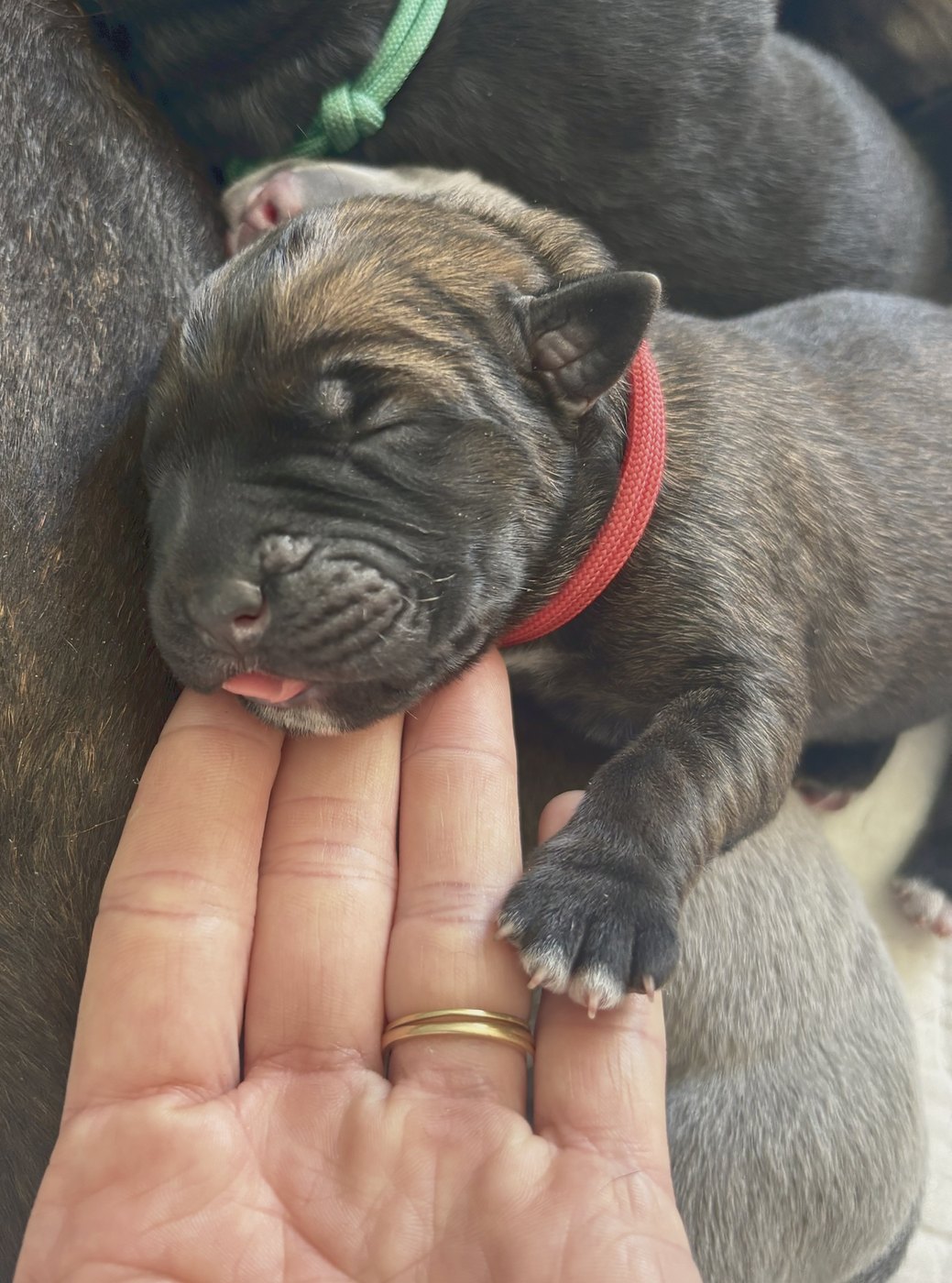
- Clear the face and airway first. Remove fetal membranes from the face immediately, then clear the mouth and nose of fluid.
- Suction gently. A DeLee mucus trap or a soft preemie bulb syringe both work. Keep suction gentle and brief, and only use it when fluid is clearly in the way — hold the puppy’s head slightly lower than its chest so gravity helps fluid drain, rather than relying on suction alone.
- Stimulate briskly. Dry the puppy vigorously with a warm towel, rubbing the muzzle and chest firmly — this is what stimulates the puppy’s own breathing reflex.
- Check for signs of life. Feel for a heartbeat, watch for spontaneous breathing or vocalizing, and check color — pink is reassuring, blue (cyanosis) means oxygen isn’t reaching tissue adequately. Check the heartbeat within about the first minute. If you cannot feel or hear one, breaths alone are not enough. Your vet may already have shown you how to do gentle chest compressions with two fingers, or a thumb and finger around the chest, fast (around two per second), pausing briefly every few compressions to give a breath. If no one has shown you, phone your vet or emergency clinic while you keep clearing the airway, warming and breathing for the puppy, and ask them to talk you through it.
- Warm the puppy. A hypothermic puppy struggles to establish normal breathing — warm the puppy gradually with dry towels, skin contact or an overhead heat source, while continuing the other steps. Avoid heating pads that can burn, and do not warm the puppy too fast. A newborn’s normal body temperature in the first week is only about 95–99 °F (35–37.2 °C). Do not feed a puppy that still feels cold: its gut cannot cope and it may inhale milk. Wait until it is warm and moving well.
- If there’s still no spontaneous breathing, gentle mouth-to-mouth or mouth-to-nose breaths can help, alongside continued stimulation. Give small breaths, just enough to see the chest rise, at roughly one every two to three seconds (about 20–30 per minute). A small resuscitation mask or neonatal bag-and-mask from your vet is better than mouth-to-snout if you have one in your whelping kit.
A technique current guidance now advises against
Swinging a puppy to forcibly expel fluid from the airway was a long-standing piece of breeder folklore, but current veterinary guidance — the 2025 RECOVER (Reassessment Campaign on Veterinary Resuscitation) consensus guidelines — explicitly recommends against it, because of the real risk of concussion or brain hemorrhage from the forces involved, sometimes described as “shaken puppy syndrome.” Gentle suction plus vigorous towel stimulation is the current, safer standard.
In practice
A breeder has always been told to swing a slow-to-breathe puppy as a first response, and has to actively unlearn this in the moment. Falling back on suction plus firm towel rubbing instead — rather than the swinging technique — reflects updated veterinary guidance, not a less serious response.
(Illustrative, composite scenario.)
On respiratory stimulant drugs
Doxapram (brand name Dopram) has historically been used by some breeders and vets as a respiratory stimulant for slow-to-breathe puppies, but current RECOVER guidance notes it’s unlikely to help when the underlying problem is inadequate ventilation, and it isn’t recommended as a first-line intervention. Effective airway clearance, stimulation, and ventilation come first; medication decisions belong to your vet.
When to stop, and when to call for help
If a puppy shows no heartbeat or breathing response after roughly 15 to 20 minutes of correct, continuous resuscitation efforts, it’s very unlikely that further attempts will succeed — this is a recognized limit, not a sign that something was done incorrectly. If you have a puppy struggling to breathe and you’re not confident in what you’re seeing, call your vet while you continue basic steps (clear airway, stimulate, keep warm) rather than waiting to see how it resolves.
After a cesarean, many puppies are slow to start breathing because some of the dam’s anesthetic or pain medication has reached them. Your vet can give reversal medication to these puppies, so tell the team straight away which puppies are flat or breathing slowly.
A scoring system some vets use
Some veterinary teams use an APGAR-style score for newborn puppies, assessed at around 5 and 60 minutes after birth — scoring heart rate, respiratory effort, muscle tone/vigor, reflex response, and mucous membrane color, each 0 to 2, for a total out of 10. A low score (0–3) flags a puppy in significant distress needing continued active support; this is a tool your vet may use or reference, more than something most breeders need to calculate themselves in the moment.
Scoring is useful for tracking how a puppy is doing afterwards, but it is not a reason to wait. A puppy that is not breathing gets help immediately.
When to call your vet
- A puppy is not breathing, or has no heartbeat you can feel: call while you keep going with airway, warmth and breaths.
- A puppy stays limp, blue or gasping after a few minutes of drying and stimulation.
- Puppies born by cesarean are flat or slow to breathe: tell the vet team at once, as reversal medication may help.
- A puppy feels cold, or its temperature stays below about 95 °F (35 °C) despite gradual warming. Do not feed it until it is warm.
- A puppy has not nursed within the first hours; it must get colostrum within the first 24 hours.
- Labor is still going on for the rest of the litter and you are worried: strong straining for 20–30 minutes with no puppy, or more than about 2 hours between puppies.
- If in doubt, call — your vet would rather hear from you early.
Work on it
A few minutes here will teach you more than re-reading the article.
Ask yourself
- Do I know the correct steps well enough to act on them without hesitating, in the moment?
- Have I unlearned any older techniques — like swinging — that current guidance no longer supports?
- Do I have a bulb syringe or mucus trap, a clean warm towel, and a heat source ready before whelping begins?
Find out & check
- Check that your whelping kit includes a bulb syringe or DeLee trap, and that you know how to use it before you need it.
Do one thing
- Review these steps once more, calmly, before your bitch’s due date arrives — not for the first time during an actual whelping.
Was this article helpful?
Anonymous. We do not store your name, email or IP address.
Sources & further reading
- Boller M et al. (2025), Journal of Veterinary Emergency and Critical Care — RECOVER Guidelines: Newborn Resuscitation in Dogs and Cats. onlinelibrary.wiley.com
- Merck Veterinary Manual — Management of the Neonate in Dogs and Cats. merckvetmanual.com
- RECOVER Initiative — Newborn Resuscitation Guidelines press release (August 2025). recoverinitiative.org
- Moon PF et al. (2000), Journal of the American Animal Hospital Association — Perioperative risk factors for puppies delivered by cesarean section in the United States and Canada. jaaha.kglmeridian.com
- VCA Animal Hospitals — Caesarean Sections in Dogs: Post-Operative Instructions. vcahospitals.com
- AKC Canine Health Foundation — Whelping and Dystocia (podcast transcript, Dr Cindy O’Connor). akcchf.org
Where evidence is limited, recommendations rest on established practice and expert judgment, and may be updated as knowledge develops. This is general information, not a substitute for immediate veterinary care during an actual whelping emergency.
Next steps
- Read next: The dam’s first 24 hours after whelping.
- Related: Cesarean section.
- Return to the area hub: Whelping: the complete guide from first contractions to recovery.