The first day after whelping is a settling-in period for the dam as much as it is for the puppies — knowing what’s normal to watch for means you’ll notice quickly if something isn’t.
The most important first
- Normal discharge (lochia) is dark red to green or brown, heavy at first, and odorless — it usually tapers off over about three weeks, and light spotting for up to 6–8 weeks can still be normal if it is decreasing and does not smell.
- After whelping her temperature is normal or slightly raised; above 103 °F (39.5 °C) is a fever and a reason to call your vet.
- Placentas are usually all passed within 24 hours of the last puppy, often eaten unnoticed. Straining again may mean a puppy is still inside.
- The dam should show interest in and allow nursing of all puppies, with protectiveness but not aggression or disinterest.
- Straining again after whelping has finished, foul-smelling discharge, or refusal to nurse are all reasons to call your vet.
Discharge in the first 24 hours
Lochia — the discharge that follows whelping — is normally dark red, brownish, or green-tinged, can be quite heavy in the first day or two, and shouldn’t have a foul smell. It’s expected to continue, gradually lightening. Most dams are clear within about three weeks, but light spotting for up to six to eight weeks can still be normal as long as it is decreasing and does not smell. What’s abnormal is an increasing volume rather than decreasing, a genuinely foul odor, or bright, fresh bleeding beyond what’s expected — any of these are reasons to check in with your vet.
Temperature and retained placentas
The well-known temperature drop below about 99 °F (37.2 °C) happens before labor, not after it. Once she has finished whelping, her temperature is more likely to be normal or slightly raised, often by a degree or two Fahrenheit (about 0.5–1 °C) for the first day or so. Take it once or twice in the first 24 hours. Call your vet if it climbs above 103 °F (39.5 °C), or if it is low and she seems weak or flat. Placentas should all be accounted for within 24 hours of the last puppy — most dams eat them, often quickly enough that it isn’t obvious it’s happened, which is why the placenta count kept during monitoring and documenting the whelping is useful to check against afterward. A missing placenta has often simply been eaten, or will usually pass on its own, but mention it to your vet. It becomes more urgent if she strains, runs a fever or develops smelly discharge.
Normal behavior: nesting, nursing, protectiveness
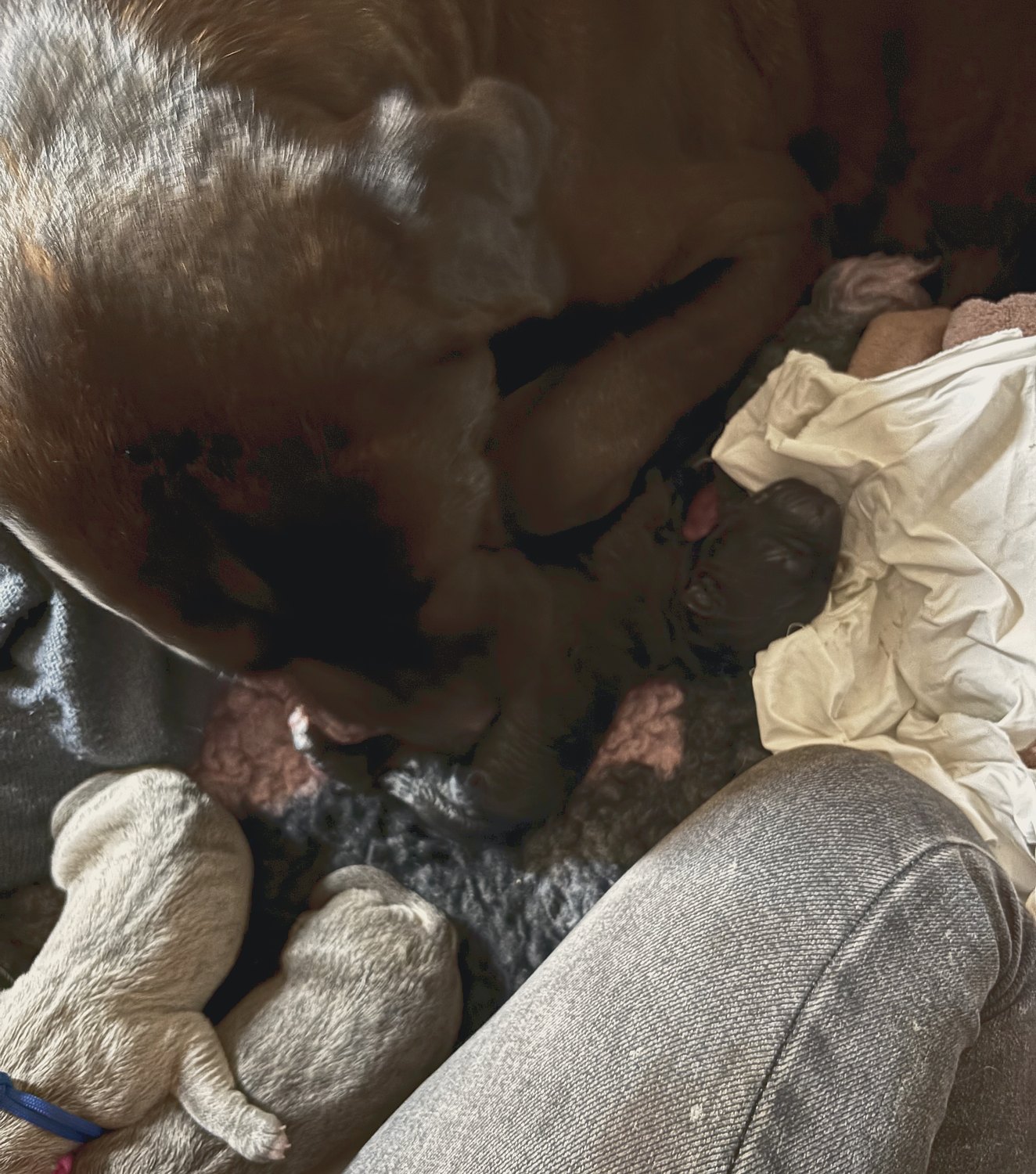
Expect the dam to settle into nesting and intermittent nursing fairly quickly, along with a degree of protectiveness over the litter — this is normal and generally softens over the following days as she settles in. Panting and trembling that were part of labor should ease off during this first day rather than continuing or worsening.
Check the puppies as well as the dam. In the first day, every puppy should find a teat and nurse. Puppies must get colostrum within the first 24 hours, as their ability to absorb its antibodies has largely gone by then. Between feeds they should be mostly quiet and sleeping. Puppies that keep crying, or one that is pushed aside and not feeding, are an early sign that something is wrong, either with the puppy or with the dam’s milk. Ask your vet the same day. Some licking of the umbilical stumps is normal, but persistent licking or nibbling that makes them bleed is not.
Weigh every puppy at birth and again at about 12 and 24 hours, on kitchen scales that read in grams, and note the results in your whelping log. A small dip in the first day is normal while nursing gets going, but call your vet the same day if a puppy loses more than about 10% of its birth weight in the first 24 hours or is still losing weight on day two. See weighing and tracking growth for what normal gain looks like after that.
In practice
A first-time breeder is startled by how protective their bitch becomes over the whelping box in the hours after delivery, growling if approached too closely. Recognizing this as a normal, common response that typically eases within a day or two — rather than a sign of a behavioral problem — helps the breeder give the dam space rather than intervening unnecessarily.
(Illustrative, composite scenario.)
Food and water
Keep fresh water within reach of the whelping box. Many dams eat little for the first hours; a soaked, easily digested meal of her usual lactation food often tempts her. Her appetite should be coming back within the first day. Loose stools are common if she ate the placentas.
When to call the vet
Straining again after whelping appears to be finished can mean a puppy is still inside, which is an emergency, so call straight away. If you are unsure whether all the puppies are out, your vet can check with an X-ray or ultrasound; feeling the belly is not reliable. Straining can also point to a retained placenta, an infection or, rarely, a uterine prolapse. Refusal to nurse, clear disinterest in the puppies, or a dam who seems unusually lethargic or unwell also warrant a call — these can be early signs of the postpartum complications covered in postpartum complications: mastitis, metritis and eclampsia.
When to call your vet
- She starts straining again after you thought she had finished: a puppy may still be inside. Call straight away.
- Her temperature is above 103 °F (39.5 °C), or low while she seems weak or flat.
- Discharge that smells foul, increases, or is bright red and heavy.
- Any puppy has not nursed: puppies must get colostrum within the first 24 hours.
- Puppies cry constantly, or one is pushed aside and not feeding.
- A puppy loses more than about 10% of its birth weight in the first 24 hours, or is still losing on day two — call the same day.
- She refuses food and water all day, is unusually lethargic, or shows no interest in the puppies.
- If in doubt, call — your vet would rather hear from you early.
Work on it
A few minutes here will teach you more than re-reading the article.
Ask yourself
- Do I know what normal lochia looks like well enough to notice if it changes?
- Am I checking my placenta count against the puppy count from my whelping log?
- Would I recognize straining after whelping as a reason to call, rather than assuming labor is simply “still finishing up”?
Find out & check
- Check your placenta count against your puppy count within the first 24 hours.
- Find out your vet’s preference for a routine postpartum check versus only calling if something seems wrong.
Do one thing
- Take and note the dam’s temperature at least once during this first 24-hour period.
Was this article helpful?
Anonymous. We do not store your name, email or IP address.
Sources & further reading
- Merck Veterinary Manual — Labor, Delivery, and Postpartum Care in Bitches and Queens. merckvetmanual.com
- Merck Veterinary Manual — Periparturient Problems in Bitches and Queens. merckvetmanual.com
- Cornell University Riney Canine Health Center — The Normal Whelping Process. vet.cornell.edu
- Merck Veterinary Manual — Metritis in Small Animals. merckvetmanual.com
- VCA Animal Hospitals — Caesarean Sections in Dogs: Post-Operative Instructions. vcahospitals.com
- PDSA — Whelping: a guide to your dog giving birth. pdsa.org.uk
- Purdue University Canine Welfare Science — Gestating Dam Nutrition. caninewelfare.centers.purdue.edu
Where evidence is limited, recommendations rest on established practice and expert judgment, and may be updated as knowledge develops.
Next steps
- Read next: Lactation and milk production.
- Related: Newborn resuscitation at birth.
- Return to the area hub: Whelping: the complete guide from first contractions to recovery.