Newborn puppies have almost no buffer when it comes to energy and fluid reserves — understanding why makes it clear why missed feeds and dehydration turn serious so much faster in a neonate than in an adult dog.
The most important first
- Puppies have minimal fat reserves and an immature liver, so blood sugar can drop dangerously after just a few hours without feeding.
- Signs of low blood sugar include weakness, incoordination, tremors, and — if untreated — seizures or coma.
- A newborn’s body is roughly 80% water, versus about 60% in an adult, so dehydration develops faster and matters sooner.
- Warmed oral dextrose or glucose gel can be given as first aid for a conscious, swallowing puppy, but this doesn’t replace a vet call.
- Severe dehydration or unresponsive hypoglycemia needs vet-administered IV or intraosseous treatment — this isn’t something to manage at home alone.
Why hypoglycemia happens so easily
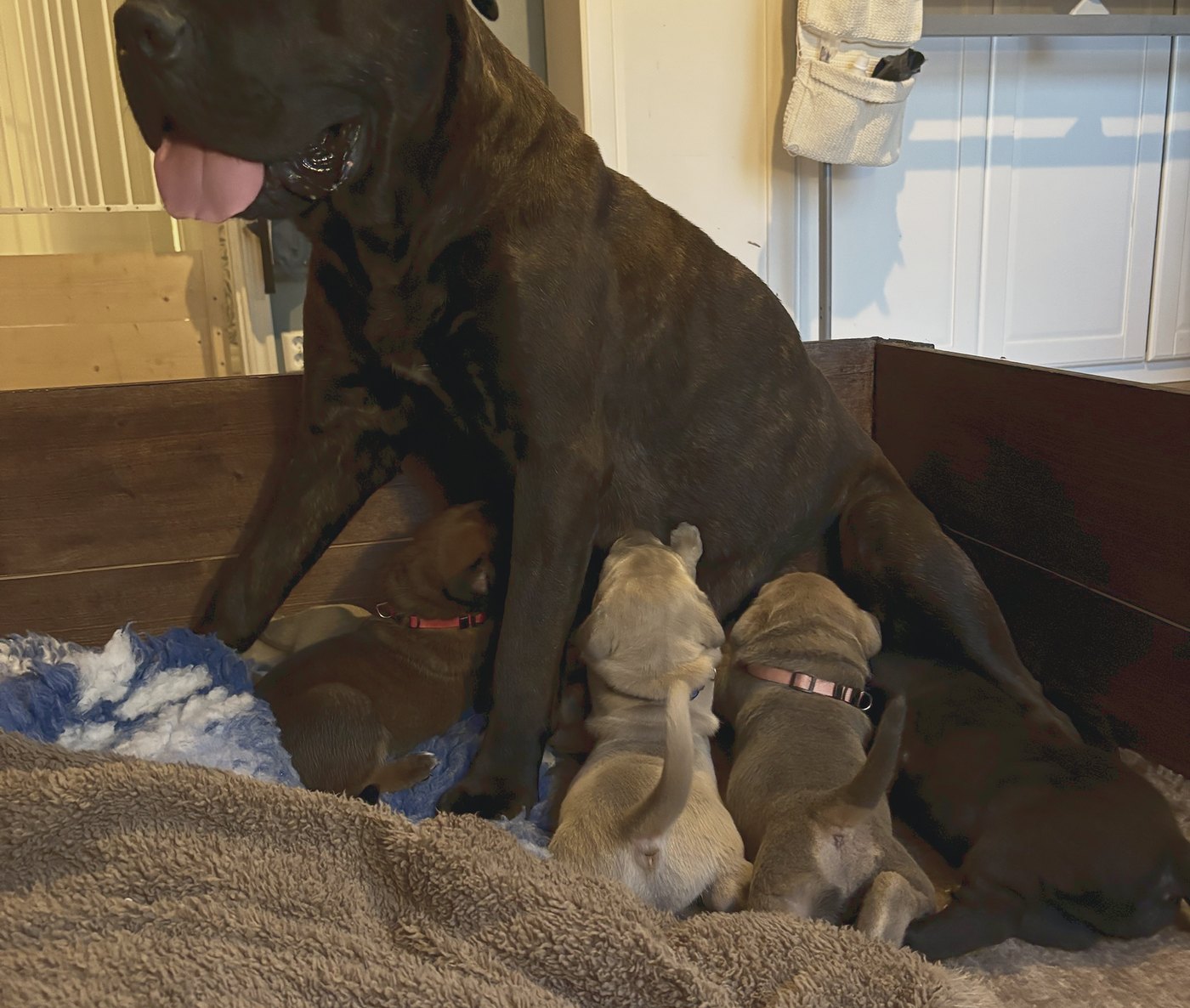
Newborn puppies carry very little fat reserve, and their liver isn’t yet fully capable of producing glucose on its own (gluconeogenesis) — combined with a naturally high metabolic rate, this means blood sugar can drop meaningfully after a fast of just a few hours. This is part of why consistent, frequent nursing (covered in nursing and monitoring milk intake) matters so much in the first days — a puppy that misses feeds is at real risk, not just a mildly hungry one.
Recognizing low blood sugar
Watch for incoordination, weakness, lethargy, poor or absent nursing, and tremors — without treatment, this can progress to seizures or coma. These signs overlap with several other neonatal problems, which is why neonatal emergencies covers hypoglycemia alongside hypothermia and fading puppy syndrome as a connected cluster of things to watch for together.
If you have a pet glucometer and your vet has shown you how to use it, readings below roughly 30–40 mg/dL (about 1.7–2.2 mmol/L) are generally considered clinically low in neonates. Treat a meter as an aid, and let your vet interpret the numbers. A weak puppy needs help whatever the number says.
Why dehydration hits harder in neonates
A newborn puppy’s body is roughly 80% water, compared to around 60% in an adult dog, and its kidneys aren’t yet able to concentrate urine efficiently — together, this means fluid losses add up faster and dehydration becomes serious at a lower absolute loss than it would in an adult. Per kilogram, a newborn needs far more fluid each day than an adult dog — roughly 130 to 220 mL per kilogram per day in total, most of it from milk. (Lower figures you may see quoted, such as 60–180 mL/kg/day, are vet rehydration rates, not a puppy’s normal daily need.) Too much fluid is also dangerous for immature kidneys and lungs, so giving fluids by injection or drip belongs with your vet.
Spotting dehydration in a newborn is harder than in an adult. The skin-pinch test is unreliable at this age. The thin skin over the belly is the most useful place to check, and the gums often stay moist until dehydration is already severe. Urine is a better everyday clue: a healthy neonate passes pale, almost clear urine when stimulated, and darker yellow urine suggests the puppy is short of fluid. Pale gums, a puppy that feels limp, or one that has stopped nursing are reasons to contact your veterinarian straight away.
In practice
A breeder assumes a puppy that missed one nursing session while sleeping soundly through a feeding window will simply catch up at the next one. Understanding how quickly a newborn’s limited reserves can be depleted is what prompts checking that puppy specifically — waking it to nurse or offering supplemental feeding — rather than assuming a single missed feed will sort itself out.
(Illustrative, composite scenario.)
First aid for a hypoglycemic puppy
Warm first. A chilled puppy cannot digest, and sugar on the gums only helps if circulation is adequate. If the puppy feels cool or its temperature is below the normal week-one range of about 95–99 °F (35–37.2 °C), start gradual rewarming and call your vet while you do it — never give milk, fluids or food by mouth to a cold puppy (see neonatal emergencies).
For a puppy that’s conscious and able to swallow, small amounts of warmed dextrose solution given orally, or a small amount of glucose gel or syrup rubbed onto the gums if it can’t swallow safely, can help as an immediate first-aid step while you arrange veterinary care. This is a bridge, not a treatment — a puppy that needed this kind of intervention should still be seen by a vet, since a severely hypoglycemic or unresponsive puppy needs IV or intraosseous dextrose and fluid support that only a vet can provide.
When to call your vet
- A puppy is weak, limp, trembling or not nursing — call straight away, even if you have given glucose gel.
- A puppy needed sugar on its gums or by mouth at all: it should still be seen by a vet the same day.
- A puppy feels cool, or its temperature is below about 95 °F (35 °C) in week 1 — warm it gradually and call while you do.
- Signs of dehydration: dark yellow urine, pale or tacky gums, or a puppy that has stopped nursing.
- Twitching, seizures or a puppy you cannot rouse — this is an emergency.
- Glucometer readings below about 30–40 mg/dL (1.7–2.2 mmol/L), if your vet has asked you to measure.
- If in doubt, call — your vet would rather hear from you early.
Work on it
A few minutes here will teach you more than re-reading the article.
Ask yourself
- Would I recognize early signs of low blood sugar in a puppy, rather than assuming it’s just tired?
- Do I know what to do as a first-aid step if a puppy seems weak and hasn’t nursed recently?
- Do I have dextrose gel or a similar product on hand as part of my whelping kit?
Find out & check
- Find out your vet’s specific first-aid guidance for a weak, non-nursing puppy, before you need it.
Do one thing
- Add glucose gel or a dextrose solution to your whelping kit if it isn’t already there.
Was this article helpful?
Anonymous. We do not store your name, email or IP address.
Sources & further reading
- Merck Veterinary Manual — Management of the Neonate in Dogs and Cats. merckvetmanual.com
- Macintire DK (2008), Vet Clin North Am Small Anim Pract 38(3):621–627 — Pediatric Fluid Therapy. pmc.ncbi.nlm.nih.gov
- Dogs NSW (Hedberg K., BVSc) — Care of puppies birth to 10 days. dogsnsw.org.au (PDF)
- VCA Animal Hospitals — Feeding Orphaned Puppies. vcahospitals.com
- VCA Animal Hospitals — Fading Puppy Syndrome in Dogs. vcahospitals.com
- Banchi P et al. (2023), Vlaams Diergeneeskundig Tijdschrift 92 — Clinical approach to neonatal mortality in dogs. iris.unito.it
Where evidence is limited, recommendations rest on established practice and expert judgment, and may be updated as knowledge develops. This is general information, not a substitute for immediate veterinary care.
Next steps
- Read next: Supplemental and tube feeding.
- Related: Neonatal emergencies: hypothermia, hypoglycemia and fading puppy.
- Return to the area hub: The neonatal period.