A weak or orphaned puppy needs more than just extra feeding — warmth, elimination help, and even socialization all need active management that the dam would otherwise handle herself.
The most important first
- A low Apgar score, poor reflexes, or failure to gain weight are early signs a puppy needs extra support.
- Orphaned or hand-reared puppies need milk replacer roughly every 2 to 3 hours around the clock in the first week.
- The dam normally stimulates urination and defecation by licking — without her, a breeder must do this manually after each feed.
- Hand-reared puppies can miss out on early littermate interaction and may need deliberate extra handling to compensate.
- A foster dam, if one is available, is generally preferable to full hand-rearing.
Identifying a weak puppy early
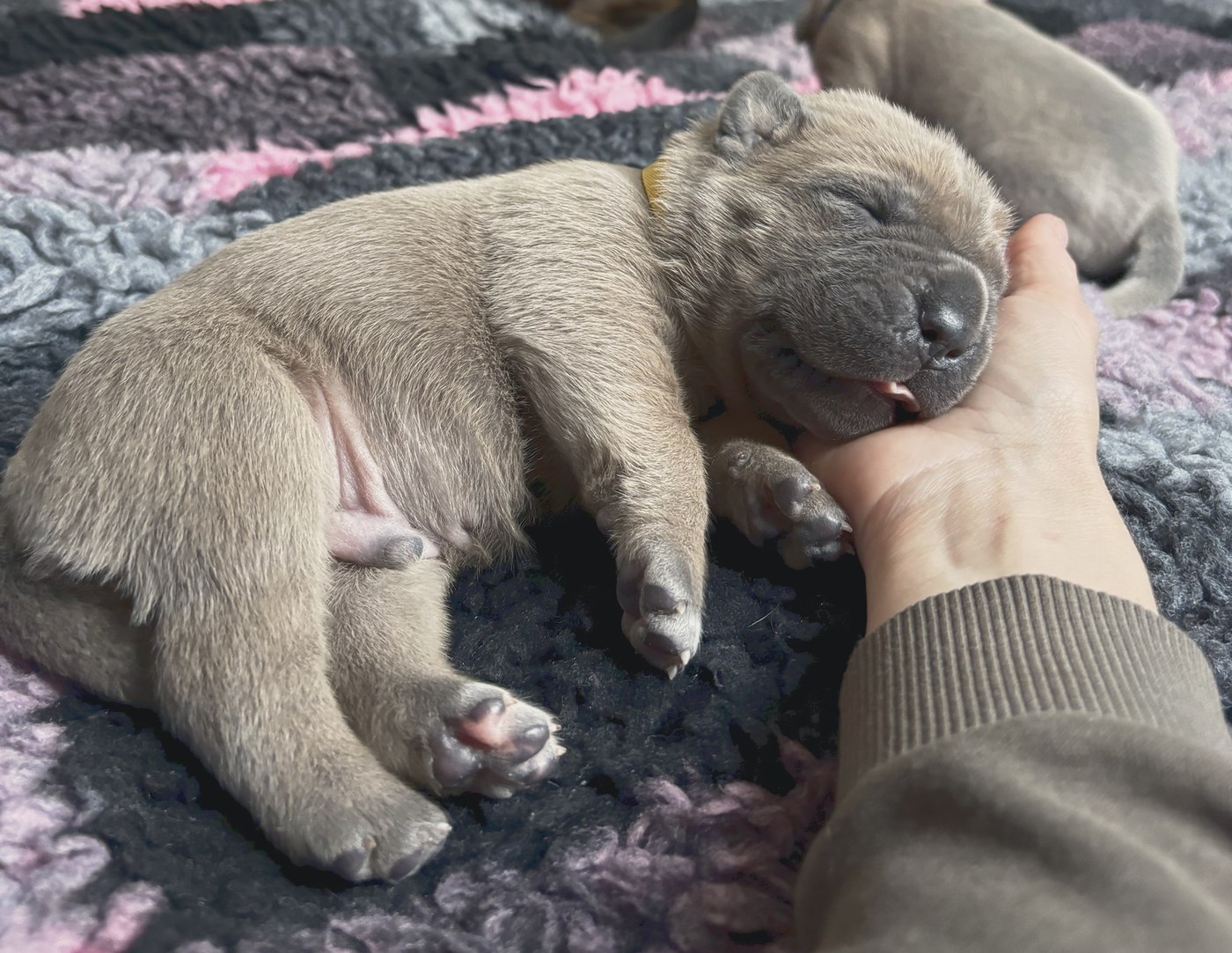
A low score on the first assessment, weak or absent reflexes, being consistently pushed aside by littermates, or a weight trend that’s flat or declining are all signs worth acting on quickly rather than waiting to see if a puppy catches up on its own. Occasionally a dam will reject a specific puppy — this itself is a signal that something may be off with that puppy, worth a vet check rather than just intervention on the breeder’s part alone.
Contact your veterinarian the same day if a puppy is not nursing, is repeatedly pushed away or lies apart from the litter, lies on its side, breathes with its mouth open, keeps crying despite appearing to feed, or is losing weight. These signs matter most in the first three days.
Extra warmth and monitoring
A weak puppy typically needs closer temperature management than the rest of the litter, since it may struggle more to maintain its own body heat even within a well-set-up whelping box — see warmth and the whelping-box microclimate for target ranges. More frequent checks, more frequent weighing, and closer nursing supervision are all reasonable for a puppy that’s been flagged as weak.
Without the dam’s body heat, a puppy depends entirely on its surroundings. Veterinary guidance suggests about 85–90 °F (29–32 °C) at puppy level in the first week, about 80 °F (27 °C) in weeks two and three, and about 69–75 °F (21–24 °C) by week four, with humidity around 55–65%. A newborn’s own body temperature is normally only about 95–99 °F (35–37.2 °C) in week one, so it cannot hold heat well. Too hot is also dangerous: high heat combined with high humidity can cause breathing problems and dehydration. Measure at puppy level, not at room height, and give the puppy a slightly cooler area it can crawl to.
Hand-rearing basics for orphaned puppies
The first day matters most. Puppies must nurse within the first 24 hours, because a newborn can only absorb protective antibodies from colostrum for about that long — absorption has largely stopped by 24 hours. If a puppy has not nursed from its dam, or from another recently whelped bitch, contact your veterinarian promptly. They can advise on ways to give some protection while that window is still open.
An orphaned puppy needs a commercial milk replacer fed on a schedule that matches its age — roughly every 2 to 3 hours around the clock in the first week, gradually extending as the puppy grows, similar to the schedule covered in supplemental and tube feeding.
Stimulating elimination
Puppies can’t urinate or defecate on their own in the first weeks — normally, the dam stimulates this by licking the puppy’s genital and anal area after each feed. Without a dam present, a breeder needs to replicate this manually, gently massaging the area with a warm, damp cloth or cotton ball after each feeding, until the puppy is old enough to eliminate independently.
Continue after every feed until the puppy can urinate and pass stool on its own, usually at around three weeks. Urine should be pale. A puppy that has not passed stool after several feeds, or whose belly feels hard or swollen, should be seen by your vet.
In practice
A first-time breeder hand-rearing an orphaned puppy focuses entirely on feeding schedule and warmth, and doesn’t realize elimination needs active help too. Recognizing that this is a normal, expected part of hand-rearing — not an optional extra — means building it into every feeding session from the start, rather than discovering the gap once a puppy becomes uncomfortable.
(Illustrative, composite scenario.)
Socialization for hand-reared puppies
A puppy raised away from its dam and littermates can miss out on early social learning that normally happens naturally within the litter, and may show slower early development as a result. Deliberately building in extra gentle handling, and reintroducing the puppy to littermates as soon as it’s medically appropriate, helps offset some of what hand-rearing alone doesn’t provide.
When a foster dam is an option
If another lactating dam is available and willing to accept an additional puppy, fostering is generally preferable to full hand-rearing — naturally nursed puppies tend to do better overall than hand-reared ones. This isn’t always available, but it’s worth considering and asking about within your breeding network before defaulting to hand-rearing alone.
When to call your vet
- A puppy has not nursed within its first hours, or is unlikely to get colostrum within 24 hours of birth — call promptly.
- A puppy is not nursing, lies apart or on its side, breathes with its mouth open, or keeps crying despite feeding.
- A puppy feels cool, or its temperature is below about 95 °F (35 °C) in week 1.
- A puppy loses weight, or has not reached at least 1.5 × its birth weight by day 7.
- No stool after several feeds, or a hard, swollen belly.
- The dam rejects one puppy repeatedly — have both the puppy and the dam checked.
- If in doubt, call — your vet would rather hear from you early.
Work on it
A few minutes here will teach you more than re-reading the article.
Ask yourself
- Would I recognize the early signs of a struggling puppy quickly enough to act?
- Do I know how to stimulate elimination correctly, if I ever need to hand-rear a puppy?
- Do I have any contacts for a potential foster dam, in case I ever need one?
Find out & check
- Find out whether anyone in your breeding network might be able to foster a puppy in an emergency.
Do one thing
- Review the elimination-stimulation technique now, so it’s not something you’re learning for the first time under pressure.
Was this article helpful?
Anonymous. We do not store your name, email or IP address.
Sources & further reading
- Merck Veterinary Manual — Management of the Neonate in Dogs and Cats. merckvetmanual.com
- VCA Animal Hospitals — Feeding Orphaned Puppies. vcahospitals.com
- Lawler DF — Neonatal and pediatric care of the puppy and kitten, Theriogenology 2008;70:384–392. confluence.cornell.edu (PDF)
- Dogs NSW (Dr Karen Hedberg BVSc) — Orphan Puppies: Supplementary Feeding. dogsnsw.org.au
- VCA Animal Hospitals — Fading Puppy Syndrome in Dogs. vcahospitals.com
- Mugnier A, Gaillard V, Chastant S (2023), Animals 13(12):1928 — Relative Impact of Birth Weight and Early Growth on Neonatal Mortality in Puppies. mdpi.com
- American Kennel Club (with Fran Smith DVM PhD DACT) — Best Practices for Whelping & Caring for Newborn Puppies. akc.org
Where evidence is limited, recommendations rest on established practice and expert judgment, and may be updated as knowledge develops.
Next steps
- Read next: Congenital abnormalities: what to look for.
- Related: Fluids, energy and blood sugar in the newborn · Supplemental and tube feeding.
- Return to the area hub: The neonatal period.