New owners almost always ask how far they can walk the puppy, when the more useful question is how much of its activity the puppy chooses for itself — because that distinction, rather than any number of minutes, is what matters while the skeleton is still growing.
The most important first
- Growth plates are soft, growing cartilage at the ends of the long bones, vulnerable until they close — roughly six months in small breeds, around eighteen months in giant ones.
- Self-directed play, where the puppy sets the pace and stops when it has had enough, differs in kind from imposed exercise it cannot decline.
- The activities of concern before maturity are repetitive and high-impact: long jogs, hurdle jumping, competition agility, sustained chasing of a thrown ball.
- Evidence linking exercise patterns to joint disease is observational and mixed: in large-breed cohorts, daily stair use in early life was associated with higher hip dysplasia risk, off-leash exercise in the first three months with lower risk. Associations, not established cause.
- The five-minutes-per-month-of-age rule is a convention, not a figure from trials: a reasonable ceiling for imposed walking, a poor target. Growth itself and the large-breed timelines are in growth and body condition in puppies.
What is actually growing
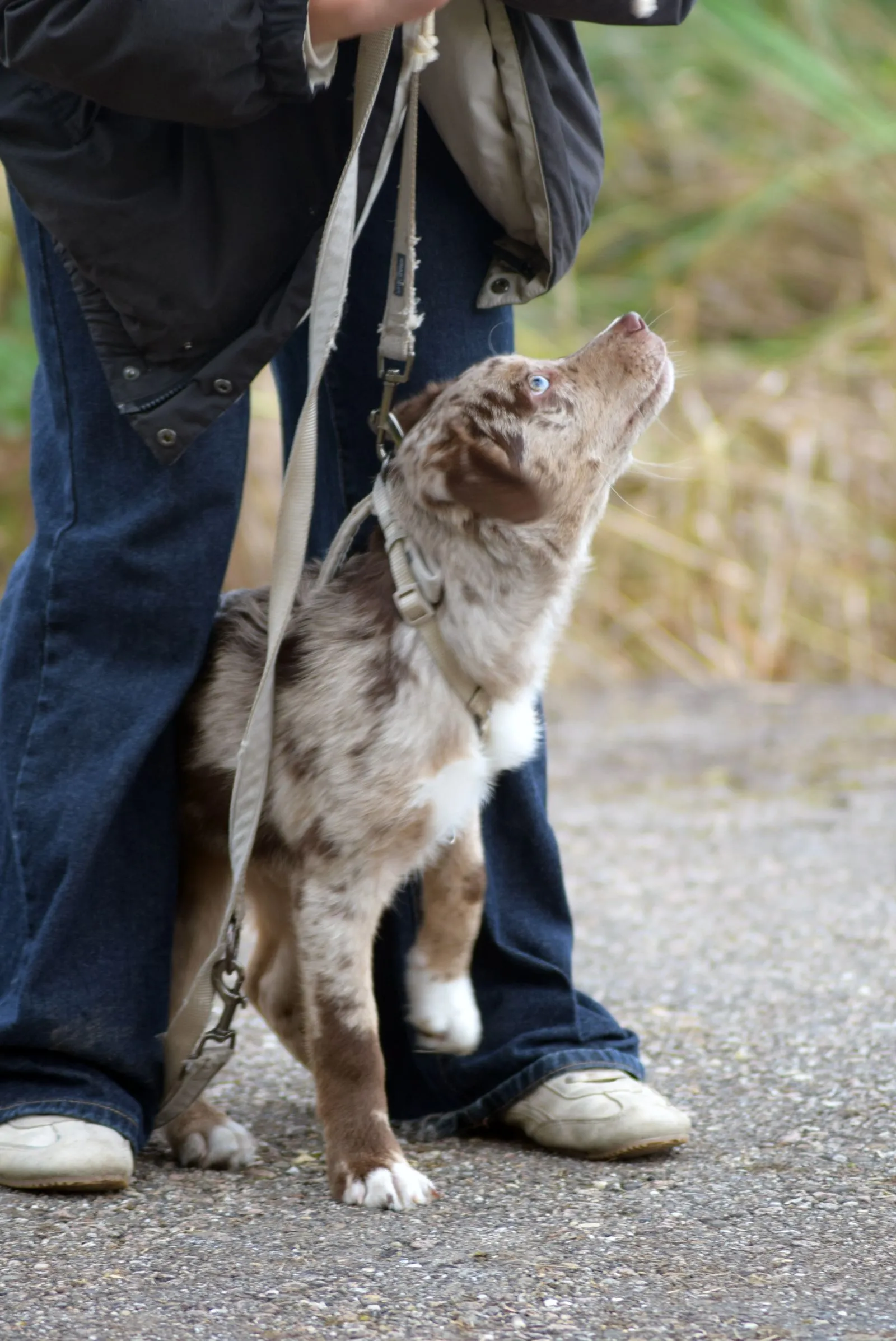
The reason exercise is treated differently in a puppy is anatomical. At each end of a growing long bone sits a growth plate: flexible, rubbery cartilage where new bone is being laid down, and softer than the bone around it. While it remains open it can be injured, and injury there can produce a lasting developmental abnormality and pain rather than a bruise that heals.
Closure is not a single date. Veterinary guidance puts it at approximately six months in small breeds and around 18 months to 2 years in giant ones, with intermediate estimates of about a year for medium breeds and twelve to eighteen months for large ones. So “puppy” as an exercise category lasts twice as long in a Newfoundland as in a terrier, and the breeder is best placed to say so before a buyer takes a nine-month-old running. Most of that window falls in the new home, so what you control is the litter’s environment and the expectations the buyer leaves with.
Growth itself is a risk factor. Hip dysplasia is shaped by heredity, nutrition, exercise and how fast a puppy grows, and conditions such as panosteitis and hypertrophic osteodystrophy appear in fast-growing large and giant breeds. Keep large-breed puppies lean, feed a diet chosen with your veterinarian for the expected adult size, and do not add calcium or other supplements unless your vet recommends them.
Self-directed play versus imposed exercise
The most useful distinction to hand a new owner is who is choosing. A puppy playing in a garden, wrestling with a littermate or investigating a ramp regulates itself: it sprints, stops, lies down, starts again, and stops for good when it is tired. Veterinary guidance is consistent that this is the exercise puppies should be getting — running and playing as they want, rather than following a plan.
Imposed exercise removes that regulation. A puppy on a lead beside a jogging human cannot stop, and a puppy retrieving a ball forty times keeps going past the point of fatigue, because the game rather than the body is setting the pace. That is the real content of the warning about forced exercise: the problem is not that the puppy moves a lot, but that the movement is repetitive, high-impact and not under its control. Free play in a safe space rarely exceeds what a puppy can tolerate; a bicycle or a ball launcher easily can.
Mental work is the substitute nobody thinks of: scent games, food puzzles and short training sessions tire a puppy without loading anything, which is why enrichment and environmental design belongs beside this article.
What the evidence does and does not say
It is worth being precise here, because this topic attracts confident rules the literature does not support. A 2020 systematic review of risk factors for canine osteoarthritis and its predisposing conditions found the exercise picture genuinely mixed. In a Norwegian study of four large breeds, puppies that climbed stairs every day during their first three months were more likely to have hip dysplasia on later X-rays, while puppies that had off-leash exercise in park-like terrain in the same period were less likely. The researchers suggested keeping puppies under three months off stairs and letting them move freely outdoors on soft, moderately uneven ground. The effects were limited to the first three months, and hip dysplasia also clustered strongly within litters — a reminder that genetics matter as much as daily routine. In a Swedish Labrador study, dogs that regularly chased balls or sticks had higher odds of both hip dysplasia (odds ratio 2.4) and elbow arthrosis (odds ratio 3.2).
Those are associations from observational studies in particular breeds, not demonstrations of cause, and the review’s own gap analysis notes that the interactions between risk factors and their relative weighting need further research. Body weight, by contrast, comes through as a modifiable factor across these conditions — which is why body condition is probably the highest-value thing a breeder can raise with a buyer.
The honest position is therefore this. There is good anatomical reason to protect open growth plates from repetitive high-impact loading, observational evidence that some exercise patterns track with joint disease in large breeds, and no trial establishing a safe number of minutes. Say that, rather than reciting a formula as though it were a dose.
Stairs and footing in the puppy room
Two everyday features of a house deserve attention while the litter is with you. Stairs recur in the risk-factor literature for large breeds, and a very young puppy on a staircase is also simply at risk of falling; blocking them, and telling large-breed buyers to carry the puppy for the first months, is cheap and concrete advice.
Flooring without grip is the other. A puppy whose feet slide from under it cannot control its limbs, and matting over smooth floors is easy to arrange — the setup is covered in the puppy environment. Direct evidence linking household flooring to joint disease in puppies is thin, so treat it as sensible practice rather than a proven preventive.
In practice
A breeder sells a large-breed puppy to an active owner, who starts taking it on progressively longer runs from five months because the dog is keen and never seems tired. The puppy is lame at nine months. Nothing about the owner’s intentions was careless; what was missing was one sentence at handover — that this breed’s growth plates would not close until around eighteen months, and that enthusiasm is not evidence a skeleton is ready.
(Illustrative, composite scenario.)
Signs to stop and call the vet
A puppy that limps, favors a leg, has lameness that moves from one leg to another, cries when a leg is handled, has warm or swollen legs, runs a fever or does not want to get up should be seen by a veterinarian. Do not wait for it to “walk off”.
During normal exercise, a puppy that sits down, lags behind or lies down mid-walk is telling you it has had enough. Carry a small puppy home rather than pushing on.
What to tell the new owner
Keep it to a few things they will remember. Let the puppy choose its own activity wherever it is safe to, and treat free play with suitable dogs and exploration on varied ground as the default. Keep imposed walking short in the first months — five minutes per month of age, once or twice a day, works as an upper limit rather than a quota. Postpone jogging, cycling, repetitive ball throwing, jumping and formal agility until the growth plates have closed, giving them the age for their own breed rather than a general figure. Also postpone repeated jumping — throwing a ball straight up, dock diving, or letting the puppy leap in and out of the car or off high furniture. Carry the puppy on stairs, and keep it lean.
Then be clear about the limits of your influence. You can hand over a puppy whose joints have had every advantage management can give them; whether that dog is sound at four is also a matter of genetics, growth rate, nutrition and three years of someone else’s decisions. Saying so is not a disclaimer — it is why the handover conversation is worth having properly, alongside the material on play and social communication between puppies that goes home with the puppy.
When to call your vet
- Your puppy limps, favors a leg, or the lameness moves from one leg to another.
- A leg looks swollen, feels warm, or your puppy cries when it is touched.
- Your puppy has a fever, goes off its food, or is reluctant to get up or move.
- You notice a bunny-hopping gait, stiffness after rest, or difficulty on stairs or getting up.
- Your puppy is gaining weight fast or looks heavy for its age — ask about diet and target growth.
- You are unsure when your breed can start running, jumping or sport training.
- If in doubt, call — your vet would rather hear from you early.
Work on it
A few minutes here will teach you more than re-reading the article.
Ask yourself
- Does my litter have varied ground and safe levels to play on, or one flat surface?
- Do I know, and can I state, the approximate age of skeletal maturity for the breed I am selling?
- Does my handover conversation distinguish self-directed play from imposed exercise, or just give a number of minutes?
Find out & check
- Ask your vet when a dog of your breed’s size can reasonably start running with an owner.
Do one thing
- Write three sentences on exercise for your puppy pack: what to encourage, what to postpone, until what age.
Was this article helpful?
Anonymous. We do not store your name, email or IP address.
Sources & further reading
- VCA Animal Hospitals — What you need to know about growth plates and exercise. vcahospitals.com
- American Kennel Club — How Much Mental and Physical Exercise Do Puppies Need?. akc.org
- Anderson KL, Zulch H, O’Neill DG, Meeson RL, Collins LM — Risk Factors for Canine Osteoarthritis and Its Predisposing Arthropathies: A Systematic Review, Frontiers in Veterinary Science, 2020. frontiersin.org
- Krontveit RI et al. — Housing- and exercise-related risk factors associated with the development of hip dysplasia as determined by radiographic evaluation in a prospective cohort of Newfoundlands, Labrador Retrievers, Leonbergers, and Irish Wolfhounds in Norway, American Journal of Veterinary Research, 2012. avmajournals.avma.org
- Sallander MH, Hedhammar Å, Trogen MEH — Diet, Exercise, and Weight as Risk Factors in Hip Dysplasia and Elbow Arthrosis in Labrador Retrievers, Journal of Nutrition, 2006. sciencedirect.com
- Merck Veterinary Manual — Hip Dysplasia in Dogs. merckvetmanual.com
- Merck Veterinary Manual (pet owner version) — Bone Disorders in Dogs. merckvetmanual.com
- American Animal Hospital Association — 2019 AAHA Canine Life Stage Guidelines. aaha.org
Where evidence is limited, recommendations rest on established practice and expert judgment, and may be updated as knowledge develops. Ages of skeletal maturity vary considerably between breeds and individuals — confirm yours with your own veterinarian.
Next steps
- Read next: Growth and body condition in puppies.
- Related: Play and social communication between puppies.
- Return to the area hub: Behavior and development.