As puppies move past the neonatal period, growth tracking shifts from a daily necessity to checks every few days and then weekly — but it doesn’t stop mattering, and body condition becomes just as useful a measure as weight alone.
The most important first
- After the neonatal period, weigh every few days until about four weeks, then weekly.
- Growth should be slow and steady — rapid growth carries its own risks, particularly skeletal issues in large and giant breeds.
- Body condition scoring (checking how easily ribs and waist can be felt) is a useful complement to weight alone.
- A puppy that loses weight, or has not gained between two weigh-ins, needs a call to your vet — stalled weight is often the first sign of illness.
- Large and giant breeds grow on a different, longer timeline than small and medium breeds — don’t judge one against the other’s curve.
From daily to weekly tracking
The intensive daily weighing that mattered so much in the neonatal period can ease to a check every few days until about four weeks and then to a weekly one, once puppies are past the highest-risk window and gaining steadily. The goal shifts from catching an acute crisis early to confirming steady, ongoing progress over time.
What steady growth looks like
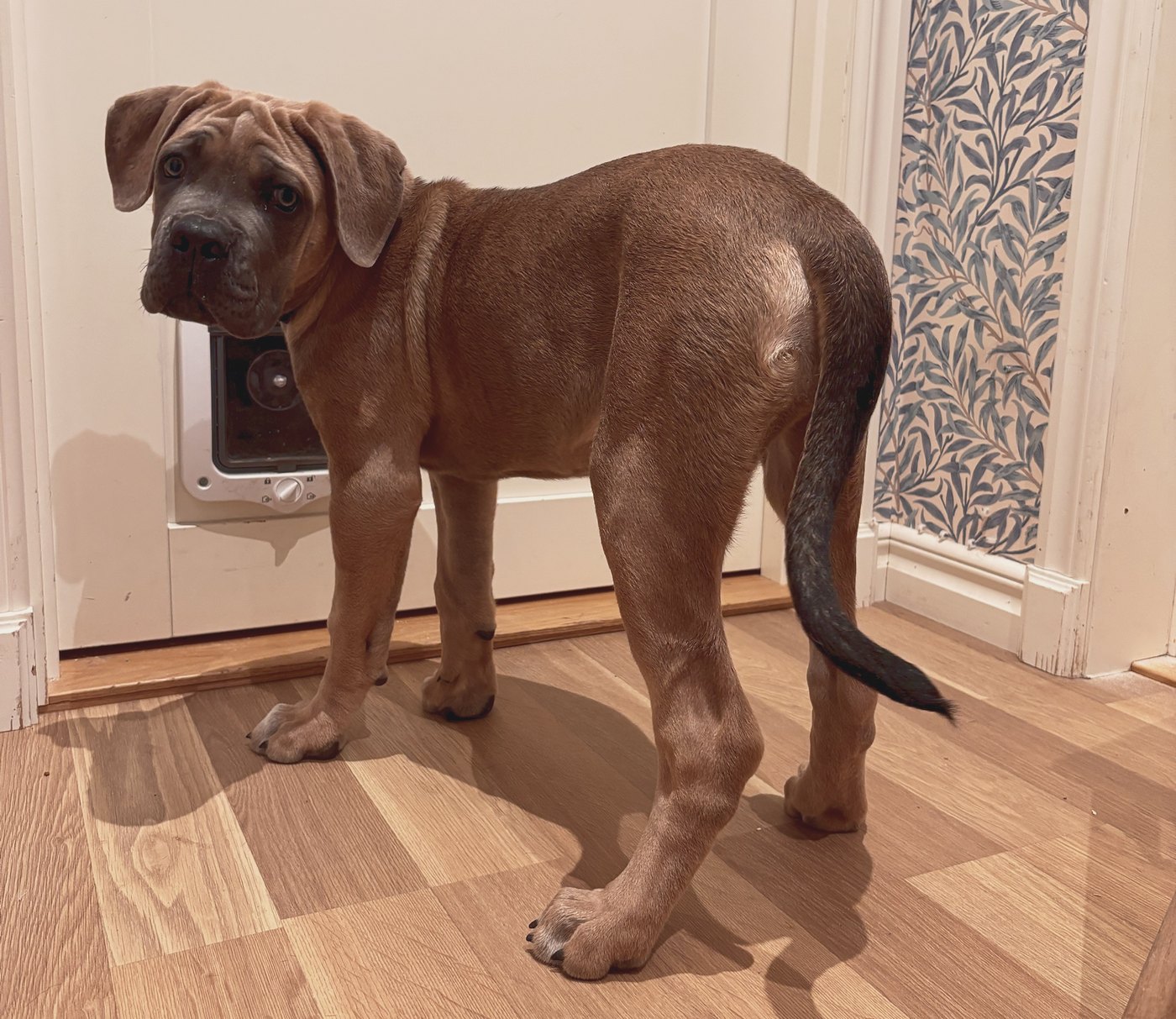
Growth through this stage should be gradual and consistent rather than rapid — pushing for fast growth, particularly in large and giant breed puppies, carries real risks including skeletal development problems, on top of setting up patterns that can contribute to obesity later. Slow and steady is the goal, not maximum growth.
Body condition scoring
Alongside weight, body condition — assessed by how easily ribs, spine, and pelvis can be felt under a light layer of fat, and whether a waist is visible from above — gives a fuller picture than a number on a scale alone. An ideal body condition means ribs are easily palpable without being visible, roughly like feeling your knuckles with your hand held flat, with a visible but not exaggerated waist.
Most vets use a nine-point scale, where 4 and 5 are ideal. At ideal condition you can feel the ribs easily under a thin layer of fat, see a waist behind the ribs from above, and see the belly tuck up toward the hind legs from the side. Some practices use a five-point scale instead, so always write down which scale you used, or the numbers will mean different things to different people.
In practice
A breeder notices one puppy in the litter looks a little rounder than its littermates and isn’t sure whether that’s a concern. Checking body condition directly — feeling for ribs and waist, rather than relying on visual impression alone — gives a clearer, more reliable answer than eyeballing size differences between puppies.
(Illustrative, composite scenario.)
When one puppy falls behind
A puppy that’s consistently smaller or trailing its littermates in weight, even without other signs of illness, is worth individual attention — closer monitoring, a body condition check, and a conversation with your vet if the gap persists or widens, rather than assuming it will simply catch up.
Weight that stalls is often the first sign that something is wrong, before a puppy looks ill. If a puppy loses weight, or has not gained between two weigh-ins, call your veterinarian rather than waiting for the next weekly check.
Breed-size differences
Small and medium breeds typically reach skeletal maturity by around 8 to 12 months, while large and giant breeds take longer, generally 10 to 16 months — a useful reminder that growth trajectories differ meaningfully by breed size, and a puppy shouldn’t be judged against a growth curve built for a different size category.
Large and giant breed puppies do best on a diet labeled for the growth of large-size dogs. Adding calcium or other supplements to a complete puppy diet is rarely needed and can be harmful, so only do it on your vet’s advice.
When to call your vet
- A puppy loses weight, or has not gained between two weigh-ins
- For litters still in the neonatal period: a puppy is not at least 1.5 times its birth weight by day 7, or has not doubled its birth weight by about day 10–14
- One puppy keeps falling further behind its littermates
- A puppy feels bony over the spine and hips, or has a swollen, pot-bellied abdomen
- Growth stalls together with diarrhea, vomiting, coughing or reduced appetite
- If in doubt, call — your vet would rather hear from you early.
Work on it
A few minutes here will teach you more than re-reading the article.
Ask yourself
- Have I transitioned from daily to weekly weighing at the right point for my litter’s age?
- Would I check body condition directly, rather than relying on visual comparison between puppies?
- Do I know the right growth expectations for my specific breed’s size category?
Find out & check
- Find out whether your vet uses a specific growth chart or body condition scale you should be tracking against.
Do one thing
- Do a hands-on body condition check on each puppy this week, not just a visual one.

Was this article helpful?
Anonymous. We do not store your name, email or IP address.
Sources & further reading
- Merck Veterinary Manual — Feeding Practices in Small Animals. merckvetmanual.com
- Merck Veterinary Manual — Management of the Neonate in Dogs and Cats. merckvetmanual.com
- Salt C, Morris PJ, German AJ, et al. (2017) — Growth standard charts for monitoring bodyweight in dogs of different sizes. PLoS ONE 12(9):e0182064. pmc.ncbi.nlm.nih.gov
- WSAVA Global Nutrition Committee — Body Condition Score chart (dog). wsava.org
- VCA Animal Hospitals — Body Condition Scores. vcahospitals.com
- University of Illinois College of Veterinary Medicine — Fading Puppy Syndrome: When Puppies Fail to Thrive. vetmed.illinois.edu
Where evidence is limited, recommendations rest on established practice and expert judgment, and may be updated as knowledge develops.
Next steps
- Read next: From nursing to weaning.
- Related: Physical development of the growing litter.
- Return to the area hub: Raising a healthy litter.