Keeping a puppy for your program is the one selection decision you cannot undo quietly — it sets the direction of the next decade of your breeding, and you make it with almost none of the information you will eventually need.
The most important first
- The decision is provisional by definition: the screening that would justify it is not available yet. In the Orthopedic Foundation for Animals’ scheme, final hip and elbow evaluation waits until 24 months and patella certification until 12 months.
- Preliminary information exists but weakens the earlier you look: preliminary hip radiographs are accepted from four months, and a normal preliminary result held at two years in 89.6% of dogs radiographed at 3–6 months against 95.2% at 13–18 months.
- What you are ultimately selecting is a breeding value, not an appearance. In UK data, heritability of hip score averaged 0.38 across 15 breeds, and of elbow score 0.218 across the five breeds with elbow data — substantial, but far from settled by one dog’s own result.
- Estimated breeding values use relatives as well as the dog itself, and are more accurate than selecting on a single phenotype — by a factor of 1.16 to 1.34 in the same analysis.
- What makes this decision survivable is keeping it open: a provisional pick, a route to reassess, and a plan for the good puppy that turns out not to be the right one.
Why eight weeks is the wrong time to decide, and why you must anyway
The timing is forced on you. Buyers are waiting, the litter leaves, and the puppy you do not keep goes to someone else. So you decide at eight weeks with what you have: pedigree and the parents’ results, litter-wide observation, a conformation impression and a temperament snapshot.
The honest way to hold that is as a hypothesis. You are not identifying the best dog in the litter; you are choosing the puppy least likely to be excluded later — one with no disqualifying fault you can already see, from a combination you have reasons for, with temperament in the range your breed and your work require. Which puppy to keep: making the decision deals with the mechanics; this article is about the evidence behind it.
The strongest discipline available is to decide against your written goal rather than against the litter. If building a breeding program and designing a long-term breeding program name the two or three traits this generation is meant to improve, the question becomes narrow and answerable: which puppy best serves those, and which weaknesses in the parents am I refusing to carry forward?
What can and cannot be judged now
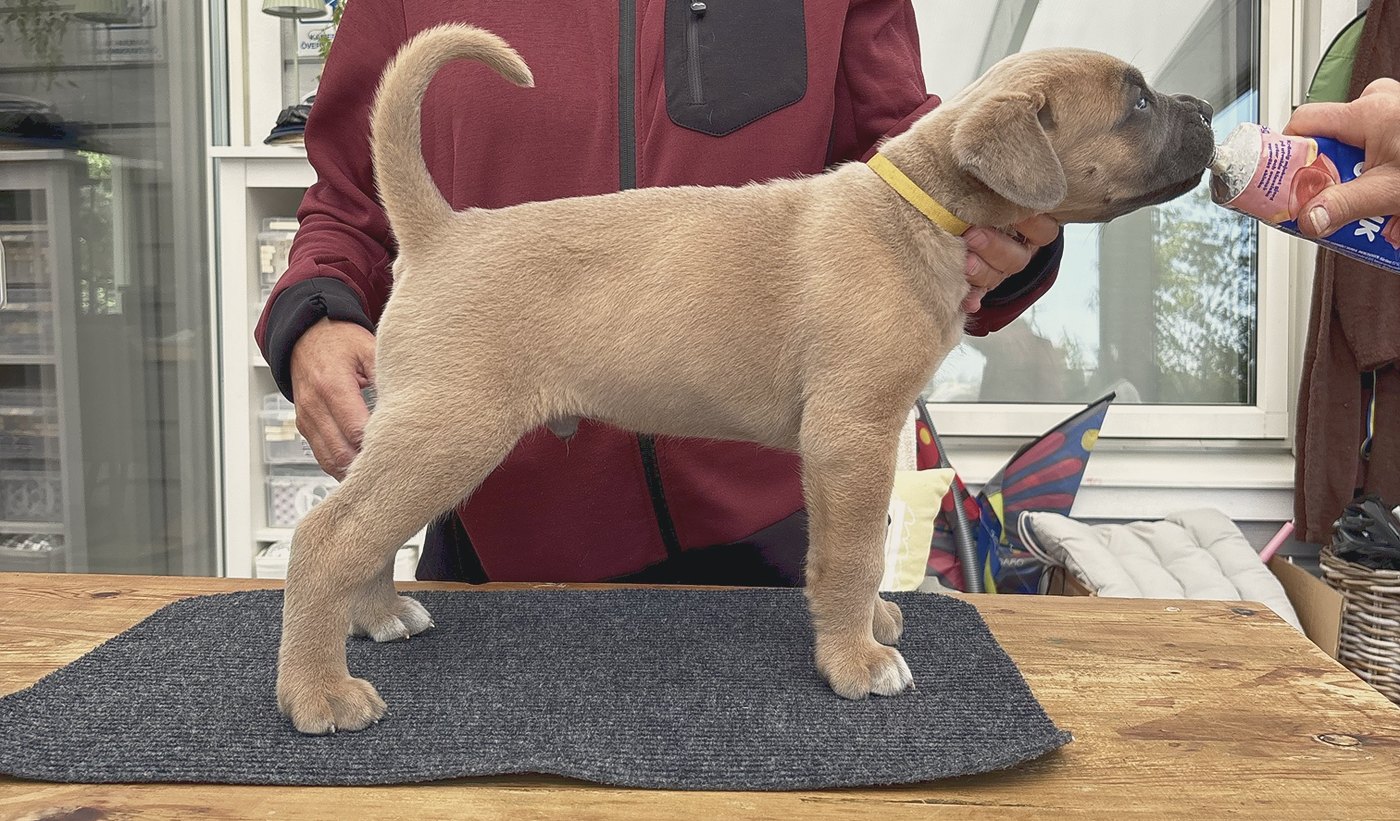
Some things are worth assessing at eight weeks, and are treated properly in evaluating conformation and physical development in puppies: balance and proportions, bite and dentition as they stand, angulation, movement on a non-slip surface, coat and pigment, and obvious faults. Function belongs here too, as tendency rather than prediction — see assessing working aptitude and function.
What cannot be judged now is most of what decides whether a dog is fit to breed from. Adult size, substance and topline change through adolescence, and the bite can change with the permanent dentition. Temperament is still forming, and the evidence gathered in what puppy tests can and can’t predict is clear that the eight-week snapshot forecasts the adult weakly. Fertility is unknown, and so is health past the first weeks — where most withdrawals eventually come from.
A few health exclusions can already be checked. OFA notes that puppies can show patellar luxation by eight weeks and suggests a preliminary patella exam at six to eight weeks, before puppies leave, as a good time to gather breeding data. In males, both testicles are normally down by six to eight weeks; a retained testicle is heritable, and an affected dog should not be bred. Ask your veterinarian to check both before you commit.
Then there is the trap of the puppy that looks best now: early maturers are conspicuous at eight weeks, and slow-maturing puppies in many breeds look unremarkable exactly when the decision is made. A full written record of the whole litter, as in observing and documenting individual puppies, lets you check that instinct later and makes evaluating the whole litter possible once the dogs are grown.
The screening that has not happened yet
Set out the timetable plainly, because it governs how long your decision stays provisional. Preliminary hip radiographs can be taken from four months, and the OFA’s published reliability for a preliminary result of normal was 89.6% for dogs aged 3–6 months, 93.8% at 7–12 months and 95.2% at 13–18 months; a preliminary grade of fair held at two years in only 76.9% of cases and warrants re-evaluation at 24 months. OFA certification is final at 24 months for hips and elbows and from 12 months for patellae. DNA tests for single-gene conditions are the exception, since they can usually be run at any age.
A prospect kept at eight weeks therefore carries an open question for two years, and some will not answer it well. Which conditions matter in your breed is the subject of health screening and health schemes; why a clear result in one dog does not clear its offspring is in genetics and inherited health and modes of inheritance.
Remember that the prospect’s environment also shapes its hips. OFA notes that how severe hip dysplasia becomes can be affected by caloric intake and exercise. Feed for steady growth and a lean body, and ask your veterinarian about suitable exercise while the dog is growing.
In practice
A breeder keeps the puppy that looks most promising at eight weeks, and places the second choice on a co-ownership arrangement with an experienced home twenty minutes away rather than at a distance. At fifteen months the kept dog’s preliminary hips come back fair and its adult bite has gone slightly wrong, while the second puppy screens well and has matured into the better representative of the breeding goal. Because both were still reachable, the program loses a year rather than a generation.
(Illustrative, composite scenario.)
Selecting on breeding value rather than on the dog in front of you
The most useful shift in thinking is from the individual to the family. An individual result tells you what one dog has; an estimated breeding value estimates what it is likely to pass on, by combining its own results with those of its relatives. The Royal Kennel Club, which publishes EBVs for hip and elbow dysplasia, quantifies the difference in confidence: roughly 60% for a dog scored itself, about 40% for a dog with both parents scored, and about 30% with only one parent scored. An EBV estimates genetic risk; the dog’s own score remains the better measure of that dog.
The population data show why this matters. In an analysis of 142,287 hip scores across 15 UK breeds and 13,908 elbow scores across five of them, genetic trends improved in all but one breed, but selection was weak — the authors described the observed intensity as equivalent to excluding less than a maximum of 18% of the highest-risk animals from breeding — and EBVs were 1.16 to 1.34 times more accurate than selecting on a dog’s own or its parents’ phenotypes. For a breeder choosing a prospect at eight weeks, the puppy’s eventual own score is one piece of evidence among several, and a puppy from a family with consistent results is a safer bet than a spectacular puppy from a patchy one.
Keeping the decision open
Treat the prospect as under review until it has done everything a breeding animal must do: matured, screened, been assessed as an adult, and — if your breed and discipline expect it — been shown or worked. Write down in advance what would cause you to withdraw it, because a criterion set at eight weeks is easier to honor than one improvised at two years, when you are attached to the dog.
Then plan for the withdrawal that is likelier than not: decide where a retired prospect will live, keep a second puppy within reach through arrangements of the kind described in guardian homes, breeding rights and co-ownership, and accept that a kept puppy which turns out to be simply a good dog is not a failure of judgment but the normal outcome of a decision made two years too early. What you learn feeds into making the next generation’s breeding decisions.
Talk to your vet when planning: at six to eight weeks, ask for a check of patellas, bite, heart, hernias and testicles in males, and which screening ages apply to your breed.
Work on it
A few minutes here will teach you more than re-reading the article.
Ask yourself
- Which two or three traits is this generation meant to improve, and does the puppy I am keeping actually serve them?
- Have I written down, in advance, what would make me withdraw this prospect from breeding?
- Am I keeping the puppy that best fits the plan, or the one that is most impressive today?
Find out & check
- Check the screening schemes in your breed for the minimum ages at which each result becomes official, and whether estimated breeding values exist for any of them in your registry.
Do one thing
- Write a one-page note on the prospect you are keeping: why this puppy, on what evidence, and the dates at which each open question is due to be answered.
Was this article helpful?
Anonymous. We do not store your name, email or IP address.
Sources & further reading
- Orthopedic Foundation for Animals — Preliminary Evaluations. ofa.org
- The Royal Kennel Club — Estimated breeding values (EBVs). royalkennelclub.com
- Lewis TW, Blott SC, Woolliams JA (2013), BMC Genetics — Comparative analyses of genetic trends and prospects for selection against hip and elbow dysplasia in 15 UK dog breeds. link.springer.com
- Orthopedic Foundation for Animals — Hip Dysplasia. ofa.org
- Orthopedic Foundation for Animals — Patellar Luxation. ofa.org
- FCI — International Breeding Strategies. fci.be
- American Kennel Club — Picking a Show Prospect Puppy From Your Litter. akc.org
- Cornell Riney Canine Health Center — Cryptorchidism in Dogs (Retained Testicle). vet.cornell.edu
Where evidence is limited, recommendations rest on established practice and expert judgment, and may be updated as knowledge develops. Minimum ages, grading systems and the availability of estimated breeding values differ between registries and countries — check the schemes that apply to your breed and jurisdiction.
Next steps
- Read next: Which puppy to keep: making the decision.
- Related: Health screening and health schemes.
- Return to the area hub: Understanding and placing each puppy.