Assessing conformation in an eight-week-old puppy is a real skill and a genuinely limited one — some of what you are looking at is the adult dog in miniature, some is a growth stage that will have reversed by Christmas, and telling the two apart is most of the job.
The most important first
- Balance and proportion read better at eight weeks than detail does; heads, chests, coats and final size do not.
- Growth is not uniform. At six months a small breed is around three-quarters of its adult size, a medium breed two-thirds, a large breed about 60% and a giant breed roughly half — and the parts do not arrive in proportion.
- Assess the bite at eight weeks and record it, but treat it as provisional: the 28 deciduous teeth that erupted at three to five weeks start being replaced at four to five months, with all 42 permanent teeth normally present by seven months.
- Look at movement loose and on a non-slip surface, in short repeated sessions, rather than once on a stacked puppy on a slippery floor.
- Nothing you see at eight weeks entitles you to promise a buyer a show dog — the same growth that makes early evaluation possible makes it revisable, which is why growth and body condition in puppies and physical development of the growing litter sit underneath this article.
What can and cannot be assessed at eight weeks
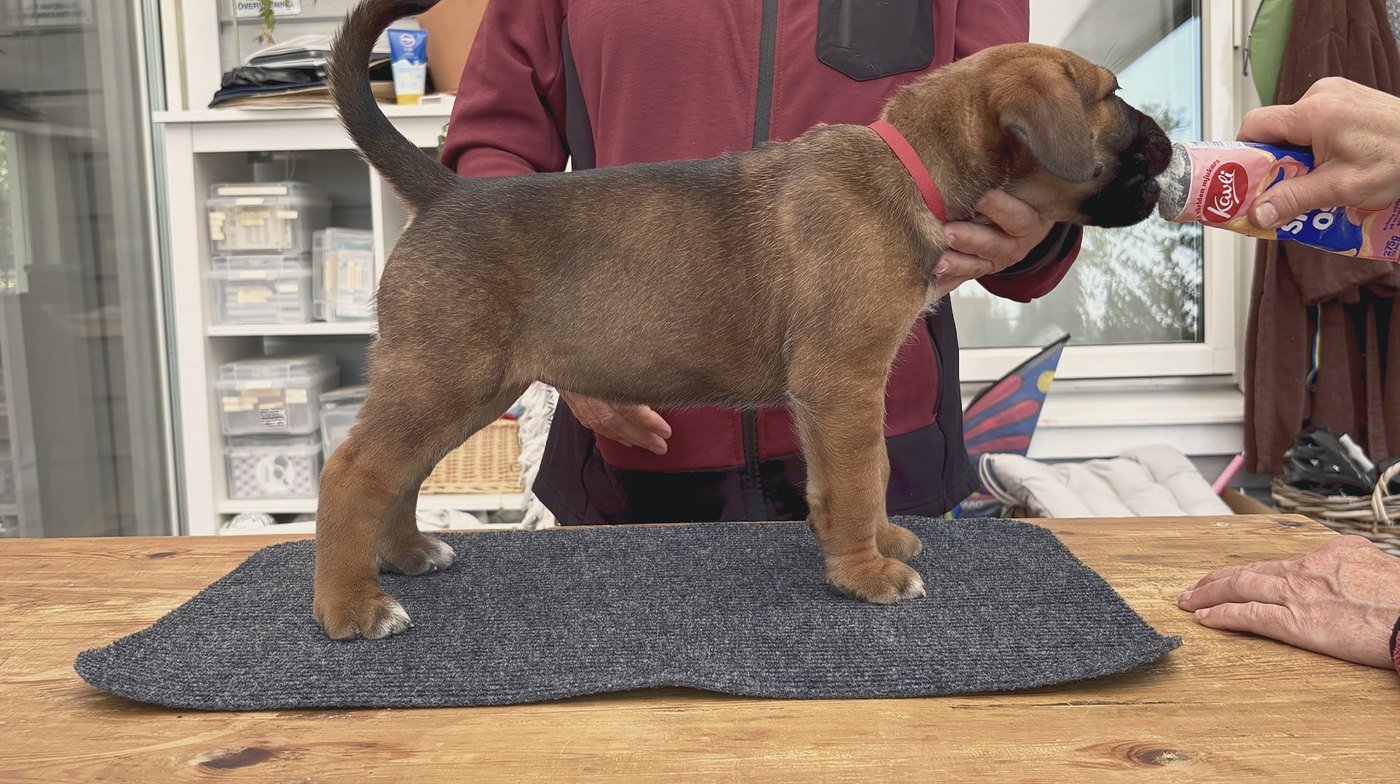
Structure is easiest to read when a puppy is old enough to stand and move but young enough not to have entered its first awkward growth phase. Many experienced breeders begin looking seriously at around three to four weeks, when puppies are mobile and can be stood up for inspection, and keep looking at intervals rather than on one appointed day.
What tends to be informative early: overall balance and the relationship of height to length; the outline when the puppy stands square of its own accord; shoulder placement on palpation; the angles of front and rear relative to each other, since a rear that does not match the front shows up as a movement problem later; tail set; and feet and toes. Whether both testicles are descended belongs in the pre-sale health checklist rather than in a conformation opinion.
What is not assessable: adult size, adult head, depth and spring of chest, adult coat, adult topline, and the secondary sex characteristics that arrive with maturity. A puppy’s front feet often turn slightly outwards at this age and commonly straighten as the ribcage rounds and pushes the elbows out. Reading that as a fault would be a mistake; so would assuming every turned-out front is temporary.
Growth stages that mislead
The commonest error is judging a puppy against an adult standard while it is halfway through rebuilding itself. Growth runs at very different rates by size: small breeds finish at roughly six to eight months, medium breeds at about twelve, and large and giant breeds at twelve to eighteen months or more, with some giants still filling out at two years. Treat these as rough ranges. Within that, rear ends outgrow fronts and wait to be caught up, muzzles lengthen out of proportion, and the whole animal can look wrong for weeks. Breeders call it the puppy uglies, and it is normal.
This has two consequences. First, one look is not an evaluation — a sequence is. Photograph or film each puppy at the same ages, from the same angles, on the same surface, and compare litter to litter over years; that record is worth more than any single opinion, including your own. Second, hold the conclusion loosely: the conventional advice from experienced exhibitors is not to make final decisions about a pick puppy until it is at least a year old, and longer in a slow-maturing breed.
Bite and dentition
The bite is the one piece of conformation you can measure rather than judge. Deciduous teeth begin to erupt at three to five weeks and most dogs have 28 of them; permanent teeth start to appear at four to five months and the full set of 42 is normally present by seven months. An eight-week bite is therefore a deciduous bite, and the change of teeth can alter the picture in either direction.
Record what you see rather than grading it: whether the incisors meet as a scissor bite, level, over or under; whether the lower canines sit clear of the upper gum line or point inwards as they erupt; whether the two sides match. Malocclusions are classified by whether the problem is one tooth out of position, a relatively short lower jaw, a relatively long lower jaw, or an asymmetric jaw. Veterinary guidance is that malocclusions are nearly always genetic, though trauma during growth can interfere with jaw development, and that only animals with a normal, atraumatic occlusion should be used for breeding. That makes a bite record a breeding record as well as a placement record — and anything likely to cause discomfort or abnormal wear belongs with your veterinarian.
Some bite faults are more than cosmetic. If a puppy’s lower canines point inward and press into the roof of its mouth, every bite hurts and can wear a hole in the palate. Have your veterinarian look at it promptly. Removing the baby teeth that cause the problem early can sometimes let the adult teeth come in better, and the window for this is narrow. Later, during the changeover from about four to seven months, a baby tooth that is still in place when its adult replacement is coming through usually needs to come out. Mention this to buyers so they know to watch for it.
Testicles
In most male puppies both testicles are in the scrotum by about eight weeks. A puppy where one or both cannot be felt at that point should be noted and rechecked by your veterinarian. Late descent happens, but it is rare after about six months. Retained testicles are considered inherited, so an affected dog should not be bred. It also carries a higher risk of testicular cancer and of torsion, a painful emergency. Record the finding honestly in the puppy’s file and tell the buyer.
Movement, surfaces and second opinions
Movement tells you what a stacked photograph cannot, and most breeders look at it in poor conditions. Use a non-slip surface — a rubber mat, matting down a corridor, short dry grass — because a puppy scrabbling on tiles shows you a gait it does not have. Watch it loose and unhurried rather than led: trotting away to its littermates in a straight line, away and back, several times across several days. Look at whether front and rear work at the same rate, whether the feet converge in one line, and whether the topline stays level in motion or only when the puppy is held.
Then get a second pair of eyes, ideally from someone who does not know which puppy you have fallen for. A mentor, a breed-club evaluator or an experienced exhibitor will see different things, and the value is highest when they assess the litter without being told your ranking. Two competent evaluators who disagree about one puppy have told you the trait is marginal.
In practice
A breeder is set on a bitch puppy at eight weeks — balanced, level, correct bite — and tells the family she is the keeper. A mentor, shown the litter without that ranking, places her third. At five months the chosen bitch is high in the rear and roach-backed, and the breeder, who has photographs at eight weeks, twelve weeks and five months, can see a growth phase rather than a change in structure. At fourteen months she is level again — and the mentor’s third-ranked puppy has turned out to be the better mover. Both stay; the decision was simply made eleven months too early.
(Illustrative, composite scenario.)
The honest limits, and how to say them
Buyers will ask which puppy is “show quality”, and the language matters. You can honestly say that a puppy shows no obvious fault at eight weeks, that its structure at this age is promising for the ring, and that you will know much more at six months and at a year. You cannot say it will be a show dog, a champion or a breeding prospect, because growth, injury, dentition and maturity all still have a say. If you sell on the basis of potential, put in writing what the assessment was, at what age, and that it was an opinion about a growing animal.
Keep the conformation opinion separate from the health assessment. A well-made puppy can have a heart murmur or a joint that needs following up, and a plain one can be robust; that is the subject of evaluating puppy health before placement. Conformation tells you about shape and movement — not about health, and not about temperament.
Good structure at eight weeks does not tell you about hip or elbow health. Those are assessed later by X-ray. In the US, the OFA offers preliminary hip evaluations from four months and final evaluations in adulthood. Other countries run their own national schemes through their kennel clubs or veterinary associations. A show-prospect assessment should say plainly that it is not a health clearance.
When to call your vet
- A puppy’s lower canines seem to press into the roof of its mouth, or the bite looks like it causes discomfort.
- One or both testicles cannot be felt by about eight weeks. Ask for a check and a plan for rechecks.
- A puppy limps, bunny-hops, or moves unevenly on more than one occasion, or cries when its legs or back are handled.
- Feet, wrists or legs look noticeably more crooked from week to week, instead of steadying.
- A baby tooth is still firmly in place while the adult tooth is coming through beside it.
- A male puppy with a retained testicle suddenly shows severe belly pain. Treat this as an emergency.
- If in doubt, call — your vet would rather hear from you early.
Work on it
A few minutes here will teach you more than re-reading the article.
Ask yourself
- Do I have photographs of my last three litters at the same ages, from the same angles — or only the ones that flattered the puppies I kept?
- When I last called something a fault at eight weeks, could I distinguish it from a growth stage, and how?
- Does my written bite record say what I observed, or only “correct”?
Find out & check
- Ask an experienced breeder or breed-club evaluator in your breed at what ages their assessments have historically been most and least reliable, and have them look at your current litter without being told your ranking.
Do one thing
- Put a non-slip mat down a corridor today and film each puppy trotting away and back, twice, with its age written on the file.
Was this article helpful?
Anonymous. We do not store your name, email or IP address.
Sources & further reading
- American Kennel Club — Picking a Show Prospect Puppy From Your Litter. akc.org
- American Kennel Club — Puppy Growth Chart: When Does My Puppy Finish Growing? akc.org
- Merck Veterinary Manual — Dental Development of Dogs. merckvetmanual.com
- Merck Veterinary Manual — Developmental Abnormalities of the Mouth and Dentition in Small Animals. merckvetmanual.com
- Cornell University College of Veterinary Medicine, Riney Canine Health Center — Cryptorchidism in Dogs. vet.cornell.edu
- VCA Animal Hospitals — Cryptorchidism in Dogs. vcahospitals.com
- Orthopedic Foundation for Animals — Hip Dysplasia. ofa.org
- The Royal Kennel Club — Breed standards. royalkennelclub.com
Where evidence is limited, recommendations rest on established practice and expert judgment, and may be updated as knowledge develops. Nothing here is veterinary advice: a suspected malocclusion, an undescended testicle or any abnormality of limb or gait should be assessed by your veterinarian.
Next steps
- Read next: Assessing working aptitude and function.
- Related: Growth and body condition in puppies · Retained puppy teeth and bite faults: what they mean for breeding.
- Return to the area hub: Understanding and placing each puppy.